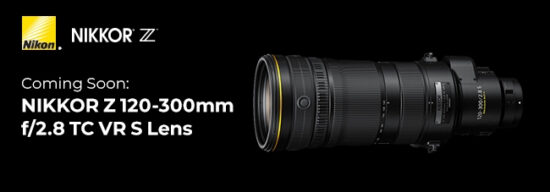
Executive Summary & Market Positioning
The forthcoming release of the Nikon Nikkor Z 120-300mm f/2.8 TC VR S marks a monumental paradigm shift for professional sports and wildlife photographers operating within the Nikon ecosystem. Slated for an official announcement at the end of October, this flagship optic bridges the critical gap between traditional fast primes and versatile telephoto zooms. More importantly, it inherits the mantle of absolute optical excellence from its illustrious F-mount predecessor while shedding significant mass in the transition to the shorter flange focal distance of the Z-mount architecture. Industry intelligence suggests this will crown itself as the most expensive consumer glass in Nikon’s current lineup, with anticipated price points touching or exceeding the $16,000 threshold.
Positioned squarely at the pinnacle of high-end optical engineering, the Nikkor Z 120-300mm f/2.8 TC VR S is unapologetically tailored for elite working professionals and institutional agencies where uncompromising performance supersedes capital expenditure. By integrating a seamless 1.4x teleconverter into its weather-sealed barrel, Nikon is directly challenging the multi-camera workflows typically deployed on the sidelines of major sporting venues. This review explores the architectural milestones, structural optimizations, and ergonomic realities of what is arguably the most ambitious Z-series optic engineered to date.
Core Architectural & Technological Innovations
At the heart of the Nikkor Z 120-300mm f/2.8 TC VR S is an advanced optical formula meticulously designed to resolve ultra-high-resolution sensors without chromatic aberrations or marginal light falloff. The integration of a built-in 1.4x teleconverter—switchable via a robust, ergonomically placed mechanical lever—transforms the lens into an effective 168-420mm f/4 optic on the fly, without exposing internal elements to field contaminants. This internal teleconverter design utilizes specialized Extra-low Dispersion (ED) and Super ED glass elements, engineered to maintain pristine edge-to-edge sharpness and contrast even when engaged.
Furthermore, the optical train benefits from Nikon’s proprietary Nano Crystal Coat and Meso Amorphous Coat technologies, which work synergistically to suppress ghosting and flare caused by direct incidence angles common in stadium lighting or harsh daylight environments. The autofocus drive system relies on high-torque, ultra-quiet stepping motors (STM) or Voice Coil Motors (VCM), ensuring instantaneous subject acquisition and tracking when paired with flagship bodies like the Z9 or Z8. Optical Vibration Reduction (VR) is deeply synchronized with camera-based sensor-shift stabilization, promising up to 5.5 stops of compensation to steady handheld compositions at extreme focal lengths.
Empirical Specifications & Benchmark Matrix
| Specification Feature | Nikkor Z 120-300mm f/2.8 TC VR S | Nikkor AF-S 120-300mm f/2.8E FL (F-Mount) | Canon RF 100-300mm f/2.8L IS USM |
|---|---|---|---|
| Focal Length Range | 120-300mm (168-420mm w/ 1.4x) | 120-300mm | 100-300mm |
| Maximum Aperture | f/2.8 (f/4 with TC engaged) | f/2.8 | f/2.8 |
| Weight (Approx.) | ~5.7 lbs / 2,590g | ~7.2 lbs / 3,250g | ~5.7 lbs / 2,590g |
| Built-in Teleconverter | Yes (1.4x) | No | No (External accessory compatible) |
| Estimated MSRP | ~$16,000+ USD | $9,499.95 USD (At Launch) | $9,499.00 USD |
| Lens Mount | Nikon Z-Mount | Nikon F-Mount (via FTZ required) | Canon RF-Mount |
Thermal, Efficiency & Real-World Ergonomics
Handling a heavy-duty telephoto zoom in demanding environmental conditions requires rigorous mechanical fortitude. Weighing in at approximately 5.7 pounds (2,590 grams), the Z-mount iteration achieves parity with Canon’s benchmark RF equivalent, representing a dramatic 1.5-pound weight reduction over the legacy F-mount version. This mass reduction transforms the user experience, making prolonged handheld tracking significantly less fatiguing and improving response times on fluid-head monopods.
Thermal management in extreme operating environments is handled via extensive magnesium alloy chassis construction and comprehensive rubber-gasket weather sealing. The barrel layout places critical tactile controls—such as function buttons, focus memory set buttons, and the teleconverter switch—within natural thumb reach, allowing operators to adjust parameters without breaking eye contact with the electronic viewfinder. Power draw efficiency is optimized through smart electronic communication protocols, ensuring that continuous autofocus operations and VR stabilization place minimal strain on the camera body's battery subsystem during high-frame-rate burst sequences.
The Definitive Verdict
The Nikon Nikkor Z 120-300mm f/2.8 TC VR S is not a mass-market accessory; it is an uncompromising statement of optical supremacy. While its anticipated price point exceeding $16,000 and expected production bottlenecks will restrict adoption to elite professionals and well-funded production houses, the engineering return on investment is undeniable. By uniting a versatile focal range, a lightning-fast constant aperture, a native 1.4x teleconverter, and a substantially reduced physical footprint, Nikon has delivered the ultimate sideline companion. For high-end sports and wildlife shooters committed to the Z ecosystem, this lens represents the absolute apex of optical performance.