Executive Overview & Market Positioning
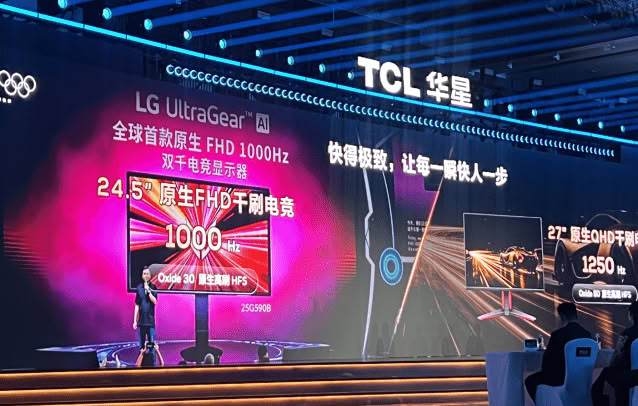
Recent disclosures from the DTC 2026 conference in Wuhan confirm a paradigm shift in high-refresh-rate display sourcing. TCL CSOT CEO Jun Zhao verified that the record-breaking 1000 Hz panel driving LG’s UltraGear 25G590B originates from CSOT’s Gen 8.5 T9 LCD fabrication facility in Guangzhou. This marks a critical milestone: the first mass-produced native 1000 Hz LCD manufactured by CSOT. Notably, LG’s procurement strategy bypasses its internal display subsidiary, LG Display, signaling a reliance on CSOT's competitive mastery over high-refresh IPS architectures.
Looking ahead, the technical synergy between LG Electronics and TCL CSOT extends beyond ultra-fast LCDs into next-generation emissive displays. High-level corporate officials at the conference confirmed that LG is actively evaluating 5K and 6K inkjet-printed (IJP) OLED monitor panels slated for production windows between 2028 and 2029. By replacing traditional Fine Metal Mask (FMM) thermal evaporation with precise nozzle-based deposition, IJP manufacturing promises drastic reductions in material waste and capital expenditure, directly challenging incumbent vacuum deposition paradigms.
Empirical Benchmark Matrix
To contextualize this hardware evolution, we evaluate the architectural parameters of the current TCL CSOT-driven 1000 Hz LCD against the upcoming IJP OLED platforms currently entering equipment installation phases at CSOT's Gen 8.6 T8 facility.
| Specification Matrix | LG UltraGear 25G590B (Current) | CSOT Gen 8.6 IJP OLED (Target 2028) | Baseline FMM OLED (Current Gen) |
|---|---|---|---|
| Panel Technology | IPS LCD (T9 Fab) | Inkjet-Printed OLED (T8 Fab) | FMM Evaporated OLED |
| Native Refresh Rate | 1000 Hz | Up to 700 Hz | 240 Hz – 480 Hz |
| Target Resolution | 1920 x 1080 (FHD) | 5K / 6K Ultra-Wide | QHD / 4K Standard |
| Substrate Gen / Fab | Gen 8.5 (Guangzhou) | Gen 8.6 (Guangzhou) | Gen 6 (Various) |
| Deposition Method | Photolithography / Thin-Film | Nozzle Inkjet Printing | Fine Metal Mask Thermal |
Thermal, Efficiency & Definitive Verdict
Pushing liquid crystal architectures to a blistering 1,000 Hz imposes severe electrical and thermal overheads on the display driver ICs (DDICs) and timing controllers, requiring aggressive mitigation strategies at the panel edge to manage localized thermal dissipation. Conversely, CSOT's upcoming Gen 8.6 T8 IJP OLED lines aim to bypass these mechanical refresh boundaries by focusing on ultra-high pixel density (5K/6K) combined with structural material efficiency. While FMM manufacturing scales poorly to large Gen 8.5+ motherglasses due to mask sagging, inkjet printing circumvents this limitation entirely, unlocking massive fabrication yields for desktop-class monitors. Ultimately, LG's dual-track reliance on CSOT—spanning record-setting 1000 Hz LCDs today and pioneering 700 Hz IJP OLEDs by 2028—cements TCL CSOT as the premier foundry engine for high-performance esports and professional display hardware.