Executive Overview & Market Positioning
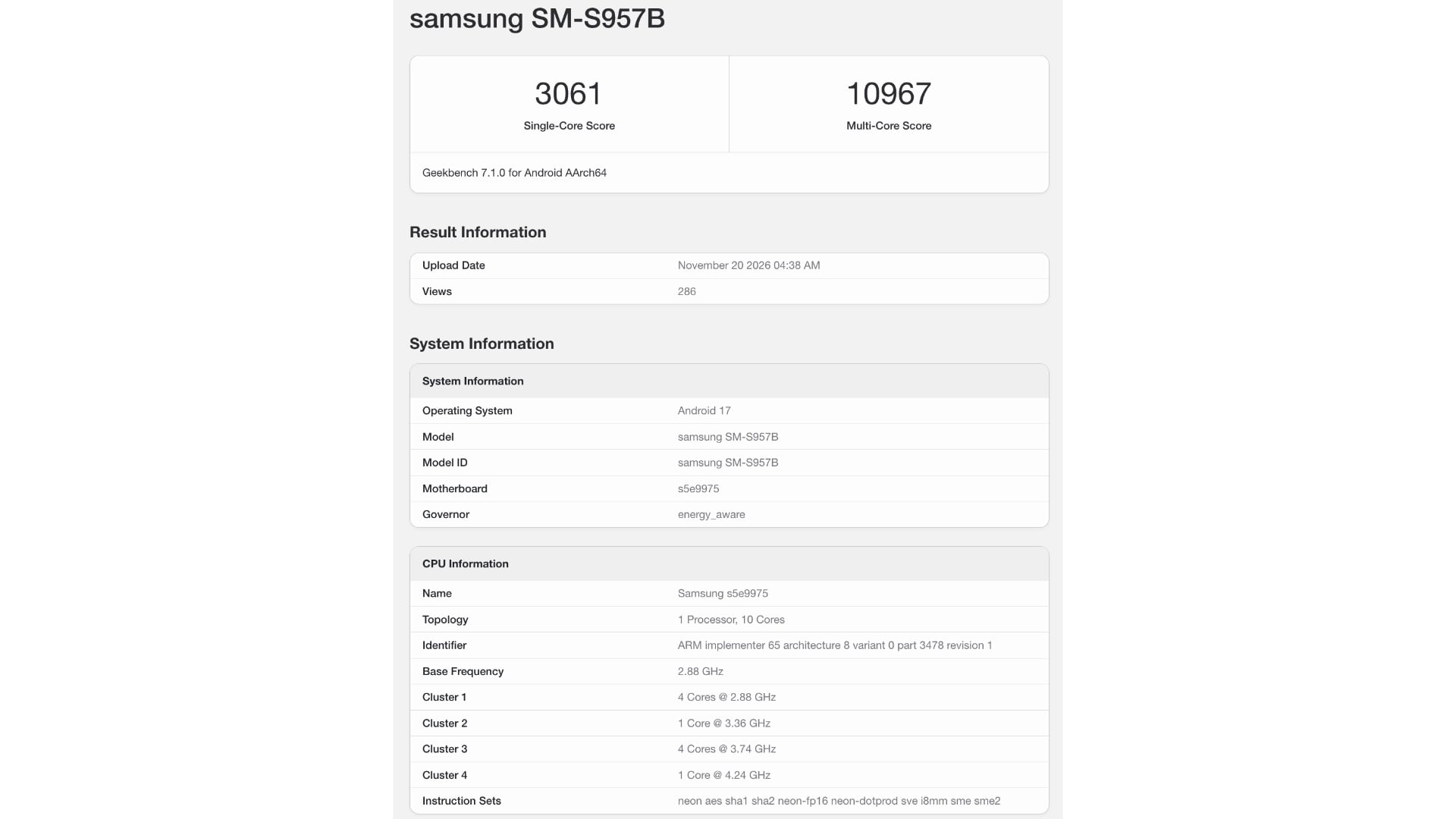
Recent empirical telemetry extracted from the Geekbench database reveals critical architectural details regarding the upcoming Samsung Galaxy S27 Pro (Model: SM-S957B). Targeted primarily at Asian and European distribution channels, this regional variant relies on Samsung's in-house silicon architecture rather than Qualcomm's tier-one Snapdragon platform. This bifurcated silicon strategy continues Samsung's long-standing hardware segmentation approach, reserving Snapdragon integration predominantly for North American and Chinese markets, alongside top-tier global units like the anticipated Galaxy S27 Ultra.
From a platform capabilities perspective, the SM-S957B build integrates 12GB of LPDDR-type system memory and executes on an Android 17 runtime environment, heavily coupled with proprietary One UI 9.5 firmware layers. While the software layer remains in pre-release development stages, the preliminary silicon footprint provides vital insight into Samsung Foundry's node progression and architectural adjustments aimed at balancing thermal envelopes with sustained compute density for high-tier mobile form factors.
Empirical Benchmark Matrix
At the core of the European and Asian Galaxy S27 Pro variant sits the Exynos 2700 (internal identifier: S5E9975). Early computational telemetry showcases a 10-core CPU configuration paired with the proprietary Xclipse 970 GPU, featuring modern Vulkan 1.4.350 graphics drivers. Initial validation runs output a single-core score of 3,061 alongside a multi-core metric of 10,967. While these raw figures trail current-generation Snapdragon flagships, such performance deltas are typical for early pre-production silicon operating on unoptimized firmware branches.
| Hardware Parameter | Samsung Galaxy S27 Pro (Exynos 2700) | Baseline / Comparison Target |
|---|---|---|
| Processor Architecture | Exynos 2700 (S5E9975) | Qualcomm Snapdragon Flagship |
| CPU Core Topology | 10-Core Configuration | Octa-Core / Custom Tri-Cluster |
| Graphics Processing | Xclipse 970 (Vulkan 1.4.350) | Adreno Series GPU |
| Memory Configuration | 12GB RAM | 12GB / 16GB RAM |
| Software Stack | Android 17 / One UI 9.5 | Android 17 / One UI 9.5 |
| Geekbench v7 (Single / Multi) | 3,061 / 10,967 | Varies (Engineering Sample) |
Thermal, Efficiency & Definitive Verdict
Evaluating the Exynos 2700 requires a balanced perspective on thermal efficiency, die size constraints, and power delivery within slim chassis designs. The integration of a 10-core CPU paired with the Xclipse 970 GPU indicates that Samsung Foundry is pushing hard on architectural throughput, though sustained thermal dissipation will dictate real-world performance stability. Because these benchmark readings derive from early software builds, final silicon optimizations and clock-frequency tuning will ultimately determine whether the Exynos 2700 can close the performance gap against competing architectures before commercial volume production scales up globally.