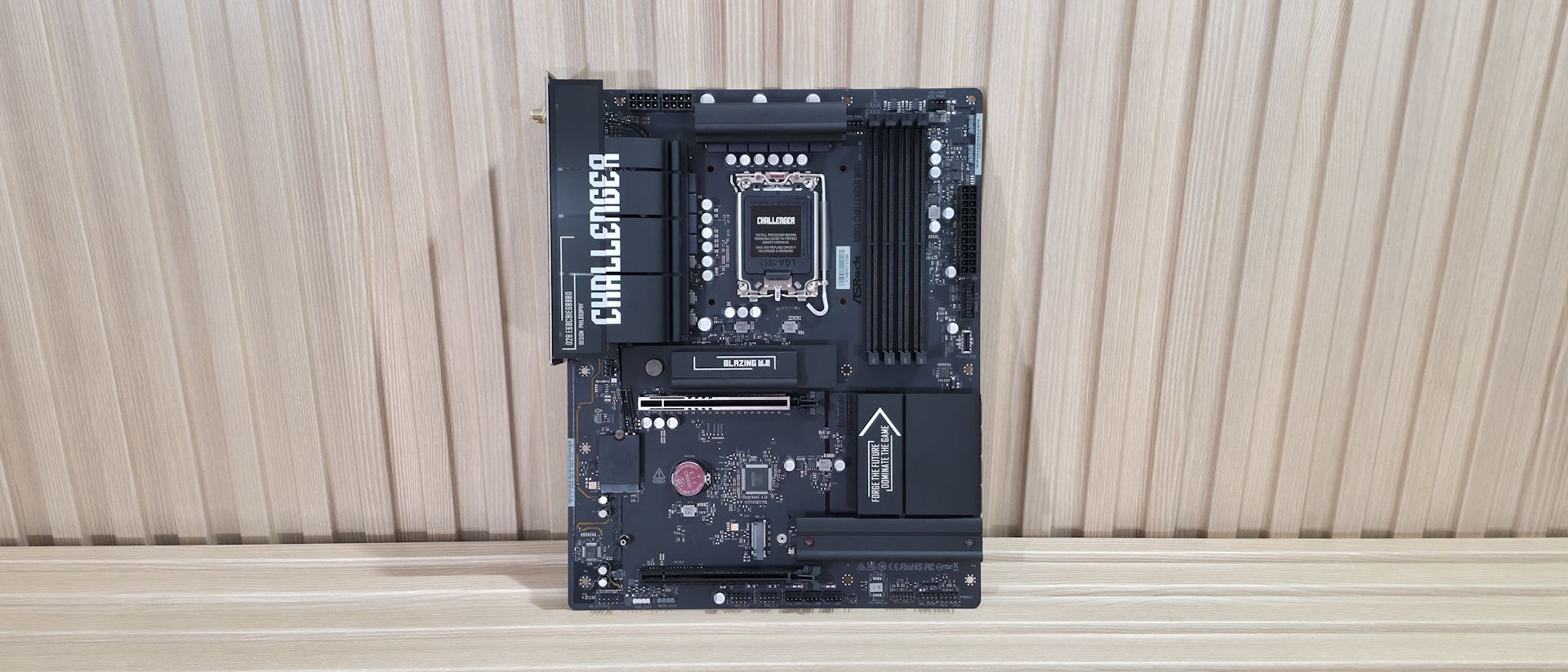
ASRock B860 Challenger Wifi Review: Budget ATX Mastery on LGA 1851
Executive Summary & Market Positioning
The mainstream Intel B860 chipset landscape has gained an aggressive new contender with the arrival of the ASRock B860 Challenger Wifi. Priced at a highly accessible $149.99, this full-sized ATX motherboard targets value-conscious system builders looking to harness Intel’s Core Ultra and Core Ultra Series 2 (Arrow Lake and Arrow Lake refresh) processors without overspending on z-series alternatives. ASRock has meticulously engineered this platform to deliver the core essentials while deliberately bypassing high-cost, enthusiast-centric luxuries that inflate the final price tag.
Positioned squarely at the entry point of the LGA 1851 ecosystem, the B860 Challenger strikes a delicate balance between cost-efficiency and modern connectivity. While budget-oriented silicon inevitably requires architectural compromises—most notably in maximum USB throughput and raw power delivery overhead—this motherboard punches above its weight class. It delivers reliable stock performance, a stealthy matte-black aesthetic, and next-generation standards like Wi-Fi 7 and PCIe 5.0, making it an attractive anchor for mainstream gaming rigs and multi-threaded creative workstations alike.
Core Architectural & Technological Innovations
Beneath its understated exterior, the ASRock B860 Challenger Wifi packs a surprising array of modern connectivity protocols. The board features three distinct M.2 sockets, with the primary slot offering blazing-fast PCIe 5.0 x4 bandwidth capable of running the latest high-speed NVMe drives at up to 128 Gbps. Dual PCIe 4.0 x4 M.2 slots round out the storage subsystem alongside four standard SATA3 ports. Memory capability is another strong suit; the four DDR5 DIMM slots officially support speeds scaling up to DDR5-8666+ via overclocking profiles, providing ample headroom for memory-intensive workloads.
Networking capabilities represent a major win for a sub-$150 platform. ASRock has integrated a Realtek RTL8125 2.5 GbE controller alongside a Realtek 8922AE Wi-Fi 7 module, ensuring robust, low-latency wired and wireless connectivity that rivals much pricier hardware. However, architectural bottlenecks do exist. The board relies on an ASMedia ASM1074 controller and caps its external and internal USB data rates at 5 Gbps (USB 3.2 Gen 1), omitting ultra-fast 10 Gbps or 20 Gbps Type-C ports—a notable omission for a modern 2026 release.
Empirical Specifications & Benchmark Matrix
To evaluate how the ASRock B860 Challenger Wifi stacks up against the typical B-series market baseline, we examine its vital hardware metrics:
| Feature / Specification | ASRock B860 Challenger Wifi | Market Baseline (Typical B860) | Verdict / Variance |
|---|---|---|---|
| Socket & Chipset | LGA 1851, B860 | LGA 1851, B860 | Parity |
| Form Factor | ATX | Micro-ATX / ATX | Full-size ATX advantage |
| Voltage Regulator (VRM) | 14-Phase (10x 50A Dr.MOS Vcore) | 12-Phase to 14-Phase | Adequate for stock operation |
| Memory Support | 4x DIMM, up to DDR5-8666+ (OC) | Up to DDR5-7200 / 8000 | Above average speed support |
| Primary Storage | (1) PCIe 5.0 x4, (2) PCIe 4.0 x4 | (1) PCIe 5.0, (1) PCIe 4.0 | Extra M.2 slot included |
| Max USB Speed | 5 Gbps (USB 3.2 Gen 1) | 10 Gbps – 20 Gbps | Below average speed limit |
| Networking | Realtek 2.5 GbE + Wi-Fi 7 | 2.5 GbE + Wi-Fi 6E / 7 | Highly competitive |
| Price | $149.99 | $140 – $180 | Excellent value proposition |
Thermal, Efficiency & Real-World Ergonomics
Power delivery on the B860 Challenger is handled by a 14-phase voltage regulator featuring 50A Dr.MOS MOSFETs dedicated to Vcore. While paper specifications suggest a modest VRM layout for heavy-duty overclocking, empirical testing reveals surprising resilience. During intense multi-threaded workloads, the board successfully drove an Intel Core Ultra 270K Plus processor at stock settings without thermal throttling or stability hiccups. Performance scores hovered securely in the average-to-above-average bracket across gaming, productivity, and synthetic suites.
That said, the physical thermal envelope requires careful management. The VRM heatsinks are functional but run noticeably warmer than those found on higher-end tier boards under prolonged, heavy loads. Builders deploying this motherboard should prioritize a chassis with optimized airflow, especially when pairing the board with top-tier silicon. Ergonomically, ASRock equips the board with seven versatile 4-pin fan/pump headers supporting both PWM and DC devices, alongside a straightforward 4-LED Post Status Checker for diagnostics. ASRock's BIOS, while fully functional, retains a dated interface layout compared to contemporary UEFI designs from competing vendors, though it gets the job done efficiently.
The Definitive Verdict
The ASRock B860 Challenger Wifi proves that budget-conscious PC building does not require sacrificing modern ecosystem standards. By delivering Wi-Fi 7, PCIe 5.0 storage support, and dependable stock thermal handling for powerful LGA 1851 processors at a highly competitive $149.99 price point, it successfully carves out its niche. While minor drawbacks like capped 5 Gbps USB speeds, warmer VRMs under load, and a dated BIOS interface require minor compromises, the board's overall feature density makes it a smart, cost-effective foundation for your next Intel build.