Executive Overview & Market Positioning
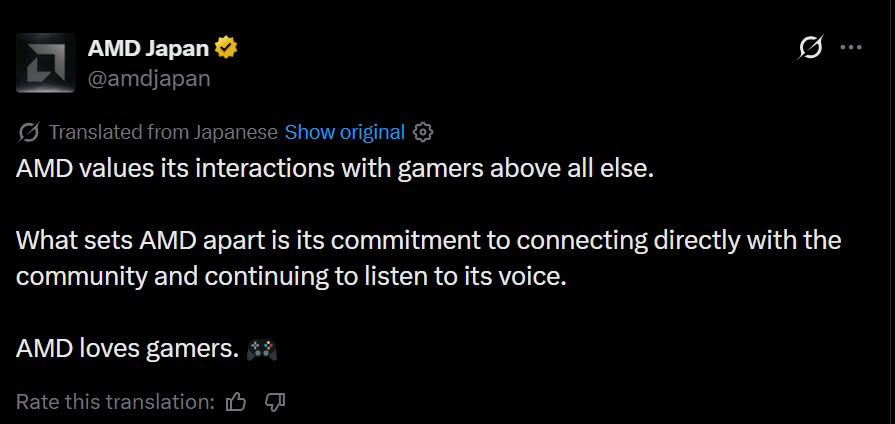
Recent messaging from AMD Japan declaring that the company "loves gamers" stands in sharp contradiction to corporate strategy and empirical financial telemetry. While public relations efforts highlighted CEO Dr. Lisa Su distributing promotional swag and a signed Radeon RX 9070 XT at a new Micro Center grand opening in Austin, these gestures fail to mask an ongoing structural pivot. Less than two weeks prior, Dr. Su explicitly designated AMD as a "data center first" enterprise, a re-characterization fully validated by the company's latest balance sheets.
This capital reallocation reflects a broader industry shift toward high-margin enterprise accelerators. As hyperscale cloud providers absorb the vast majority of advanced node wafer allocations, consumer-facing graphics and enthusiast hardware are effectively being deprioritized. The friction between promotional rhetoric and commercial reality highlights the challenges legacy semiconductor firms face when balancing enthusiast heritage against massive enterprise growth vectors.
Empirical Benchmark Matrix
Financial disclosures for Q3 2026 underscore this divergence, with overall revenue reaching a record $13.4 billion—a 45% year-over-year increase—driven predominantly by enterprise infrastructure. The Data Center segment surged to $8.5 billion, capturing 64% of total revenue with a staggering 97% year-over-year growth rate. Conversely, the combined Client and Gaming segment contracted to $3.7 billion. While Client revenue demonstrated relative resilience with a 7% increase, the Gaming division collapsed by 40% year-over-year down to $773 million, representing under 6% of total corporate revenue.
| Financial Metric / Segment | Q3 2025 Baseline | Q3 2026 Actual | YoY Growth / Delta | Strategic Focus |
|---|---|---|---|---|
| Total Revenue | $9.24 Billion | $13.40 Billion | +45.0% | Enterprise Scale |
| Data Center Segment | $4.31 Billion | $8.50 Billion | +97.0% | Primary Priority |
| Client & Gaming Segment | $4.02 Billion | $3.70 Billion | -8.0% | Mixed Hardware |
| Gaming Revenue (Discrete) | $1.29 Billion | $773 Million | -40.0% | Deprioritized |
Thermal, Efficiency & Definitive Verdict
From a silicon allocation and thermal design perspective, the economic rationale driving AMD's pivot is unambiguous. Enterprise accelerators command higher gross margins per square millimeter of silicon compared to monolithic or multi-chiplet gaming GPUs, which must compete in heavily contested consumer price bands. With data center sales projected to expand by an additional 50% sequentially into Q4—while the consumer roadmap offers little immediate relief outside of a CES 2027 Ryzen "Zen 6" teaser—social media gestures cannot override corporate balance sheets. For hardware analysts and enthusiasts alike, the empirical data confirms that consumer gaming is no longer the primary engine of AMD's silicon deployment strategy.