Executive Overview & Market Positioning
Architect Labs, a Palo Alto-based silicon startup, has introduced Frostbite—a general-purpose CPU featuring a completely novel instruction set architecture (ISA) discovered, designed, and verified end-to-end by autonomous AI systems. Diverging sharply from mainstream von Neumann architectures, Frostbite bypasses conventional hardware dependency-tracking, runtime instruction scheduling, and deep cache hierarchies. Traditional multicore processors allocate massive die area and power budgets to cache coherence protocols and out-of-order execution engines to manage instruction parallelism. By casting computation away from sequential execution streams, Frostbite sidesteps these silicon penalties entirely.
The underlying computational model relies on interaction nets, a graph-rewriting paradigm formalized in 1990. In this topology, programs compile into interconnected nodes where rewriting operations occur only on disjoint pairs. Because these transformations are mutually exclusive and strictly local, they execute concurrently without race conditions, locks, or dynamic thread synchronization. The AI agents responsible for Frostbite started with zero architectural priors, initially generating a speculative 141-page specification before translating it into a formal, machine-checked language called ASL. This formal foundation fed directly into Arcmodel, a high-speed software simulator enabling parallelized hardware exploration and iterative power optimization.
Empirical Benchmark Matrix
Simulated on a 7nm process node, a four-tile Frostbite cluster operating at 500 MHz (down from an 800 MHz early synthesis peak) was benchmarked against a baseline dual-issue, in-order silicon-proven CPU core across 25 distinct workloads. The architecture’s intrinsic parallelism yields substantial performance-per-watt and area-efficiency gains, though efficiency varies significantly depending on workload divergence.
| Metric / Workload Category | Baseline Comparison Core | Frostbite AI-Designed CPU | Delta / Multiplier |
|---|---|---|---|
| Node & Frequency | 7nm / Unspecified | 7nm / 500 MHz (Final Layout) | N/A |
| Performance per Watt (25 Workload Geo-Mean) | 1.0x (Normalized) | Frostbite Cluster | 4.59x Efficiency |
| Performance per Area | 1.0x (Normalized) | Frostbite Cluster | 8.77x Area Density |
| 10 Tuning Workloads (Mean) | 1.0x (Normalized) | Frostbite Cluster | 6.02x Efficiency |
| 15 Held-Out Evaluation Workloads (Mean) | 1.0x (Normalized) | Frostbite Cluster | 3.83x Efficiency |
| Best Case Workload (conv2d, held-out) | 1.0x (Normalized) | Frostbite Cluster | 23.12x Efficiency |
| Worst Case Workload (Recursive Fibonacci) | 1.0x (Normalized) | Frostbite Cluster | 1.15x Efficiency |
Thermal, Efficiency & Definitive Verdict
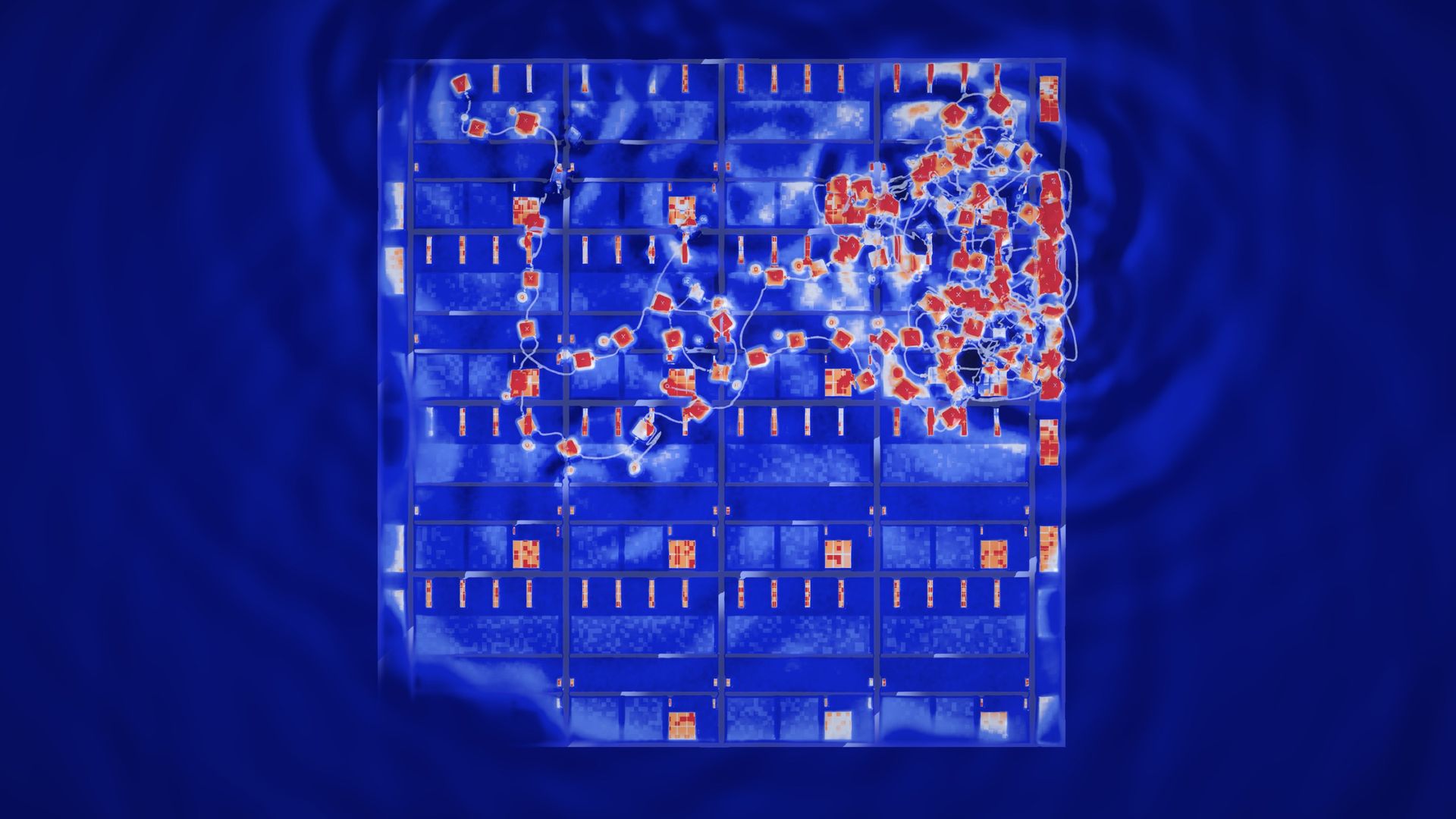
Power distribution telemetry reveals a fundamental shift in energy allocation. While conventional cores expend 57 percent of their energy pool on memory subsystems and 27 percent on fetching, decoding, and issuing instructions, Frostbite compresses instruction overhead down to 6 percent. Memory energy consumption drops to 38 percent due to small local memories replacing large shared caches. However, this trade-off introduces a 26 percent energy overhead dedicated to the on-chip network and graph schedulers. Clock distribution remains a dominant thermal drain, consuming 41 percent of Frostbite's energy budget compared to 49 percent for the baseline core. While Frostbite remains a simulated 7nm design without physical tape-out validation, its unprecedented architectural exploration proves that automated AI agents can bypass human bias to discover viable, high-efficiency compute paradigms. In the coming months, broader evaluations against out-of-order superscalar architectures on standard SPEC and PARSEC suites will establish whether interaction nets can scale beyond specialized workloads into mainstream data center and client silicon.