Executive Overview & Market Positioning
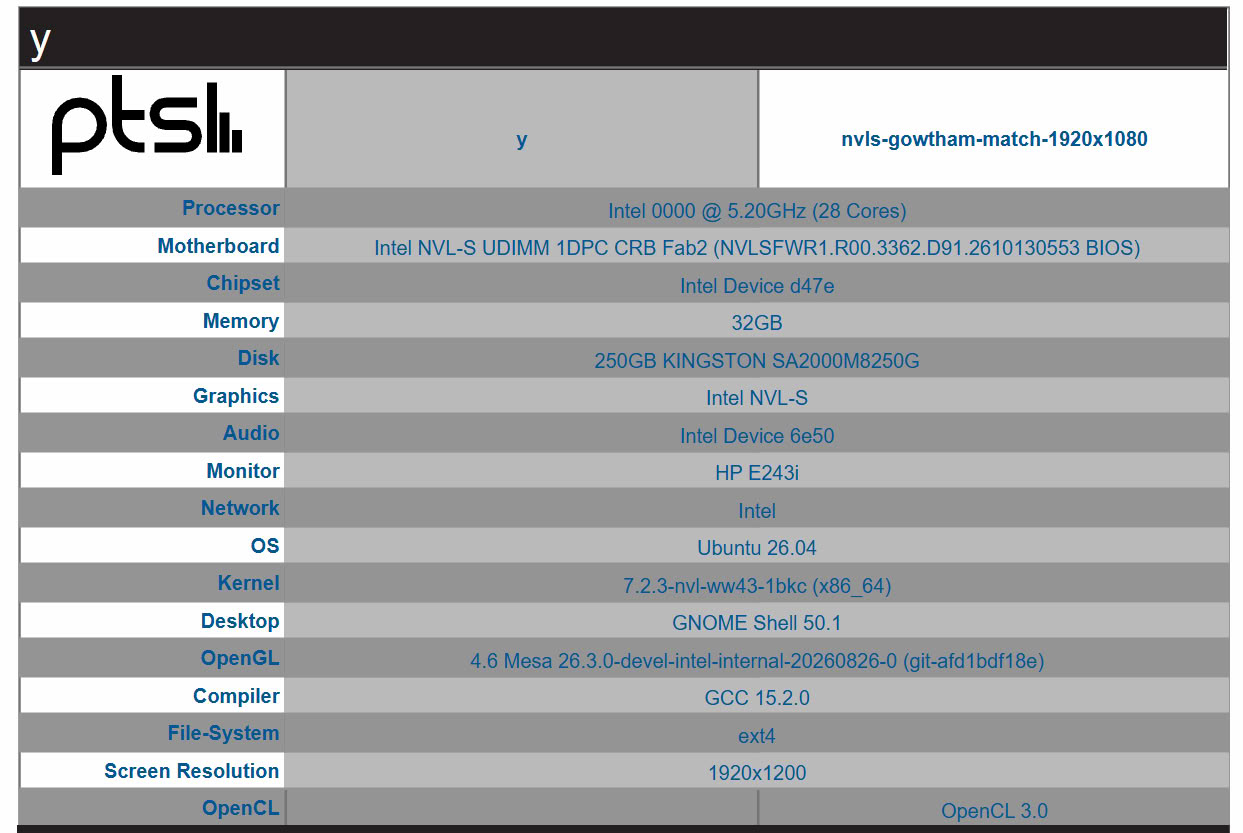
Recent telemetry captured within the OpenBenchmark validation suite has exposed an early engineering sample of Intel's upcoming desktop architecture, designated provisionally as "Nova Lake-S." The silicon in question surfaces under the enigmatic "Intel 0000" moniker, validating industry whispers regarding a structural overhaul of Intel's client processor nomenclature. Moving definitively away from the legacy three-digit SKU taxonomy, this engineering sample features the "NVL" identifier, aligning with a rumored four-number classification scheme engineered to accommodate complex heterogenous core distributions and advanced architectural tiers.
From a platform perspective, the single-compute die Nova Lake-S variant under evaluation breaks from purely synthetic compute metrics by engaging integrated graphics workloads under the "Intel NVL-S" descriptor. Telemetry reveals a heavy deployment of concurrent compute and graphical validation routines, ranging from ray-traced execution paths like Quake II RTX and Unigine engines to heavy OpenCL and Hashcat cryptographic passes. This stress-testing strategy indicates that Intel is validating the unreleased platform's cohesive memory subsystem, power delivery tolerances, and graphics instruction set architecture simultaneously under extreme thermal duress.
Empirical Benchmark Matrix
Captured validation data highlights a 28-core topology operating alongside a peak reported clock frequency of 5.2 GHz. While engineering samples (ES) notoriously operate under non-standard firmware loops, unoptimized power thresholds, and fluctuating voltage-frequency curves, this initial frequency metric provides vital insight into the clock-scaling behavior of the single-compute die architecture. The inclusion of diverse OpenCL and graphics workloads confirms that memory controllers and fabric interconnects are functioning at targeted high-frequency states during validation passes.
| Architectural Parameter | Baseline Architecture | Nova Lake-S (Engineering Sample) | Empirical Delta / Note |
|---|---|---|---|
| Core Topology | Variable (P+E Core Mix) | 28-Core Configuration | Single-compute die layout |
| Peak Observed Clock | 5.0 GHz - 5.5 GHz (Varies) | 5.2 GHz | Early ES validation frequency |
| Integrated Graphics | Intel Graphics (Xe-LPG) | Intel NVL-S | Next-gen iGPU execution units |
| SKU Identification | 3-Digit / Core Ultra naming | Intel 0000 (NVL prefix) | Transitioning to four-digit scheme |
Thermal, Efficiency & Definitive Verdict
While the 5.2 GHz telemetry point is undeniably encouraging for early silicon health, hardware analysts must treat this frequency metric as a preliminary indicator rather than a final retail baseline. Silicon maturity, microcode iterations, and platform power limits (PL1/PL2 thresholds) will undergo substantial tuning prior to commercial launch. Ultimately, the appearance of Nova Lake-S confirms that Intel's next-generation desktop roadmap is actively progressing through rigorous multi-workload stress testing. The integration of advanced compute benchmarks alongside graphics pipelines signals a robust, high-performance architecture primed to challenge competitive desktop silicon upon its eventual market debut.