Executive Summary & Market Positioning
The desktop monitor ecosystem has reached a critical inflection point characterized by the rapid commoditization of self-emissive display technology. Historically, 4K OLED gaming panels were relegated to high-barrier-to-entry pricing—often exceeding $1,300 at launch—making them aspirational hardware rather than practical desktop peripherals. However, as of late 2025, market consolidation and refined manufacturing yield rates have pushed high-performance units like the MSI MPG 321URX and ASRock Phantom Gaming series into the sub-$700 bracket. This price correction signifies that OLED is no longer a niche enthusiast play but the new baseline for high-fidelity PC engagement.
From a market positioning standpoint, we are witnessing a complete displacement of premium IPS (In-Plane Switching) panels. While IPS remains the standard for color-accurate productivity, the sheer contrast ratio advantage of OLED—bolstered by near-infinite black levels—renders traditional liquid crystal displays obsolete for entertainment and immersive gaming. For the end-user, this represents an era where upgrading to a 4K OLED is not merely an aesthetic choice, but a functional imperative for those looking to maximize the effective utility of current-generation graphics architectures.
Core Architectural & Technological Innovations
The primary driver of this transition is the optimization of pixel density and high-frequency refresh rates. Moving from a standard 27-inch 1440p monitor (approx. 109 PPI) to a 32-inch 4K panel (approx. 138 PPI) provides a tangible increase in text sharpness and granular image detail. The shift to 240Hz, while demanding significant GPU resources, provides a discernible reduction in motion blur and input latency. When paired with modern temporal upscaling solutions like Nvidia DLSS and AMD FSR, users can achieve high-fidelity output that preserves visual integrity while offloading the computational burden of native 4K rendering.
Beyond simple resolution, the migration to OLED facilitates superior color gamut coverage, with many modern QD-OLED panels achieving near-total DCI-P3 and sRGB volume saturation. Unlike edge-lit IPS panels, which suffer from backlight bleed and limited local dimming zones, OLEDs provide pixel-level luminance control. This eliminates the 'blooming' artifacts seen in FALD (Full Array Local Dimming) displays and delivers a perceptually instantaneous response time—often measured in microseconds—which effectively eliminates the ghosting traditionally associated with VA or older IPS matrices.
Empirical Specifications & Benchmark Matrix
| Feature | Baseline IPS (27" 1440p) | Premium 4K OLED (32" 240Hz) | Competitive Advantage |
|---|---|---|---|
| Resolution | 2560 x 1440 | 3840 x 2160 | +125% Pixel Count |
| Contrast Ratio | 1,000:1 | ~1,500,000:1 | Infinite Black Levels |
| Response Time | 1ms - 5ms (GtG) | <0.03ms (Typical) | Negligible Ghosting |
| PPI Density | 109 PPI | 138 PPI | Superior Text Clarity |
| Color Gamut | 90-95% DCI-P3 | 99%+ DCI-P3 | Higher Color Volume |
Thermal, Efficiency & Real-World Ergonomics
Thermal management in 4K OLEDs remains a non-trivial engineering challenge. Because organic compounds degrade under sustained thermal stress, the integration of passive heat sinks or active airflow systems is essential to preventing premature panel wear or burn-in. Users should note that these displays require slightly more careful power management than their LCD counterparts, as peak brightness is often governed by Automatic Brightness Limiting (ABL) circuits that normalize power draw during full-screen white scenes to protect the panel's longevity.
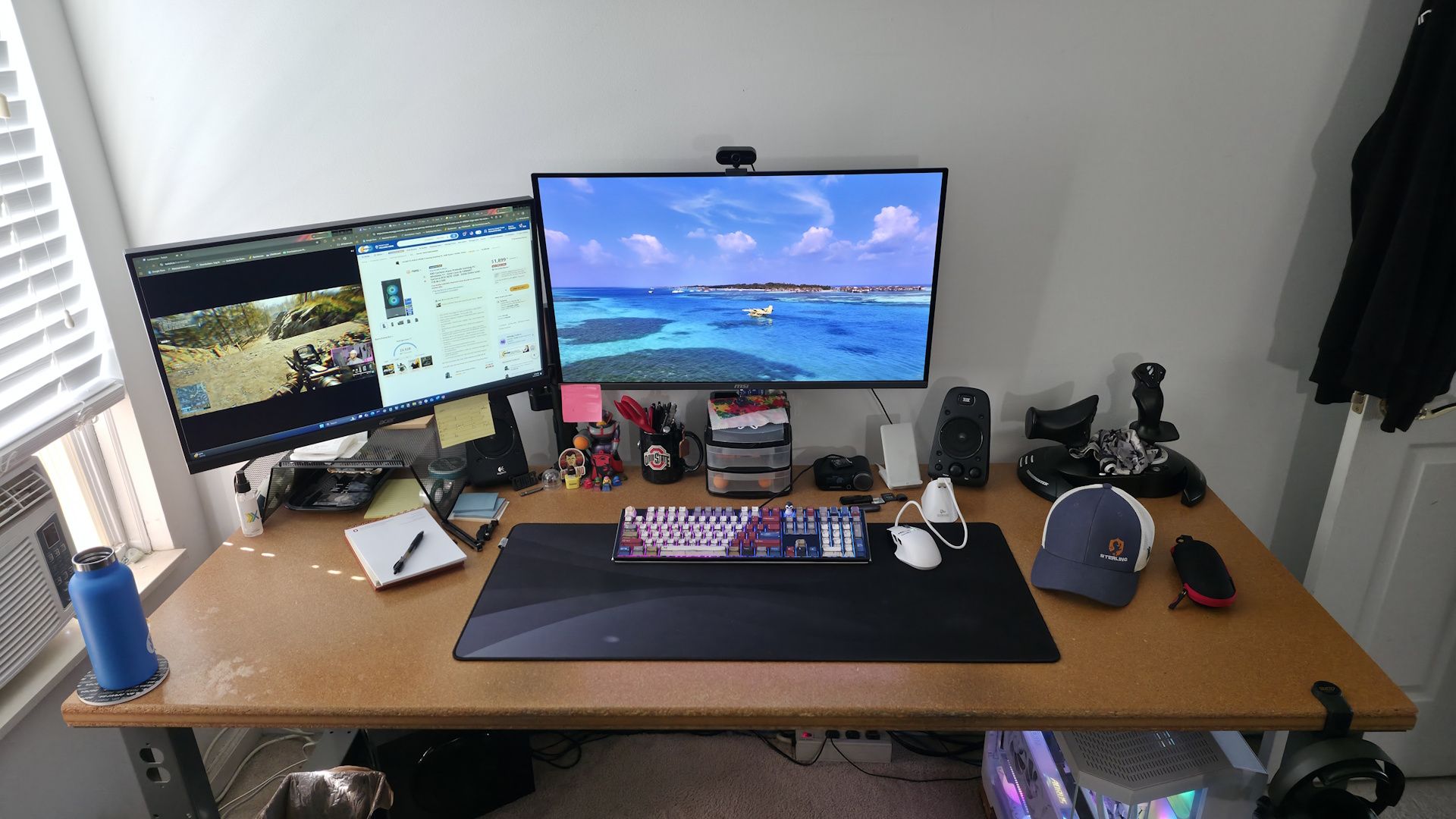
Ergonomically, the transition to 32-inch 4K panels requires a reconsideration of desk depth and workspace layout. The increased screen real estate facilitates a superior multi-window workflow, allowing users to move from a dual-monitor setup to a single, seamless, high-PPI surface. When paired with high-performance GPUs like the RTX 50-series, the operational smoothness achieved at 4K/240Hz creates an immersive feedback loop that significantly reduces eye strain during long-duration sessions, provided the user maintains appropriate viewing distance for the higher density.
The Definitive Verdict
For the discerning user, the 4K OLED upgrade is arguably the most impactful hardware investment currently available on the market. While 1440p OLEDs remain a budget-friendly entry point for high-refresh gaming, the resolution, pixel density, and color volume benefits of a 32-inch 4K panel provide a demonstrably better long-term value. With price points dropping below $700, the hesitation that previously defined this market segment is no longer justifiable. We recommend current-gen 4K OLEDs as the terminal monitor upgrade for the next 3-5 years of hardware cycles.