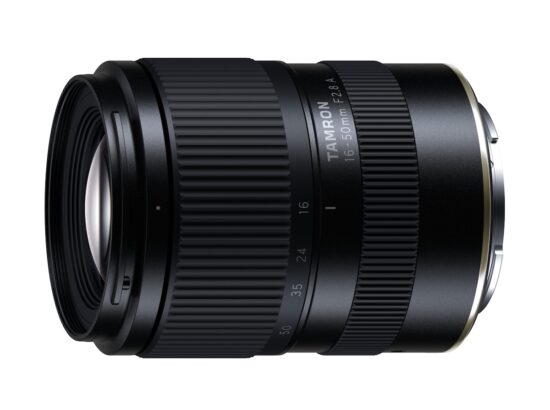
Executive Summary & Market Positioning
The landscape of the Nikon Z-mount APS-C ecosystem has long awaited a high-performance, constant-aperture standard zoom that balances professional-grade optics with the portability inherent to the DX-format sensor. Tamron’s announcement of the 16-50mm f/2.8 (Model B091) signifies a strategic expansion of their third-party initiative, providing Nikon Z-series users with a versatile alternative to native glass. By focusing on a compact, wide-aperture design that covers the classic 24-75mm equivalent focal range, Tamron is positioning this lens as an essential "go-to" daily driver for street photographers, travel enthusiasts, and hybrid content creators.
From a market standpoint, the 16-50mm f/2.8 arrives at a critical juncture. As Nikon continues to emphasize its DX-mount mirrorless cameras, the demand for specialized, lightweight optics that do not compromise on aperture speed has intensified. Tamron has cleverly leveraged their existing optical platforms to produce a lens that feels tailor-made for the Z-mount, addressing the gap between entry-level kit zooms and heavy, expensive full-frame glass. This is the 14th lens from Tamron for the Z-mount, cementing their role as the premier provider of specialized, high-utility optics for Nikon’s smaller-sensor mirrorless bodies.
Core Architectural & Technological Innovations
At the heart of the 16-50mm f/2.8 is an optical formula comprised of 14 elements in 10 groups, engineered to maintain high contrast and sharpness across the entire focal range. The inclusion of a constant f/2.8 maximum aperture is the hallmark of this design, enabling a shallower depth-of-field and better low-light performance than standard variable-aperture zooms. Tamron’s engineering team has prioritized a balance between chromatic aberration suppression and compact dimensions, utilizing the unique flange distance of the Nikon Z-mount to optimize the rear-element placement for maximum peripheral clarity.
Technologically, the lens incorporates a high-precision autofocus drive system designed to meet the demands of modern hybrid shooting. The motor architecture is optimized for both stills and video, promising silent, rapid tracking that integrates seamlessly with Nikon’s Eye-AF and subject detection systems. Further elevating its utility is the physical construction, which includes weather-resistant gaskets and a fluorine coating on the front element to repel moisture, oils, and fingerprints. These refinements highlight a shift toward "professional-grade durability" in a consumer-friendly, lightweight form factor.
Empirical Specifications & Benchmark Matrix
| Feature | Tamron 16-50mm f/2.8 (Z-Mount) | Market Baseline (DX Zooms) |
|---|---|---|
| Focal Length | 16-50mm (24-75mm eq.) | 16-50mm or 18-55mm |
| Max Aperture | f/2.8 (Constant) | f/3.5-5.6 (Variable) |
| Weight | 315g | 150g - 250g |
| Construction | 14E / 10G | 9E / 7G average |
| Min. Focus | 0.15m (Wide) | 0.25m - 0.30m |
| Filter Thread | 55mm | 46mm - 52mm |
Thermal, Efficiency & Real-World Ergonomics
Ergonomically, the B091 is built with a "Toned Profile Next" aesthetic, emphasizing a streamlined barrel that minimizes protrusion and weight distribution issues. Weighing in at 315g, the lens is exceptionally balanced on the Nikon Z-series DX bodies, avoiding the front-heavy fatigue common with larger f/2.8 zooms. The inclusion of a custom strap-hole on the front lens cap is a thoughtful, albeit subtle, engineering decision that indicates a focus on real-world field workflow, ensuring that the cap remains secure during rapid gear changes in dynamic environments.
From a thermal and efficiency perspective, the optical arrangement allows for heat dissipation through the lens barrel without the need for complex, heavy internal cooling solutions. The internal focus mechanism ensures that the barrel does not extend or rotate during focus acquisition, which is an invaluable feature for those utilizing circular polarizers or variable ND filters. The 7-blade circular diaphragm design, which retains its circularity through two stops of aperture reduction, provides smooth transition zones and pleasing background blur, making this lens an ideal candidate for cinematic video acquisition in a compact, portable kit.
The Definitive Verdict
The Tamron 16-50mm f/2.8 Di III-A is a decisive win for the Nikon Z APS-C lineup. It manages to solve the persistent "aperture struggle" of DX shooters by offering a constant f/2.8 aperture without the prohibitive bulk of full-frame glass. For photographers who demand a professional-grade output from a lightweight, everyday setup, this lens is an easy recommendation. It is not merely a replacement for a kit lens; it is an architectural upgrade that prioritizes image fidelity and operational convenience in equal measure.