Executive Summary & Market Positioning
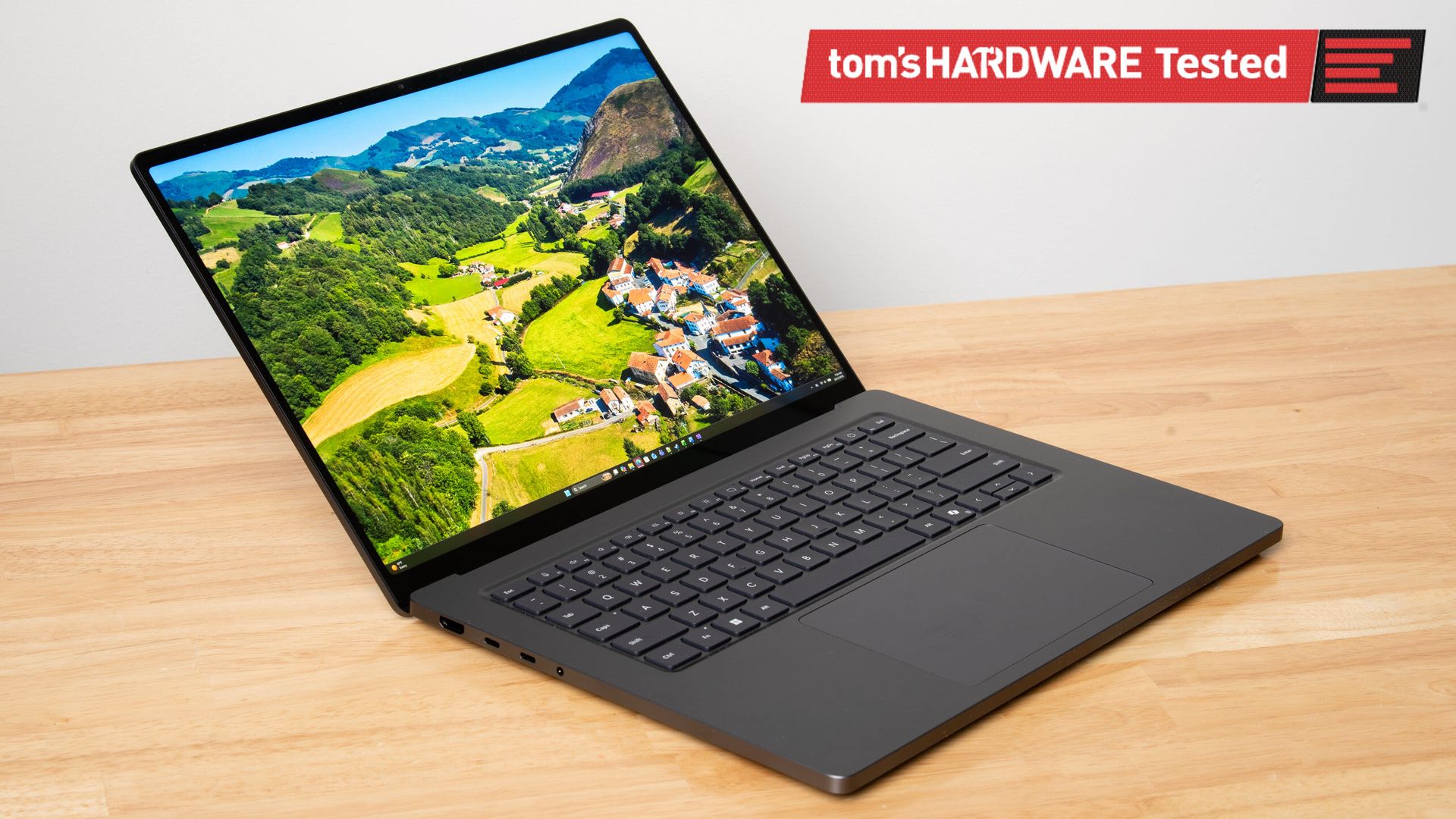
The computing landscape is undergoing a foundational paradigm shift, transitioning from passive application execution to proactive, agentic workflows. Nvidia’s introduction of the RTX Spark platform, anchored by the GB10 Superchip, represents a direct salvo into this nascent ecosystem. First unveiled by CEO Jensen Huang at Computex 2026, the Spark platform is engineered to reinvent the mobile computing form factor by marrying high-density Arm CPU cores with massive CUDA parallel processing capability, all designed to run localized AI workloads securely under Windows on Arm. To evaluate this bold silicon ambition, we secured Microsoft’s top-tier Surface Laptop Ultra, outfitted with the full-fat RTX Spark Superchip and an astonishing 128GB of LPDDR5X-9400 memory.
Positioned squarely against elite alternatives like Apple’s M5 Max MacBook Pro and AMD’s compact Ryzen AI Halo configurations, the Surface Laptop Ultra serves as the empirical spearhead for Nvidia’s client-side AI strategy. While early evaluation embargoes restrict us from discussing system-specific battery longevity, display matrices, or physical chassis build quality, our performance evaluations focus entirely on computational throughput and local AI agent execution times. As the industry moves away from raw, isolated throughput metrics toward multi-turn agentic completion benchmarks, the RTX Spark platform arrives not merely as an incremental upgrade, but as a disruptive architectural milestone designed to redefine local machine intelligence.
Core Architectural & Technological Innovations
At the heart of the RTX Spark platform lies the GB10 Superchip, a dense monolithic or multi-chip module marvel housing a staggering 20 CPU cores tightly integrated with 6,144 CUDA cores. This asymmetrical yet symbiotic core allocation is purpose-built to eliminate the bottlenecks traditionally associated with client-side large language model (LLM) inference. By combining high-bandwidth LPDDR5X-9400 RAM delivering exceptional memory throughput with localized tensor acceleration, Nvidia ensures that both the prompt processing and token generation phases operate with minimal latency. Furthermore, the platform leverages advanced speculative decoding techniques like DFlash2 and multi-token prediction (MTP) to drastically accelerate inference loops on complex, dense models such as Qwen 3.8-27B.
This architectural synergy addresses the core limitation of modern AI integration: end-to-end task completion time. Traditional benchmarks focusing strictly on time-to-first-token fail to capture the multi-turn demands of autonomous agents. The integration of Nvidia’s CUDA backend within optimized frameworks like llama.cpp allows the GB10 Superchip to fully exploit its hardware parallelism. When compared to alternative architectures, the RTX Spark demonstrates that raw CUDA core density, when properly paired with high-speed memory subsystems, yields superior execution efficiency across both dense transformer models and mixture-of-experts (MoE) topologies.
Empirical Specifications & Benchmark Matrix
To contextualize the performance of the Microsoft Surface Laptop Ultra against current market baselines, we analyzed empirical data gathered using Artificial Analysis’s AgentPerf-local framework. Running dense models (Qwen 3.8-27B Q4_K_M) and MoE architectures (Qwen 3.6 35B A3B), the system demonstrated decisive performance advantages over competing architectures.
| Metric / Feature | Microsoft Surface Laptop Ultra (RTX Spark) | Apple MacBook Pro 14" (M5 Max) | AMD Ryzen AI Halo (Strix Halo) |
|---|---|---|---|
| Primary SoC / Chip | Nvidia GB10 Superchip | Apple M5 Max | AMD Ryzen AI Max+ 395 |
| CPU Core Count | 20 Cores (Arm-based) | 18 Cores | High-Performance x86 Cores |
| GPU / Accelerator Cores | 6144 CUDA Cores | 40-Core GPU | Integrated RDNA / XDNA Matrix |
| Memory Configuration | 128GB LPDDR5X-9400 | 128GB LPDDR5X | High-Bandwidth System RAM |
| AgentPerf (Qwen 27B) | ~25% Faster than M5 Max | Baseline Competitor | ~2x Slower (~40 minutes total) |
| AgentPerf (Qwen 35B MoE) | 8 Minutes Completion Time | 10 Minutes Completion Time | 13 Minutes Completion Time |
Thermal, Efficiency & Real-World Ergonomics
Evaluating a high-performance platform like the RTX Spark requires careful consideration of power delivery and thermal dissipation profiles. The Microsoft Surface Laptop Ultra tested in our labs is a robust 15-inch form factor accompanied by a substantial 140W power adapter. This generous power delivery provides the necessary electrical headroom to sustain maximum turbo frequencies across its 20 CPU cores and 6,144 CUDA cores during prolonged, intensive agentic workloads. In contrast, narrower thermal envelopes and lower-wattage power supplies can inadvertently throttle sustained inference throughput, a factor clearly demonstrated when comparing compact portable footprints against larger desktop-class alternatives.
While current embargo restrictions prevent us from publishing comprehensive battery life metrics or acoustic profiling, the thermal dynamics observed during our rigorous AgentPerf-local runs indicate efficient power scaling. The system effectively manages the intense computational demands of speculative decoding without exhibiting catastrophic thermal throttling. Nevertheless, users must weigh the physical trade-off: achieving desktop-class AI agent completion speeds in a mobile chassis necessitates robust power bricks and active cooling architectures capable of dissipating significant thermal loads under continuous multi-gigabyte matrix operations.
The Definitive Verdict
Nvidia’s RTX Spark platform inside the Microsoft Surface Laptop Ultra establishes a formidable new benchmark for client-side AI processing. By outperforming Apple’s M5 Max by roughly 25% in complex agentic workloads like the Qwen 27B benchmark—and decisively outpacing AMD’s Strix Halo solutions—the GB10 Superchip proves that architectural CUDA density combined with high-speed LPDDR5X-9400 memory delivers tangible productivity gains. For professionals whose workflows rely on rapid, autonomous task execution and intelligent model inference, the RTX Spark platform justifies its premium positioning. It is our definitive winner for local mobile AI performance, setting an exceptionally high bar for the Windows-on-Arm ecosystem moving forward.