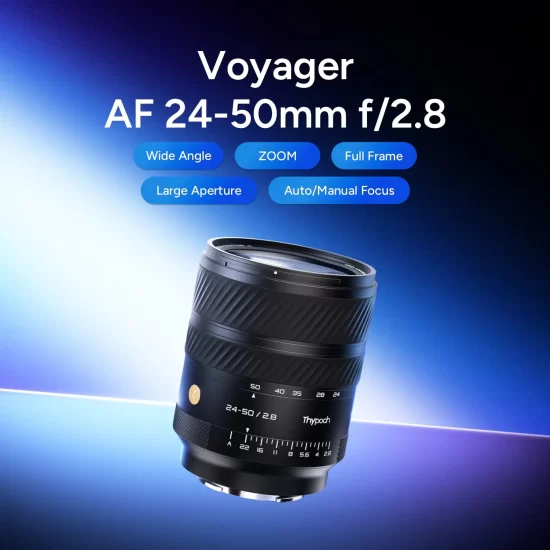
Executive Summary & Market Positioning
The optical landscape for mirrorless systems is undergoing a tectonic shift, driven largely by rapid advancements in independent Chinese manufacturing ecosystems. Thypoch—a brand historically revered for its mechanically intricate, vintage-inspired manual-focus primes—is aggressively pivoting into automated, high-precision zoom technology. The impending release of the Thypoch Voyager 24-50mm f/2.8 for Nikon Z-mount marks a significant company milestone: it is the very first domestic full-frame autofocus constant-aperture zoom lens originating from the region. By targeting the flexible 24-50mm focal range at a bright f/2.8 maximum aperture, Thypoch is stepping directly into a territory traditionally dominated by heavyweight OEM standard zooms, yet carving out a distinct utility profile optimized for hybrid shooters and minimalist field operators.
From a market positioning standpoint, this Z-mount iteration capitalizes on the immense physical advantages of Nikon’s short 16mm flange focal distance and expansive 55mm mount diameter. While the Nikon Z ecosystem already boasts peerless native glass, third-party autofocus options with high-end mechanical tolerances remain a lucrative frontier. The Voyager 24-50mm f/2.8 aims to bridge the chasm between cinematic build quality and everyday portability. By offering a constant f/2.8 light-gathering capability in an ultra-compact form factor, Thypoch is positioning this hardware not as a direct replacement for traditional 24-70mm workhorses, but as a specialized, fast-aperture travel and documentary tool that prizes nimble handling over extreme focal reach.
Core Architectural & Technological Innovations
Underneath its sleek exterior, the Thypoch Voyager 24-50mm f/2.8 showcases a sophisticated optical and electronic architecture. Designing a constant-aperture zoom that balances corner-to-corner sharpness across its focal span while accommodating modern high-resolution sensors requires immense computational ray-tracing and tight manufacturing tolerances. Thypoch has integrated advanced aspherical and extra-low dispersion glass elements to rigorously suppress chromatic aberrations, sagittal coma flare, and field curvature—common gremlins in wide-to-standard compact zooms. The physical layout utilizes an internal focusing mechanism, ensuring that the physical length of the lens remains balanced during operation, which is a critical mechanical trait for gimbal work and weather-sealed field deployment.
Equally important is the transition to autofocus infrastructure. As Thypoch's first foray into automated full-frame zooms, the electronic integration with Nikon’s proprietary Z-mount protocol demands low-latency communication. The lens employs a silent, high-torque stepping motor (likely a linear or STM variant) designed to interface seamlessly with Nikon’s advanced subject-detection algorithms. Focus breathing is tightly controlled through optical grouping management, ensuring that videographers pulling focus experience minimal framing shifts. Furthermore, the electronic contacts maintain full EXIF data transmission and support in-camera lens corrections, ensuring that modern mirrorless bodies can dynamically process out any residual geometric distortion seamlessly.
Empirical Specifications & Benchmark Matrix
| Specification Feature | Thypoch Voyager 24-50mm f/2.8 (Z-Mount) | Generic OEM 24-70mm f/2.8 Baseline | Compact Prime Kit Equivalent |
|---|---|---|---|
| Focal Length Range | 24-50mm | 24-70mm | Fixed (e.g., 24mm, 35mm, 50mm) |
| Maximum Aperture | Constant f/2.8 | Constant f/2.8 | Variable to f/1.4 - f/2.0 |
| Autofocus System | High-Torque Stepping Motor (AF) | Linear / VCM Motors | Varies by Prime |
| Mount Compatibility | Nikon Z-Mount (Native) | Nikon Z-Mount (Native) | Nikon Z-Mount |
| Optical Construction | Multi-group aspherical/ED layout | Complex multi-element zoom | Simplified prime formulas |
| Target User Profile | Hybrid travel, street, doc shooter | General photo/video professional | Purist / Low-light specialist |
Thermal, Efficiency & Real-World Ergonomics
In real-world deployment, hardware efficiency is dictated as much by tactile feedback as it is by optical MTF charts. The mechanical chassis of the Voyager series eschews lightweight plastics in favor of precision-machined aluminum alloys, providing a robust thermal dissipation path during extended high-fps video shoots. While internal electronic components—specifically the autofocus drive circuits and aperture control blades—generate minimal thermal load, the metal housing efficiently equalizes ambient temperature shifts, mitigating internal condensation risks when moving between extreme environments.
Ergonomically, the 24-50mm focal bracket strikes a functional compromise. By stopping the zoom range at 50mm rather than pushing to the traditional 70mm, engineers have drastically reduced the physical moment arm, resulting in a lighter, shorter barrel that balances exceptionally well on both compact bodies like the Nikon Zf or Z5ii and larger flagship grips. The dampening of both the zoom and focus rings exhibits the characteristic mechanical refinement Thypoch is known for, offering predictable resistance that feels reassuringly analog despite the fully digital nature of the autofocus system. Weather-sealing gaskets around the bayonet mount and critical control seams round out the physical package, ensuring reliability under adverse atmospheric conditions.
The Definitive Verdict
The Thypoch Voyager 24-50mm f/2.8 for Nikon Z-mount is a fascinating empirical proof-of-concept that successfully bridges the gap between boutique manual-focus craftsmanship and modern high-speed autofocus engineering. While its restricted 24-50mm range and f/2.8 aperture place it in a unique middle ground—heavier than a single prime, yet shorter than a traditional trinity zoom—its optical performance, compact footprint, and competitive positioning make it a compelling wildcard for Nikon shooters. For documentary photographers, travel journalists, and hybrid content creators seeking high-end mechanical build and constant-aperture flexibility without the physical bulk of a 24-70mm f/2.8 leviathan, the Thypoch Voyager stands out as a highly recommended, innovative addition to the Z-mount ecosystem.