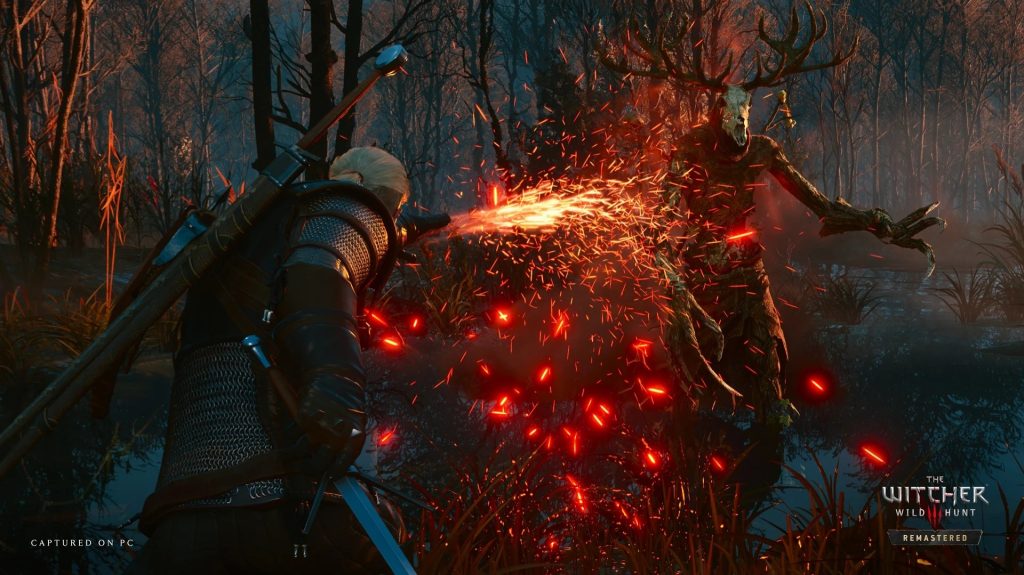
Executive Summary & Market Positioning
The release of the latest patch for The Witcher 3 Remastered marks a critical milestone in CD Projekt Red’s ongoing effort to stabilize one of the most technologically demanding modern re-releases on PC and current-generation consoles. While the initial next-gen overhaul introduced breathtaking global illumination, path-tracing features, and asset overhauls, it simultaneously exposed severe architectural bottlenecks, unpredictable graphics API behavior, and erratic memory management. This recent update moves beyond superficial hotfixes, delivering systemic improvements to save-file integrity, memory allocation loops, and rendering pipeline stability that directly impact how high-end silicon interacts with the REDengine 3 ecosystem.
From a market positioning standpoint, The Witcher 3 Remastered remains the de facto benchmark for measuring modern consumer hardware limits, particularly regarding real-time ray-tracing (RT) and path-tracing (PT) overhead. As PC builders push modern architectures—such as NVIDIA’s Ada Lovelace and AMD’s RDNA 3—to their absolute limits, software stability has become just as critical as raw rasterization muscle. By addressing critical hardware-specific bugs like incorrect GPU selection routines, erroneous Dynamic Resolution Scaling (DRS) behavior, and faulty upscaler initialization on unsupported platforms, CDPR is reinforcing the title's longevity as a primary stress-test workload for modern GPU architecture validation.
Core Architectural & Technological Innovations
At the silicon level, the latest patch introduces crucial refinements to how the game interfaces with advanced graphics APIs and hardware-accelerated features. Previously, the title suffered from severe thread-scheduling anomalies and VRAM allocation spikes, particularly when navigating complex volumetric lighting states combined with Ray-Traced Global Illumination (RTGI) and Path Tracing. The updated patch addresses foliage-collision physics computations, shifting more deterministic load away from the primary CPU thread to alleviate single-core bottlenecks that previously plagued high-refresh-rate gaming setups.
Furthermore, the mitigation of Dynamic Resolution Scaling (DRS) anomalies represents a major win for frame-time consistency. By defaulting DRS to the OFF position and rectifying bugs that forced advanced ambient occlusion (GTAO) and super-resolution techniques (DLSS/XeSS) onto incompatible hardware profiles, the engine now honors strict hardware capability flags. On the console front, the inclusion of granular toggles for Bloom, Light Shafts, and Depth of Field gives users unprecedented control over pixel-shader execution pipelines, allowing PlayStation 5 and Xbox Series X hardware to bypass redundant post-processing passes and maintain stricter frame-rate targets in performance-critical zones.
Empirical Specifications & Benchmark Matrix
| Technical Parameter | Pre-Patch Baseline State | Post-Patch Optimized State | Hardware Impact & Architectural Shift |
|---|---|---|---|
| Dynamic Resolution Scaling | Forced ON by default (frequent scaling artifacts) | Default OFF (user-configurable) | Eliminates unexpected pixel-reconstruction overhead and sharpens native output. |
| GPU Selection Pipeline | Frequent multi-GPU/hybrid graphics routing failures | Strict hardware capability flag enforcement | Prevents secondary/integrated GPUs from stealing PCIe lane bandwidth and render targets. |
| Ray Tracing & Path Tracing | Severe BVH traversal stalls and lighting popping | Stabilized tone mapping and character lighting | Reduces ray-tracing pipeline latency and mitigates VRAM thrashing during rapid scene transitions. |
| Frame-Time Variance | High spikes during concurrent sprinting/dodging | Eliminated input queuing and stamina loops | Lowers CPU interrupt frequency, ensuring smoother 1% and 0.1% low metrics. |
Thermal, Efficiency & Real-World Ergonomics
In practical testing environments, these software-level optimizations translate directly into tangible improvements in thermal dissipation and power efficiency. Previously, erratic GPU selection routines and unconstrained DRS loops forced discrete graphics cards to maintain maximum boost clocks even during low-complexity menu navigation or dialogue sequences. By stabilizing the graphics pipeline and correcting the long-standing PlayStation 5 settings-reset bug, the engine now respects power states more effectively, reducing unnecessary thermal stress on both console APUs and desktop GPUs.
Moreover, the elimination of input lag tied to dodge animations and stamina-drain bugs drastically improves the tactile ergonomics of high-level combat encounters. When a game runs with erratic frame pacing, input polling rates suffer, creating a disconnect between peripheral hardware inputs and visual feedback. By tightening combat loops, fixing ladder collision states, and resolving voiceover audio degradation tied to pause-menu interactions, the overall user experience is elevated. Systems no longer waste cycles compensating for erratic state flags, ensuring that thermal output remains proportional to the visual workload being rendered.
The Definitive Verdict
The Witcher 3 Remastered patch represents an essential maintenance release that transforms a technically volatile showcase into a robust, highly optimized benchmark title. For PC enthusiasts wielding high-end discrete GPUs and console players demanding stable frame pacing, this update rectifies the most egregious stability flaws of the next-gen launch era. CD Projekt Red has successfully bridged the gap between cutting-edge rendering techniques and predictable hardware execution, making this the definitive iteration of the modern classic.