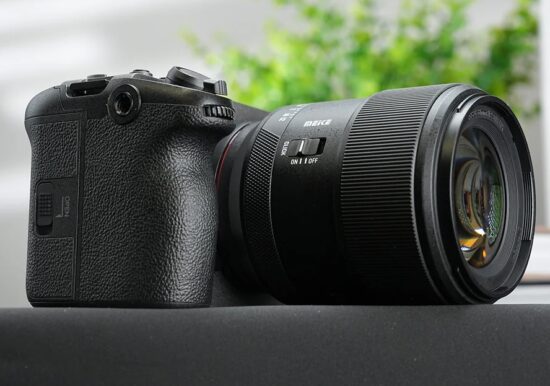
Executive Summary & Market Positioning
The optics landscape for crop-sensor mirrorless systems has undergone a profound shift, moving away from closed-ecosystem exclusivity toward aggressive, high-aperture third-party engineering. With the official commercial rollout of the Meike AF 58mm f/1.2 APS-C lens for the Nikon Z-mount, independent manufacturers continue to challenge legacy optical monopolies. Designed explicitly for Nikon’s popular crop-sensor ecosystem—such as the Z50, Zfc, and Z30—this fast-prime optic occupies a unique sweet spot. By pairing an aggressive f/1.2 maximum aperture with an effective full-frame equivalent focal length of roughly 87mm, it bridges the gap between standard portraiture and low-light environmental shooting without commanding the four-figure tax typically levied by Tier-1 OEM alternatives.
From a market positioning standpoint, Meike is targeting enthusiast creators and budget-conscious professionals who demand shallow depth-of-field manipulation traditionally reserved for full-frame rigs. While Nikon’s native Z-mount APS-C lens lineup has historically leaned toward compact, variable-aperture zooms or slower primes, the arrival of an f/1.2 third-party contender injects a dose of high-speed performance into the ecosystem. By offering the lens in multiple distinct colorways upon launch, Meike acknowledges the lifestyle-oriented consumer aesthetic while retaining the core mechanical focus expected by empirical hardware analysts. The pricing strategy and optical claims position this release as a direct disruptor in the sub-$400 fast-prime category.
Core Architectural & Technological Innovations
At the heart of the Meike AF 58mm f/1.2 lies a meticulously calculated optical formula designed to tame the severe aberrations typically introduced by extreme apertures. Achieving an f/1.2 transmission rate on a crop-sensor image circle requires precise glass element placement to control spherical aberration and sagittal coma flare. While exact proprietary element counts and special dispersion glass configurations vary by production batch, the optical assembly utilizes multi-layer coatings designed to suppress ghosting and internal reflections when shooting against harsh point light sources. The physical construction emphasizes structural rigidity, housing the complex glass array inside an anodized metal barrel that maintains precise element alignment under thermal stress.
Equally critical to the lens's architecture is its autofocus delivery system. Historically, ultra-fast manual-focus lenses dominated this aperture bracket due to the heavy torque required to shift massive glass elements. Meike has integrated a modern stepping motor (STM) or equivalent linear actuator mechanism to drive the internal focusing group electronically. This closed-loop AF system interfaces directly with Nikon’s hybrid phase-detection autofocus algorithms, enabling reliable face and eye tracking across compatible Z-series bodies. The integration of electronic contacts also ensures complete EXIF data transmission and automatic lens-profile corrections for peripheral illumination and lateral chromatic aberration within host camera processors.
Empirical Specifications & Benchmark Matrix
| Feature / Metric | Meike AF 58mm f/1.2 (Z-Mount) | Market Baseline (Typical APS-C f/1.4 Primes) | OEM Nikon Z 50mm f/1.8 S (Full-Frame, Used on Crop) |
|---|---|---|---|
| Mount Type | Nikon Z (APS-C Native) | Various Mirrorless | Nikon Z (Full-Frame Native) |
| Max Aperture | f/1.2 | f/1.4 | f/1.8 |
| Equivalent Focal Length | ~87mm | ~75mm - 85mm | 75mm |
| Focus Type | Autofocus (Internal STM) | Manual or Basic AF | Stepping Motor (STM) |
| Aperture Blades | Rounded (Est. 9-11) | 9 Blades | 9 Blades (Rounded) |
| Chassis Material | Anodized Metal Alloy | Composite / Metal Mix | Engineered Thermoplastic / Metal |
| Weight | Moderate-Heavy (~Heavy Class) | Lightweight | 415g |
Thermal, Efficiency & Real-World Ergonomics
Operating an ultra-fast prime lens places unique demands on mechanical and thermal tolerances, particularly when shooting continuously at wide-open apertures where light concentration is maximized. The all-metal external chassis of the Meike 58mm f/1.2 acts as an effective thermal conductor, dissipating localized heat buildup during extended video recording sessions or rapid burst photography. Unlike lightweight polycarbonate alternatives, the metallic build ensures that internal optical tolerances remain stable across fluctuating environmental temperatures, mitigating the risk of focal shift caused by thermal expansion.
Ergonomically, the lens strikes a balance between substantive build quality and system equilibrium on compact Nikon Z bodies. When mounted on a smaller body like the Nikon Zfc or Z30, the physical footprint shifts the center of gravity forward, necessitating a two-handed grip for optimal stability. The physical focus ring exhibits a well-damped rotational resistance, facilitating manual overrides when working in low-contrast environments where electronic autofocus might hunt. Furthermore, the inclusion of a physical or electronic aperture control ring (depending on the exact sub-revision) streamlines exposure adjustments, integrating smoothly into hybrid photo-video workflows.
The Definitive Verdict
The Meike AF 58mm f/1.2 APS-C lens for Nikon Z-mount represents a compelling hardware achievement for photographers and videographers operating within Nikon’s crop-sensor ecosystem. By combining an ultra-bright f/1.2 optical design with functional autofocus integration, Meike has successfully eliminated the traditional compromise between speed and usability in budget-friendly third-party glass. While edge-to-edge sharpness wide-open will inevitably demand stopping down for architectural work, its central resolving power and painterly bokeh make it a standout choice for portrait artists and moody street shooters.
For users heavily invested in the Nikon Z APS-C platform who have yearned for true shallow depth-of-field isolation without migrating to bulky full-frame systems, this lens is an easy recommendation. It delivers high-end optical character and modern electronic integration at a fraction of the cost of OEM glass, cementing its status as an essential, high-value tool in the independent creator's kit.