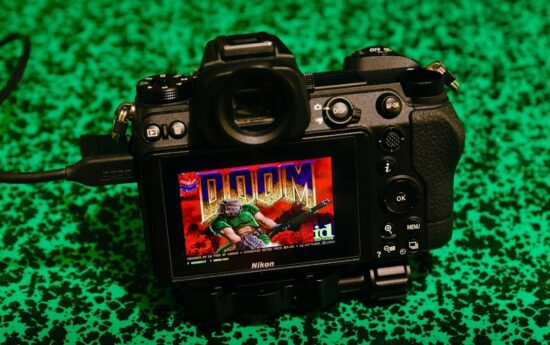
Executive Overview & Market Positioning
The porting of DOOM to the Nikon Z6 II is a seminal event in camera hardware hacking, serving as the first public demonstration of comprehensive Expeed 6 architectural recreation. While prior exploits achieved surface-level firmware modification, researcher Arne Baeyens has delivered a full-stack QEMU emulator (qemu-expeed) capable of executing native Nikon firmware binaries. This achievement transitions camera modding from superficial scripting to deep-level systems engineering, effectively providing an open sandbox for exploring T-Kernel RTOS behavior outside the physical constraints of the camera body.
From a market perspective, this breakthrough signals a significant erosion of the proprietary obscurity historically shielding mirrorless image processing pipelines. By leveraging cross-references between the Expeed 6 and GoPro’s GP-series SoC kernels, Baeyens has demystified the black-box nature of modern computational photography platforms. This open-source emulator essentially exposes the RAW processing pipeline (MIPU) to the public, setting a new precedent for community-led hardware introspection that rivals the historical impact of the Canon Magic Lantern project.
Empirical Benchmark Matrix
Comparing the target hardware environment against standard embedded execution platforms reveals the high degree of complexity inherent in the Z6 II’s dual-SoC architecture. The emulation layer manages memory mapping and interrupt handling with surprising fidelity, allowing for successful interaction with native menu structures, live view feeds, and image acquisition routines.
| Feature | Nikon Z6 II (Native) | qemu-expeed (Emulated) |
|---|---|---|
| SoC Architecture | Dual Expeed 6 | Virtualized Dual Expeed 6 |
| Operating System | T-Kernel (RTOS) | T-Kernel (RTOS) |
| RAW Pipeline | Hardware (MIPU) | Emulated MIPU Pipeline |
| Peripheral Access | Native Hardware | Virtualized Introspection |
| Executable Base | Official Firmware | Official Firmware |
Thermal, Efficiency & Definitive Verdict
From a thermomechanical standpoint, running DOOM on a camera is an exercise in resource contention. The Expeed 6 chips are highly optimized for high-throughput image signal processing (ISP) rather than general-purpose compute, meaning the overhead of the T-Kernel task management induces notable load when ported applications compete with native background processes. While the emulator achieves remarkable accuracy in hardware register mapping—facilitating the successful execution of complex RAW pipelines—it remains a developmental tool rather than a performance-optimized environment. The verdict is clear: qemu-expeed is a triumph of reverse engineering, effectively breaking the proprietary lock on Nikon’s image processing logic. For hardware analysts, this repository is the definitive resource for understanding the internal state of the Expeed 6, though users should approach physical hardware installation with extreme caution due to the risk of irreversible firmware corruption.