Executive Summary & Market Positioning
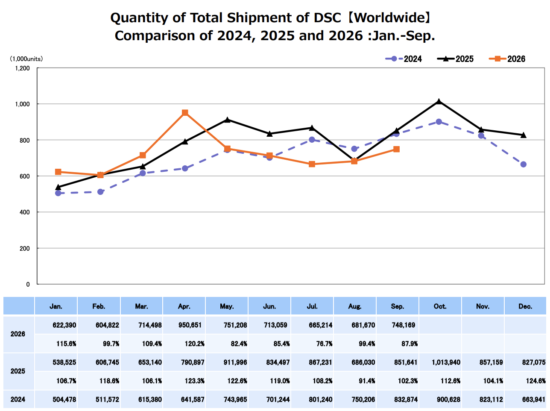
The Camera & Imaging Products Association (CIPA) has released its production and shipment metrics for September 2026, offering a rigorous empirical window into the ongoing metamorphosis of the global consumer imaging hardware market. As smartphone computational photography continues to press the lower bounds of standalone digital capture, the dedicated camera ecosystem is forced to navigate a landscape defined by aggressive value premiumization. Rather than chasing sheer volume, legacy hardware manufacturers—led by cornerstone optical engineers—are anchoring their fabrication pipelines to high-margin, professional-grade mirrorless platforms and specialized high-performance glass.
Evaluating the year-to-date trajectory through September 2026 reveals a maturing hardware sector that has largely purged legacy DSLR manufacturing lines. Total annual sales of interchangeable lens camera (ILC) bodies are projected to land between 6.0 and 6.25 million units, pulling back slightly from earlier seasonal peaks to settle near 2023 baseline volumes. However, this contraction in raw unit throughput does not translate to financial regression; overall shipped values have climbed by 3% globally. This divergence underscores a fundamental paradigm shift: imaging hardware is no longer a high-volume consumer electronic, but a specialized professional instrument class driven by high average selling prices (ASPs).
Core Architectural & Technological Innovations
Underpinning this fiscal resilience is the relentless structural evolution of mirrorless camera architectures. While mirrorless unit volume dropped by 8% compared to the previous year, total shipped value for these bodies actually increased by 2%. This critical margin expansion is enabled by the integration of stacked CMOS sensor designs, high-speed global shutter readouts, and increasingly sophisticated neural processing units (NPUs) dedicated to on-sensor phase-detection autofocus and real-time subject classification. Manufacturers are successfully trading unit velocity for higher per-device valuations by packing flagship-tier silicon into mid-tier and high-end enterprise bodies.
Concurrently, the optical engineering segment demonstrates remarkable stabilization. Both sub-35mm and full-frame (35mm and larger) lens categories experienced minor unit contractions of 6% and 8% respectively, yet both segments yielded a 3% increase in shipped value. This signals that consumers are prioritizing premium, high-aperture glass capable of resolving the extreme spatial frequencies demanded by modern high-megapixel sensors. The resulting lens-to-body sales ratio has ticked upward to 1.58, compared to 1.51 a year prior, confirming that hardware buyers are aggressively expanding their optical ecosystems at the point of purchase.
Empirical Specifications & Benchmark Matrix
| Hardware Segment | Year-Over-Year Unit Growth | Year-Over-Year Value Growth | ASP Trend / Structural Shift |
|---|---|---|---|
| DSLR Bodies | -36% | -38% | Rapid phase-out; terminal product lifecycle |
| Mirrorless Bodies | -8% | +2% | Margin expansion via high-end silicon integration |
| Compact Cameras | +15% | +13% | Niche resurgence driven by dedicated creator demand |
| Sub-35mm Lenses | -6% | +3% | Premium tier preference offsetting volume drops |
| Full-Frame+ Lenses | -8% | +3% | High-resolution optical formatting priority |
Thermal, Efficiency & Real-World Ergonomics
As mirrorless bodies continue to shrink in physical volume while scaling up computational workloads, thermal dissipation has emerged as a primary hardware engineering bottleneck. Modern 8K capture modes and sustained multi-frame burst processing push passive magnesium-alloy chassis to their thermal limits. Manufacturers are increasingly relying on advanced graphite thermal sheets and active internal airflow designs in flagship architectures to prevent sensor throttling. The efficiency of these thermal strategies directly dictates real-world ergonomics, dictating whether a high-performance body can sustain high bit-rate recording in adverse field environments without inducing operator discomfort.
Simultaneously, mechanical shutter assemblies are undergoing a generational re-evaluation. With high-speed electronic shutters approaching the distortion-free thresholds of mechanical curtains, physical shutter modules are increasingly reserved for specialized flash synchronization or entirely omitted in favor of pure electronic designs. This mechanical simplification not only improves reliability metrics by reducing moving parts subject to physical wear, but also optimizes internal spatial efficiency, allowing engineers to pack larger battery capacities and more robust in-body image stabilization (IBIS) actuator units into identical physical footprints.
The Definitive Verdict
The September 2026 CIPA dataset paints a clear, unvarnished portrait of a hardware industry operating at peak efficiency under constrained volume conditions. The absolute collapse of the legacy DSLR ecosystem—marked by a severe 36% drop in units and 38% in value—is now complete, ceding total market dominance to advanced mirrorless architectures. While compact cameras show a surprising 15% unit rebound fueled by creator-driven demand, the true engine of the imaging economy remains full-frame and medium-format mirrorless systems paired with high-performance optical glass. For hardware enthusiasts and enterprise investors alike, the takeaway is decisive: the future of digital capture belongs not to mass-market volume, but to uncompromising engineering specialization and high-value system integration.