Executive Summary & Market Positioning
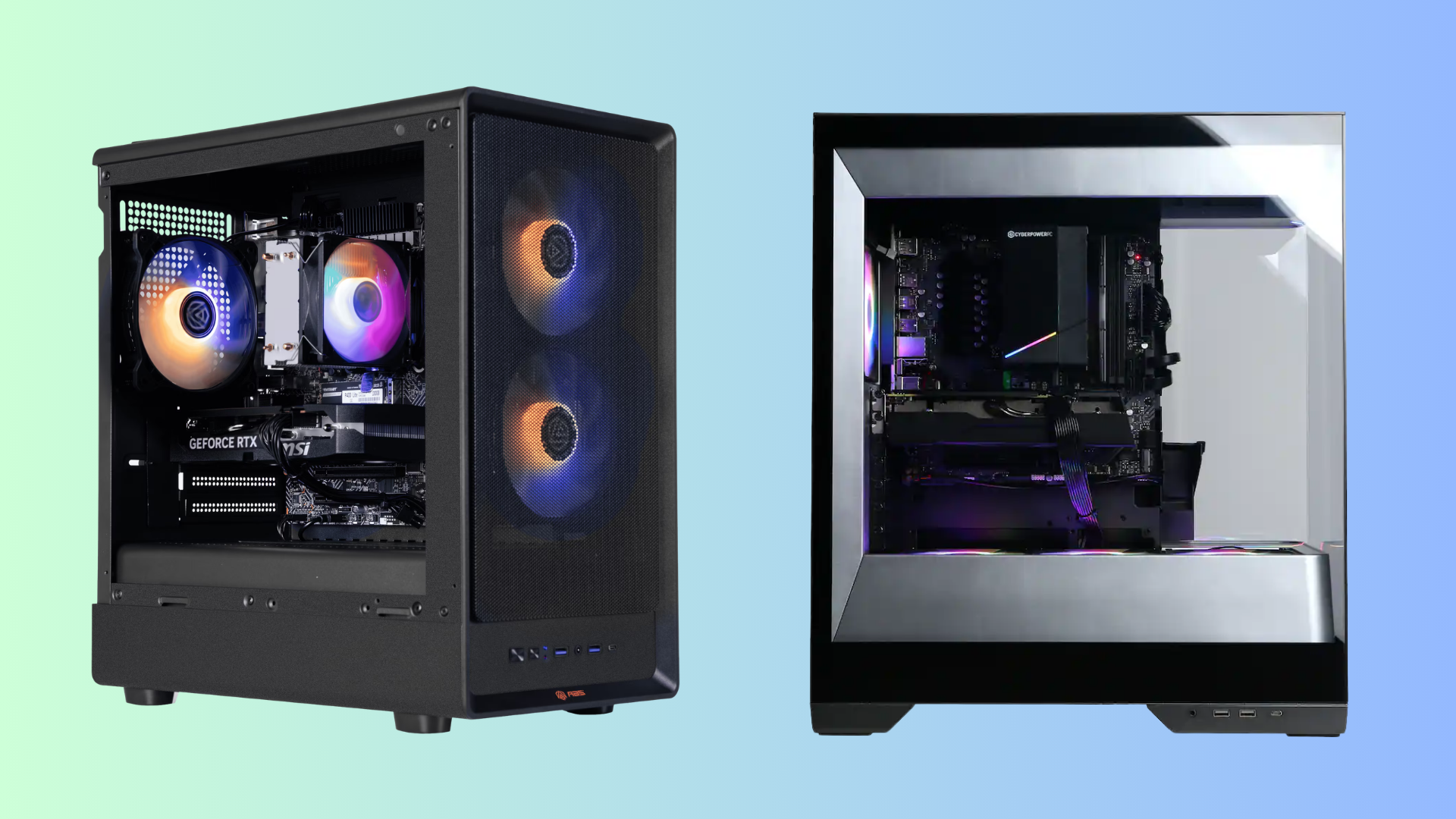
The sub-$1,000 pre-built gaming PC segment has historically been a graveyard of proprietary motherboards, legacy memory standards, and compromised entry-level silicon. However, shifting retail dynamics following major promotional cycles have forced system integrators to recalibrate. Currently, retail stalwarts Walmart and Best Buy are hosting aggressive promotional drops on two compelling mid-tier desktops: the ABS Cyclone M Aqua, anchored by an Nvidia GeForce RTX 5060, and a CyberPowerPC configuration powered by AMD's Ryzen platform and Radeon graphics. Both machines are priced aggressively at the psychological $999 threshold, offering modern micro-architecture to mainstream buyers.
Positioned squarely at the high-refresh-rate 1080p gaming demographic, these rigs bypass the extreme cost premiums associated with native 4K hardware while delivering robust frame rates across modern AAA titles. Yet, beneath their matching price tags lie fundamentally divergent engineering philosophies. The ABS system leans heavily into immediate peripheral value, packaging high-efficiency graphics hardware alongside bonus storage capacity. Conversely, the CyberPowerPC alternative trades immediate storage perks for foundational platform longevity. For empirical hardware analysts, this price point represents a fascinating crossroad between raw graphical throughput and long-term upgradeability.
Core Architectural & Technological Innovations
The internal silicon dichotomy defines the core appeal of these systems. The ABS Cyclone M Aqua relies on the Intel Core i5-14400F, operating on the mature LGA 1700 socket paired with 16GB of DDR4-3200 system memory. While the CPU architecture is a proven workhorse for budget builds, its primary technological catalyst is the integrated Nvidia GeForce RTX 5060 (8GB VRAM). This Ada Lovelace-adjacent (or subsequent generational equivalent) GPU brings advanced feature sets to the sub-$1,000 tier, notably full support for DLSS suite upgrades, including multi-frame generation. This AI-accelerated rendering pipeline provides a vital performance safety net for demanding titles or experimental higher-resolution scaling.
In contrast, the CyberPowerPC rig at Best Buy pivots toward an all-AMD ecosystem. It deploys the Ryzen 7 8700F processor—a robust chip running with a 4.1 GHz base clock and a 5.0 GHz boost envelope—mounted on the contemporary AM5 socket. This grants the CyberPowerPC a decisive architectural advantage in platform lifespan, allowing for drop-in CPU upgrades years down the line. Coupled with 16GB of faster DDR5 memory and the AMD Radeon RX 9060 (8GB VRAM), this machine sacrifices a degree of Nvidia's proprietary upscaling dominance in favor of native rasterization performance, memory bandwidth headroom, and modern DDR5 data rates.
Empirical Specifications & Benchmark Matrix
| Component / Metric | ABS Cyclone M Aqua (Walmart) | CyberPowerPC Gaming Master (Best Buy) | Market Baseline (Typical $1k Build) | Verdict / Delta |
|---|---|---|---|---|
| Price | $999.00 | $999.99 | $1,050.00 | Tie (Exceptional value) |
| CPU | Intel Core i5-14400F | AMD Ryzen 7 8700F | Intel Core i5-13400F | CyberPowerPC wins (AM5 longevity) |
| Motherboard Platform | LGA 1700 (DDR4) | AM5 (DDR5) | LGA 1700 (DDR4) | CyberPowerPC superior upgrade path |
| GPU | Nvidia GeForce RTX 5060 (8GB) | AMD Radeon RX 9060 (8GB) | RTX 4060 / RX 7600 | ABS wins (DLSS feature richness) |
| System Memory | 16GB DDR4-3200 | 16GB DDR5 (Speed unspecified) | 16GB DDR4-3200 | CyberPowerPC wins (Memory bandwidth) |
| Primary Storage | 1TB NVMe SSD | 1TB NVMe SSD | 500GB - 1TB NVMe SSD | Tie |
| Bonus Hardware | Verbatim 2TB Vi7000 Gen 4 SSD | None | None | ABS wins (Massive storage value) |
Thermal, Efficiency & Real-World Ergonomics
Thermal performance in pre-built systems under $1,000 often dictates component longevity, particularly given the power densities of modern silicon. The ABS Cyclone M Aqua utilizes a standard mid-tower chassis design with adequate airflow channels to keep the Core i5-14400F and RTX 5060 within safe thermal envelopes. Because the RTX 5060 prioritizes high performance-per-watt metrics, heat output remains manageable during sustained gaming sessions, keeping fan acoustic profiles comfortably subdued in typical desktop environments.
Meanwhile, the CyberPowerPC configuration benefits from the inherent power efficiency of the Ryzen 7 8700F architecture. Built on an advanced process node, the AMD CPU draws relatively modest power under load, easing the thermal burden on the included CPU cooler. The Radeon RX 9060 complements this efficient baseline, ensuring that chassis cooling solutions do not have to resort to high-RPM, high-noise acoustics to dissipate heat. However, buyers should note that system integrators at this price tier frequently deploy basic cooling hardware, meaning empirical users may eventually wish to swap stock coolers for aftermarket cooling solutions to maximize sustained boost frequencies.
The Definitive Verdict
Choosing between these two sub-$1,000 systems ultimately depends on whether your priority is immediate hardware extras or long-term platform sustainability.
The ABS Cyclone M Aqua is the superior choice for users seeking immediate utility out of the box. By coupling the feature-rich Nvidia RTX 5060—complete with advanced DLSS and frame generation capabilities—with an unexpected bonus Verbatim 2TB Gen 4 SSD, ABS delivers unmatched peripheral and storage value.
Conversely, the CyberPowerPC build is the definitive winner for forward-looking builders. Its adoption of the AM5 socket, Ryzen 7 8700F processor, and DDR5 memory infrastructure provides an invaluable upgrade path that the dead-end LGA 1700 platform simply cannot match. If you want maximum features today, buy the ABS; if you want a system designed to evolve tomorrow, secure the CyberPowerPC.