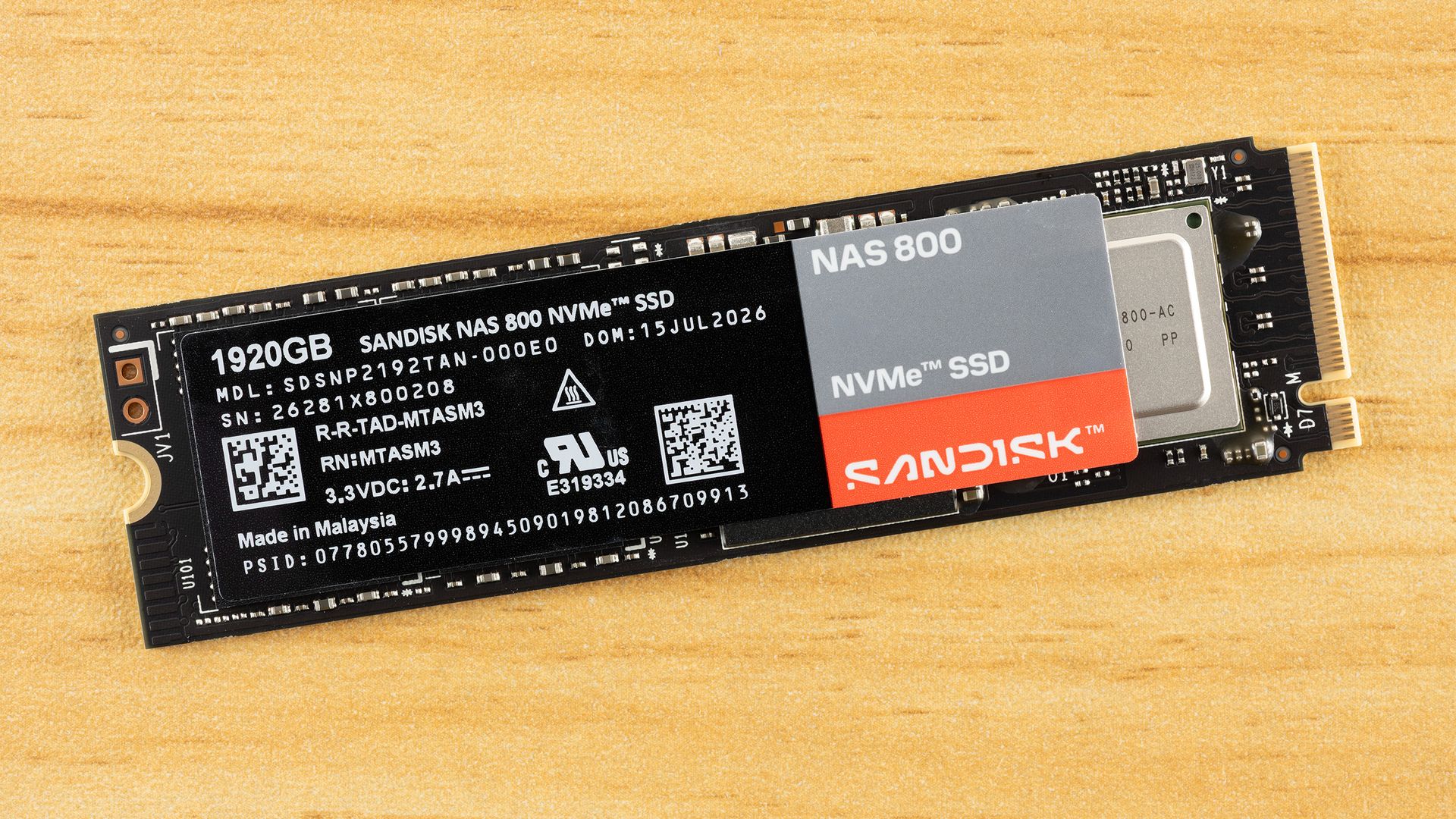
Executive Summary & Market Positioning
The SanDisk NAS 800 arrives at a pivotal juncture in the storage market, bridging the gap between high-performance consumer NVMe drives and the restrictive, often inaccessible world of enterprise hardware. By leveraging the same foundational architecture as the acclaimed WD Black SN8100/Optimus GX Pro series, SanDisk has positioned the NAS 800 as the definitive choice for prosumers, small-office/home-office (SOHO) administrators, and workstation power users who require consistent, 24/7 reliability without sacrificing the blistering speeds of the PCIe 5.0 interface. It is a calculated product: by optimizing for sustained write endurance rather than peak burst synthetic benchmarks, SanDisk acknowledges that the modern NAS environment is evolving.
Market-wise, the NAS 800 occupies a premium tier. While users could technically deploy standard consumer Gen 5 drives in a NAS enclosure, they do so at the peril of premature flash degradation. The NAS 800 effectively mitigates this risk through aggressive overprovisioning and high-tier NAND binning. While the price point—sitting 25% to 65% above standard enthusiast drives—may cause sticker shock, it is objectively justifiable for users managing multi-terabyte datasets, high-frequency database logging, or media production workflows where the cost of a drive failure far outweighs the initial hardware investment.
Core Architectural & Technological Innovations
At the heart of the NAS 800 resides the Silicon Motion SM2508 controller, a flagship eight-channel PCIe 5.0 powerhouse that excels in both low-latency throughput and thermal management. Unlike standard consumer controllers that prioritize raw peak speed, the SM2508 in this configuration is tuned for sustained IOPS, ensuring that the drive doesn’t throttle under the continuous write-load typical of RAID-Z pools or high-traffic server environments. This is further supported by a 2GB LPDDR4 DRAM cache, which maintains a 1:1,000 ratio to the NAND, providing significantly better address mapping performance than the halved cache sizes often found in cost-optimized gaming SSDs.
The drive utilizes SanDisk’s proprietary 218-layer BiCS8 TLC flash. This high-density NAND is the secret sauce behind the NAS 800’s industry-leading endurance figures, offering up to 14PBW (Petabytes Written) on the 7.68TB model. By employing a more robust overprovisioning strategy, the controller has significantly more "breathing room" for garbage collection and wear-leveling algorithms. This physical architecture, combined with TCG Opal encryption support, ensures that the drive remains performant and secure even as it nears its rated lifespan, a critical differentiator from standard retail NAND setups.
Empirical Specifications & Benchmark Matrix
| Specification | SanDisk NAS 800 (1.92TB) | Market Baseline (Gen5 Consumer) | Advantage |
|---|---|---|---|
| Sequential Read | 14,900 MB/s | 12,000 - 14,000 MB/s | Marginal |
| Sequential Write | 13,200 MB/s | 8,000 - 10,000 MB/s | Significant |
| Endurance (TBW) | 3,500 TB | 1,200 - 1,500 TB | >2x Gain |
| DRAM Cache | 2GB LPDDR4 | 1GB - 2GB LPDDR4 | Balanced |
| Security | TCG Opal | AES-256 (Limited) | High |
| Warranty | 5-Year | 5-Year | Standard |
Thermal, Efficiency & Real-World Ergonomics
Thermal management is the Achilles' heel of many Gen 5 drives, but the NAS 800 exhibits surprising poise. Operating at an average power draw of approximately 6.5W to 7.5W, it remains well within the operational thermal envelope for standard M.2 slots, even those with limited airflow. Because the drive is designed for constant, measured throughput rather than the erratic, thermally-intensive spikes of high-end gaming loads, it maintains a flatter thermal curve. While the 7.68TB model features a double-sided PCB design that requires careful clearance check, the single-sided 1.92TB and 3.84TB units are remarkably slim and easy to integrate into compact NAS appliances.
The inclusion of SanDisk’s Dashboard software adds significant value for the professional user. Unlike bloated "gaming-first" utilities, the SanDisk suite is lean, providing granular SMART telemetry, clear health status, and a straightforward interface for firmware updates. For users implementing these drives in mission-critical environments, the compatibility with Acronis True Image for drive cloning and backup is a welcome, standard-issue inclusion that simplifies the deployment process across a server rack or workstation farm.
The Definitive Verdict
The SanDisk NAS 800 is not a drive for the casual gamer or the budget-conscious enthusiast; it is a specialized instrument for users who value data longevity and sustained performance above raw cost-per-gigabyte. Its ability to marry the extreme speeds of the PCIe 5.0 protocol with the endurance requirements of a 24/7 server environment is a massive win for the industry. While the price premium is steep, the 14PBW longevity on the higher-capacity models effectively changes the math for enterprise-lite applications. For those building a high-performance NAS or a workstation where downtime is an unacceptable variable, the NAS 800 is the new gold standard.