Executive Overview & Market Positioning
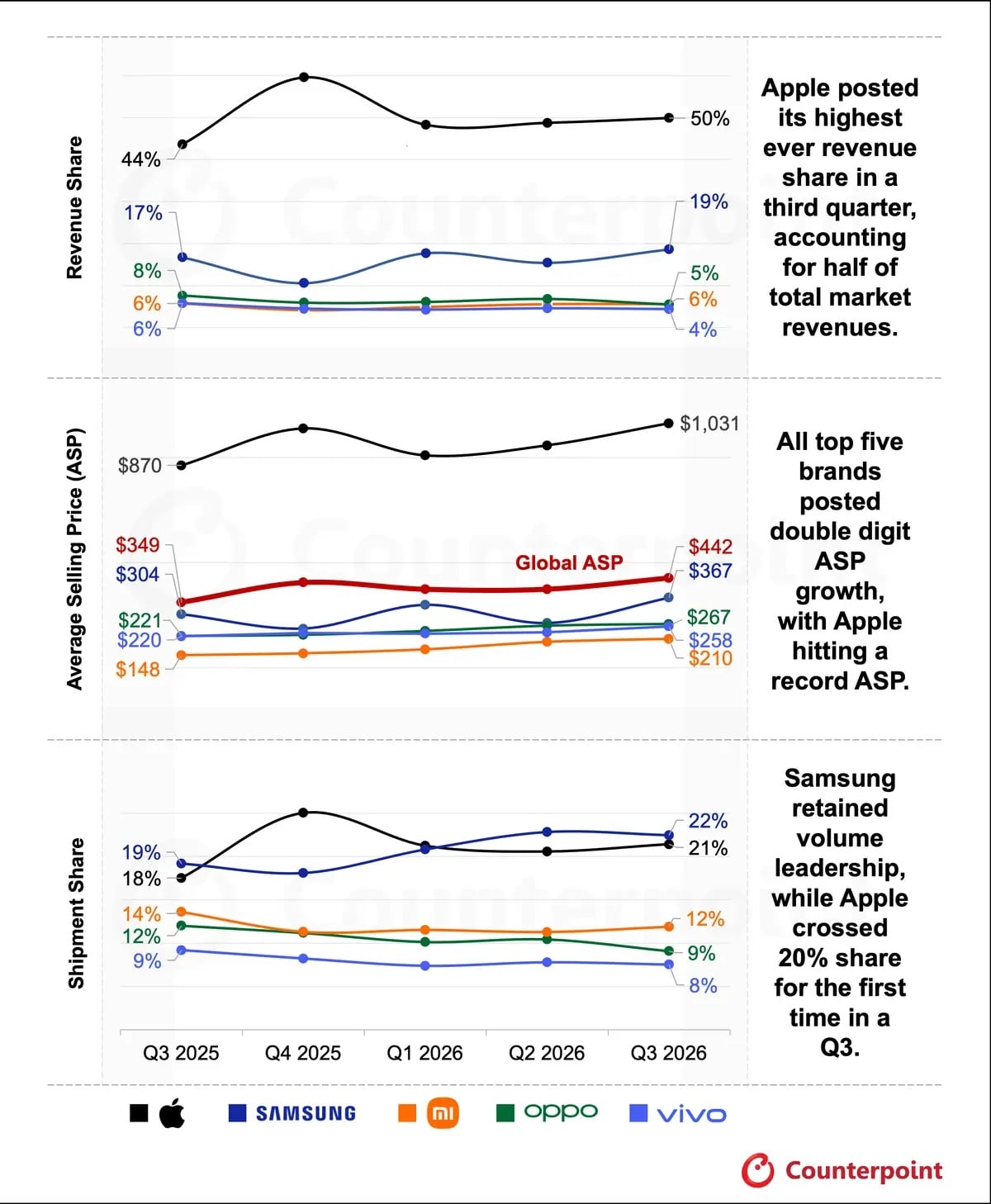
In a landscape defined by a 19% contraction in global shipment volumes, Samsung has solidified its position as the market leader with a 22% volume share in Q3 2026. This performance underscores a fundamental pivot in mobile hardware strategy: shifting focus from volume-driven saturation to margin preservation. Amidst rising manufacturing costs and acute memory supply constraints, the company successfully offset lower unit sales by increasing its Average Selling Price (ASP) by 21% year-over-year. This tactical recalibration allowed Samsung to post a 14% revenue increase, effectively decoupling its financial health from the broader industry’s volume-based slump.
Contrasting with this, the broader Android ecosystem struggled to navigate current macro headwinds. While manufacturers like Xiaomi managed to maintain flat revenue through high-end portfolio shifts, competitors like OPPO and vivo experienced revenue contractions of 26% and 22%, respectively. Apple remains the outlier in value capture, securing 50% of global smartphone revenue through an unprecedented $1,031 ASP. Samsung’s ability to defend its margin via a vertical integration strategy—which provides a critical buffer against surging memory component pricing—remains the primary differentiator between it and its fragmented Android rivals.
Empirical Benchmark Matrix
Performance metrics indicate that Samsung’s revenue stability is predicated on its premium tier, specifically the Galaxy S26 Ultra and Z Fold 8, which maintain robust demand despite aggressive price hikes. The following table highlights the divergence in fiscal positioning and market value across the sector.
| Manufacturer | YoY Revenue Change | ASP (Q3 2026) | Market Positioning Strategy |
|---|---|---|---|
| Apple | +17% | $1,031 | Premium Value Hegemony |
| Samsung | +14% | $367 | Vertically Integrated Scale |
| Xiaomi | 0% | Variable | Portfolio Upscaling |
| OPPO/vivo | -24% (avg) | Low-Mid | Market Contraction/Exit |
Thermal, Efficiency & Definitive Verdict
As component cost pressures—particularly within the high-density memory segment—persist through 2027, the industry is entering an era of "structural inflation" for mobile hardware. Samsung’s internal supply chain optimization acts as a thermal heat sink for its operating margins, insulating it from the price shocks that have decimated smaller competitors. Our verdict is clear: the era of accessible high-end hardware is ending. OEMs that lack deep-tier component manufacturing capabilities will continue to lose market share. Moving into 2028, consumers should anticipate that any reduction in bill-of-materials (BOM) costs will be reallocated by manufacturers into internal hardware upgrades rather than retail price deflation. Samsung is currently the only entity outside of the Apple ecosystem demonstrating the operational maturity to sustain this high-margin, high-spec trajectory.