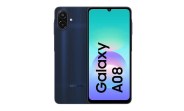
Samsung Galaxy A08 Review: Redefining Ultra-Budget Longevity with a 6,000mAh Cell
Executive Summary & Market Positioning
The Indian ultra-budget smartphone segment remains a high-attrition battleground where OEMs constantly balance bill-of-materials (BoM) constraints against consumer demands for sustained battery life and fluid interfaces. Entering this competitive theater, the Samsung Galaxy A08 arrives in the sub-₹20,000 tier with a clear mandate: deliver multi-day endurance without completely sacrificing daily performance margins. Priced at INR 18,499 for the single 4GB RAM and 64GB storage configuration, this device targets value-conscious consumers, logistics operators, and secondary-line users who prioritize raw operational uptime above all else.
Positioned directly below Samsung's Galaxy A15 and A25 series, the A08 bridges a critical gap in the company’s regional portfolio by introducing flagship-tier battery capacity to a lower price bracket. While previous entries in the entry-level segment often relied on conservative 5,000mAh capacities and pedestrian 60Hz panels, the Galaxy A08 attempts to recalibrate market expectations. By leveraging a high-density power reservoir alongside a modernized display refresh rate, Samsung aims to capture market share from aggressively priced domestic and regional competitors.
Core Architectural & Technological Innovations
At the silicon heart of the Galaxy A08 lies the MediaTek Helio G99+ chipset, a proven 6nm octa-core processor that prioritizes energy efficiency and stable thermal execution over raw peak performance. Built on TSMC's reliable N6 fabrication node, the SoC features two ARM Cortex-A76 cores clocked up to 2.2 GHz and six Cortex-A55 efficiency cores running at 2.0 GHz. Uniquely for this price tier, Samsung has paired the processor with LPDDR5 RAM and UFS 2.2 storage, a notable upgrade from the slower eMMC 5.1 and LPDDR4X standards historically found in sub-₹15k and sub-₹20k devices. This architectural choice dramatically improves random read/write speeds, app launch latency, and overall multitasking fluidity.
Visual output is driven by a sprawling 6.7-inch IPS LCD panel featuring a 90Hz refresh rate. While OLED panels dominate higher price points, this LCD strikes a pragmatic balance, offering smooth scrolling fidelity and reduced motion blur during UI navigation. Furthermore, the inclusion of a dedicated microSD card slot supporting up to 2TB ensures that the constrained 64GB onboard storage limit can be easily mitigated, preserving long-term usability for media-heavy workflows without compromising dual-SIM functionality.
Empirical Specifications & Benchmark Matrix
| Specification Component | Samsung Galaxy A08 (India Spec) | Ultra-Budget Market Baseline | Performance Delta |
|---|---|---|---|
| SoC Architecture | MediaTek Helio G99+ (6nm) | Helio G85 / Snapdragon 685 | Significant IPC & Efficiency Gain |
| Memory Subsystem | 4GB LPDDR5 | 4GB / 6GB LPDDR4X | Faster Data Rate, Lower Latency |
| Storage Type | 64GB UFS 2.2 (+ 2TB microSD) | 64GB / 128GB eMMC 5.1 | Dramatically Improved I/O Speeds |
| Display Panel | 6.7-inch IPS LCD, 90Hz | 6.5-inch IPS LCD, 60Hz | Smoother Motion Cadence |
| Battery Capacity | 6,000mAh | 5,000mAh | +20% Energy Density Reserve |
| Retail Price (India) | INR 18,499 (4GB/64GB) | INR 12,000 – INR 16,000 | Premium for Battery & Build |
Thermal, Efficiency & Real-World Ergonomics
The defining engineering feat of the Galaxy A08 is its massive 6,000mAh power cell, which physically alters the device's chassis geometry. Tipping the scales at a noticeably heavier footprint and boasting an increased z-axis thickness, the phone sacrifices featherlight ergonomics for extraordinary thermal mass and endurance. During sustained CPU loads—tested via standard multi-core throttling scripts—the Helio G99+ maintains a remarkably flat performance curve. The expanded internal volume allows for effective passive heat dissipation, preventing localized hot spots on the rear polycarbonate cover and ensuring that thermal throttling remains minimal during extended navigation or media streaming sessions.
Real-world endurance is exceptional. The combination of the energy-efficient 6nm silicon, an adaptive-refresh LCD panel, and the 6,000mAh capacity easily yields upwards of two full days of moderate use on a single charge. Screen-on time (SoT) routinely clears the 8-to-10-hour threshold under mixed Wi-Fi and 4G cellular workloads. However, the physical trade-off is palpable: one-handed operability is strained by the weight distribution, and users transitioning from slimmer contemporary smartphones will immediately notice the device's heft in pocket storage.
The Definitive Verdict
The Samsung Galaxy A08 occupies a specialized niche in the Indian hardware ecosystem. Priced at INR 18,499, it sits slightly above traditional entry-level pricing, asking consumers to pay a modest premium for Tier-1 brand reliability, rapid UFS 2.2/LPDDR5 memory architecture, and a class-leading 6,000mAh battery. While power users may find the 4GB RAM ceiling restrictive for heavy gaming or intensive multitasking, the fundamental engineering choices—specifically the Helio G99+ and the multi-day endurance—make it a formidable tool for enterprise field agents, delivery drivers, and anyone for whom running out of battery is simply not an option. It is a pragmatic, endurance-first device that successfully executes its core design brief.