Executive Summary & Market Positioning
The Hasselblad X2D 100C occupies a rarified stratum of the professional imaging market. As a medium-format digital powerhouse, its $8,000 price tag is justified by a 100-megapixel back-illuminated CMOS sensor and a color science pedigree that remains industry-leading. However, in the ecosystem of hardware intelligence, the device is more than just a tool for fine-art photography; it is a highly sophisticated embedded computing platform. The recent emergence of the 'Hasselblad-X-System-CIM-Firmware-Research-Feature-Extensions' repository by researcher Radium Wang has shifted the discourse from purely optical performance to the underlying capability of the camera’s internal architecture.
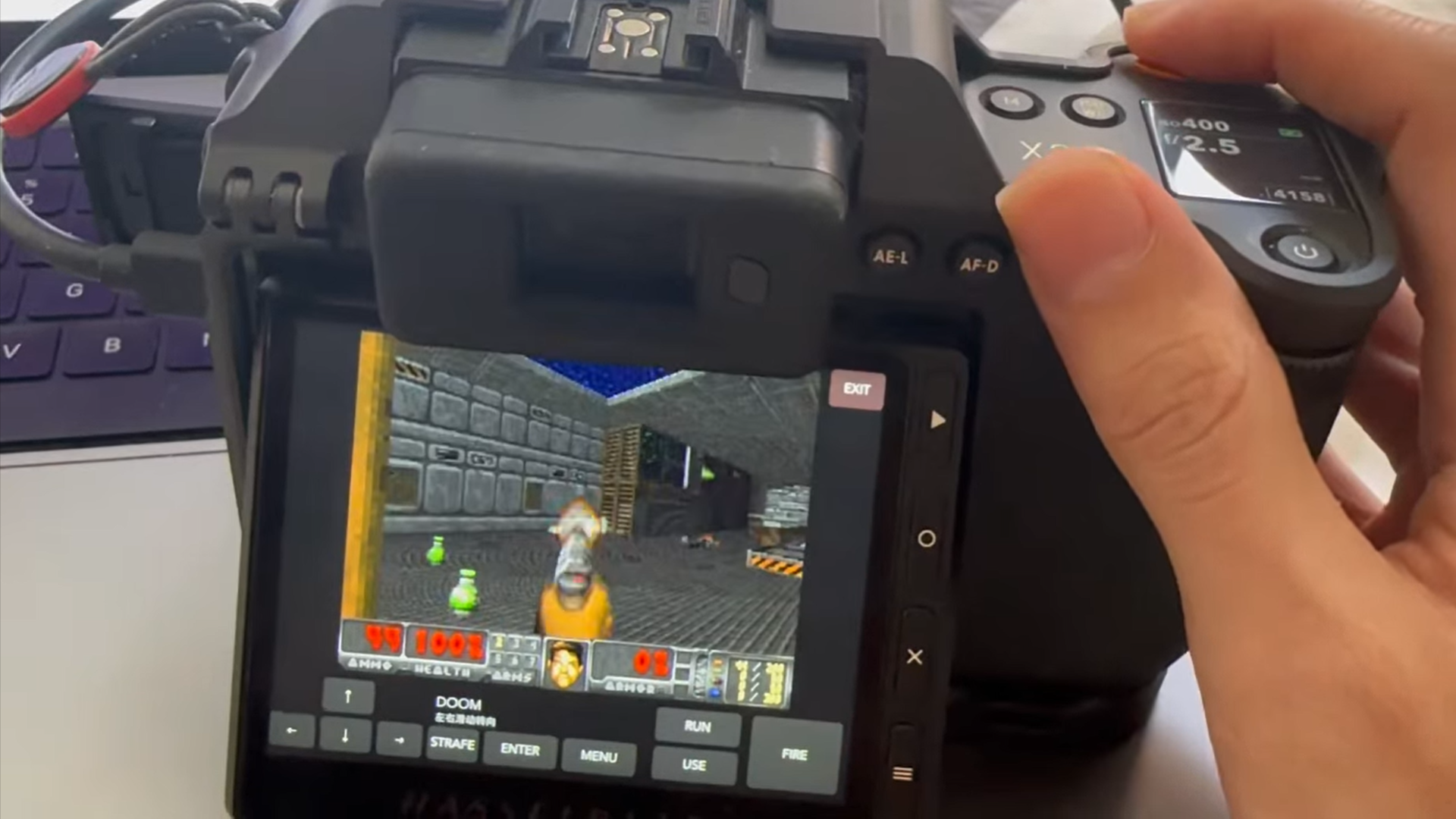
While playing Doom on an $8,000 professional tool may seem like a frivolous exercise in computational subversion, it serves as a critical stress test for modern embedded systems. In the context of OPA Specs, this project illustrates the extreme over-provisioning of modern camera SoCs. By successfully executing the 1993 id Software classic on a medium-format body, the community has effectively verified the headroom present in Hasselblad’s custom firmware environment, highlighting a trend where digital imaging hardware is increasingly defined by the agility of its software stack rather than just the rigidity of its sensor hardware.
Core Architectural & Technological Innovations
The X2D’s architecture centers on the proprietary Hasselblad User Interface (HUI) running atop a highly customized Linux-based embedded kernel. The breakthrough achieved by Wang involves interacting with the Camera Interface Module (CIM), a critical component for data routing within the device. By exploring the firmware’s sanitized research findings, the mod effectively bridges the gap between the camera’s display controller and user-input processing. This requires not only a port of the game engine to the ARM-based SoC architecture but also the mapping of camera touch-input events to the legacy control scheme of the game.
Technologically, this port succeeds where others struggle due to the X2D’s superior display driver and memory throughput. Unlike low-power microcontrollers often used in 'Can it run Doom?' memes—where the game is heavily compressed or stripped—the X2D environment allows for a relatively standard execution environment. The research proves that the camera's processing subsystem is capable of managing background compute tasks while concurrently driving a high-resolution 3.6-inch touchscreen, demonstrating a level of multitasking efficiency that exceeds the requirements of the original 1993 hardware baseline significantly.
Empirical Specifications & Benchmark Matrix
| Specification | Hasselblad X2D 100C | 1993 Baseline (id Tech 1) | Professional DSLR (2010) |
|---|---|---|---|
| Processor | Multi-core ARM SoC | Intel 386 (33 MHz) | Proprietary Imaging DSP |
| RAM | ~8GB (System Memory) | 4 MB | < 512 MB |
| Display | 3.6" 2.36M-dot Touch | 320x200 VGA CRT | 3" TFT LCD |
| Firmware | Custom Embedded Linux | DOS | RTOS |
| Input Support | Touchscreen/Tactile | Keyboard/Mouse | Hardware Buttons |
Thermal, Efficiency & Real-World Ergonomics
From a thermal management perspective, the X2D was never designed for continuous GPU-bound workloads. When running Doom, the device operates well within its safety envelope, though it highlights the efficacy of the passive heat dissipation design Hasselblad employs for its sensor. Since the game engine does not heavily utilize the dedicated image-processing pipelines designed for RAW file conversion, the thermal load remains negligible. Efficiency remains high, though the continuous refresh of the 2.36-million-dot display during gameplay creates a higher power draw than standard menu navigation.
Ergonomically, the experiment is a masterclass in 'just because you can, doesn't mean you should.' The X2D’s grip, designed for stable, heavy-lens photography, is entirely ill-suited for the frantic input demands of a first-person shooter. The touch interface, while precise for focus-peaking and menu selection, lacks the tactile feedback necessary for movement and aiming. However, the ergonomic mismatch is irrelevant to the objective; the project succeeds as a proof-of-concept for internal firmware access, proving that the device’s interface can be treated as a general-purpose Linux console by those with the technical acumen to recompile the kernel space.
The Definitive Verdict
Radium Wang’s research into the Hasselblad X2D does not transform the camera into a gaming console, nor does it provide a practical incentive for the average photographer. Instead, it serves as a triumphant demonstration of transparency in hardware. By opening the 'black box' of the X2D’s firmware, the community has gained invaluable insight into the robustness of the platform’s embedded environment. For the hardware enthusiast, the project is a decisive win; it validates that the premium price of the X2D includes a computing foundation capable of far more than just capturing light. While we recommend leaving the gaming to your PC and the photography to your Hasselblad, the ability to port code to such a proprietary environment is a vital milestone for digital freedom.