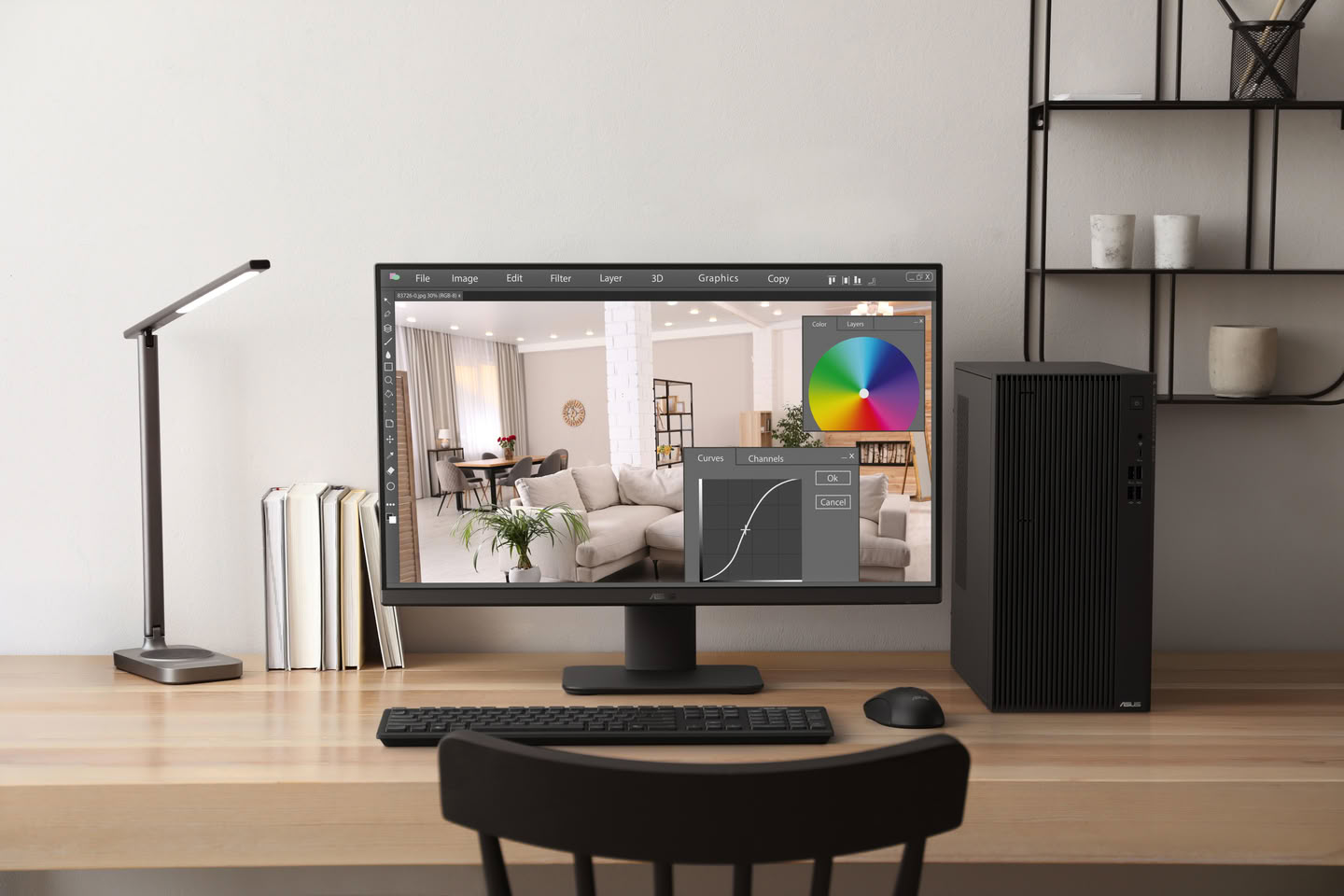
Executive Overview & Market Positioning
The commercial desktop segment requires a strict equilibrium between compute density, thermal reliability, and capital expenditure. ASUS addresses this vertical with the introduction of the ExpertCenter P300 Mini Tower (model P302MV), an enterprise-focused desktop engineered specifically for small-to-medium business (SMB) deployments. Positioned as a value-driven workhorse, the chassis aims to reclaim desktop footprint efficiency without sacrificing the deterministic performance required for day-to-day office productivity workloads.
From a platform architecture perspective, the P300 Mini Tower leverages modern Intel mobile-class or highly efficient desktop-derivative silicon, capping its thermal design power (TDP) ceiling at 45 W. This strategic constraint allows ASUS to maintain an aggressive acoustic and thermal envelope within a compact form factor. By targeting the 45 W bracket, the OEM positions the P300 to capture enterprise deployments that prioritize low idle power draw and predictable thermal dissipation over unconstrained peak wattage scaling.
Empirical Benchmark Matrix
To contextualize the hardware capabilities of the ASUS ExpertCenter P300 Mini Tower (P302MV), we compare its core specifications against a generic commercial entry-level mini-tower baseline. The OEM highlights a 38% peak performance delta over class competitors, largely attributable to an enhanced proprietary thermal design that prevents early thermal throttling under sustained multi-threaded office workloads.
| Hardware Parameter | ASUS ExpertCenter P300 (P302MV) | Generic SMB Baseline Desktop |
|---|---|---|
| Processor Tier | Up to Intel Core 7 | Intel Core i5 / Entry Core 7 |
| Max Thermal Design Power (TDP) | 45 W | 65 W – 95 W |
| Memory Capacity Ceiling | Up to 16 GB RAM | Up to 16 GB – 32 GB RAM |
| Storage Ceiling | Up to 2 TB Total NVMe SSD | Up to 512 GB – 1 TB NVMe SSD |
| Chassis Form Factor | Mini Tower (Optimized Footprint) | Standard Mini Tower |
| Claimed Peak Performance Delta | +38% vs Class Competitors | Baseline (0%) |
Thermal, Efficiency & Definitive Verdict
The defining engineering choice of the ExpertCenter P300 is its strict adherence to a 45 W TDP envelope. While traditional commercial desktops lean on high-wattage silicon that quickly saturates basic heatsinks, ASUS has paired its processor tier with an enhanced thermal apparatus designed to maximize sustained frequency within a lower energy budget. This yields tangible dividends in enterprise environments: reduced thermal output translates directly to lower ambient cooling loads in dense office settings and increased component longevity. Memory support capped at 16 GB and a 2 TB NVMe SSD storage ceiling adequately cover standard productivity applications, data security requirements, and local caching needs. Ultimately, the ASUS ExpertCenter P300 Mini Tower (P302MV) succeeds by trading raw, unthrottled wattage for intelligent, sustained efficiency. For organizations scaling out standardized office infrastructure where reliability, desk space, and total cost of ownership dictate procurement, the P300 presents a compelling, high-signal hardware proposition.