Executive Overview & Market Positioning
Recent secondary market telemetry originating from Alibaba’s Xianyi platform has brought an elusive piece of silicon to light: a bare printed circuit board functioning as an engineering sample of NVIDIA’s unreleased GeForce RTX 4090 Ti. Surfaced via community intelligence and hardware tracking networks, this engineering artifact corroborates architectural leaks from early 2023. At the time, NVIDIA was iterating heavily on the monolithic AD102 silicon, aiming to push the absolute limits of TSMC's 4N process node before thermal and electrical dissipation boundaries forced a pivot.
Market positioning for this canceled flagship would have targeted extreme-enthusiast compute workloads and halo gaming segments. However, the operational reality of managing a projected 600-watt Total Board Power (TBP) envelope presented severe integration hurdles. The infamous four-slot "cinder block" cooler designs leaked during the product's active development phase highlighted the immense thermal dissipation requirements. By mid-2023, NVIDIA shelved the project, opting instead to streamline production around the retail RTX 4090 and later pivot resources toward next-generation architectures.
Empirical Benchmark Matrix
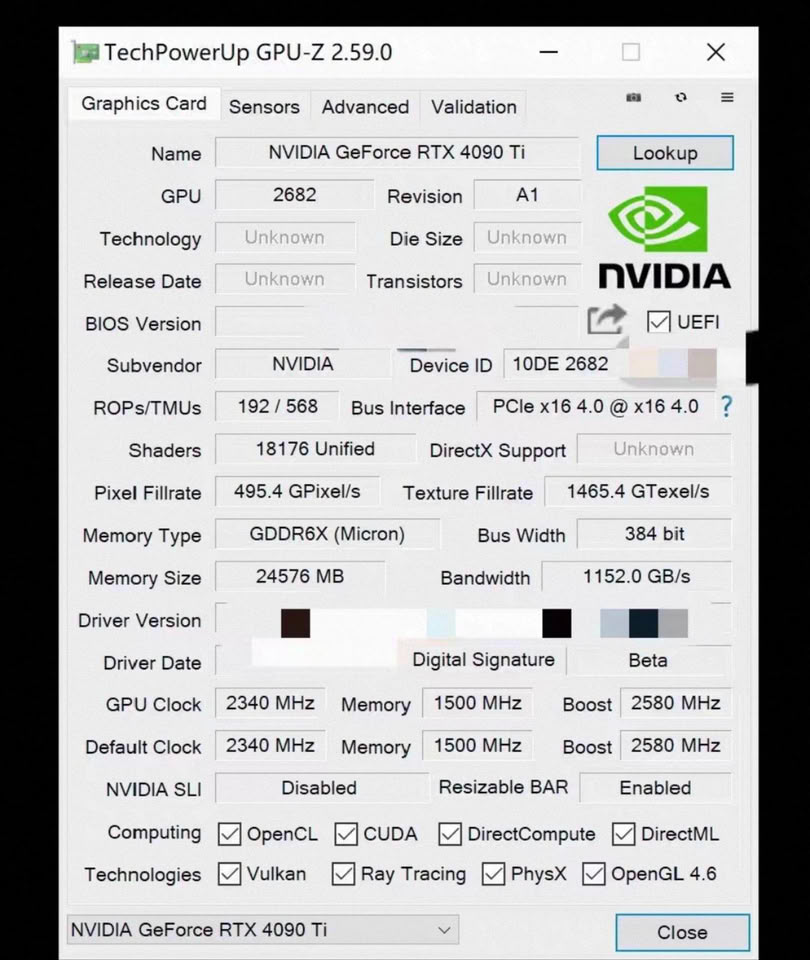
Hardware auditing via unauthorized GPU-Z extractions reveals a device ID of 10DE 2682—distinct from the retail RTX 4090's 10DE 2684 ID—while running on a restricted, internal NVIDIA driver build. The underlying monolithic die configuration unlocks the full potential of the AD102 architecture, scaling up core counts, memory bus width, and operational bandwidth substantially past retail limitations.
| Hardware Metric | NVIDIA GeForce RTX 4090 (Retail) | Unreleased RTX 4090 Ti (Engineering Sample) |
|---|---|---|
| Architecture / Node | Ada Lovelace / TSMC 4N | Ada Lovelace / TSMC 4N |
| Device ID | 10DE 2684 | 10DE 2682 |
| CUDA Cores | 16,384 | 18,176 |
| Render Output Units (ROPs) | 176 | 192 |
| Texture Mapping Units (TMUs) | 512 | 568 |
| Base / Boost Clock | 2,230 MHz / 2,520 MHz | 2,340 MHz / 2,580 MHz |
| VRAM Configuration | 24 GB GDDR6X | 24 GB Micron GDDR6X (24 Gbps) |
| Memory Bus Width | 384-bit | 384-bit |
| Memory Bandwidth | 1,008 GB/s | 1,152 GB/s |
| Target Board Power (TBP) | 450 W | ~600 W (Leaked Spec) |
Thermal, Efficiency & Definitive Verdict
From a pure thermodynamic and electrical efficiency standpoint, the cancellation of the RTX 4090 Ti remains a calculated engineering concession by NVIDIA. While the 11.4% increase in CUDA cores and boosted 24 Gbps Micron VRAM delivering 1,152 GB/s of bandwidth yield formidable theoretical throughput, the jump to a 600-watt thermal ceiling introduces profound cooling and infrastructure complexities for standard consumer desktops. Ultimately, this engineering sample serves as a fascinating silicon relic—a testament to architectural over-provisioning that arrived just before power-to-performance efficiency imperatives permanently reshaped high-end GPU roadmaps.