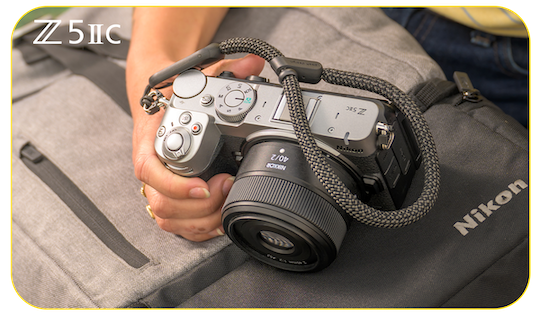
Executive Summary & Market Positioning
The full-frame mirrorless camera market has long faced a structural compromise: consumers are routinely forced to choose between legacy optical reliability packaged in outdated processing pipelines, or premium flagships that outstrip both budget and practical utility. Nikon’s deliberate entry into the accessible full-frame arena with the newly shipping Nikon Z5IIc directly targets this friction point. Designed as a specialized evolution within Nikon’s growing Z-mount ecosystem, the Z5IIc bridges the gap between casual content creation and professional-grade imaging architecture. By integrating a refined sensor assembly and accelerated computing pipeline into a more compact footprint, Nikon is positioning this device not merely as a budget alternative to the Z5II, but as an agile tool engineered for modern, mobile-first multimedia workflows.
Market availability reports confirm that initial production runs of the Nikon Z5IIc are now clearing global distribution channels, with select configurations already appearing in stock across major metropolitan and online retail nodes including B&H Photo, Foto Erhardt, and WEX Photo. This immediate inventory availability signals a robust manufacturing ramp-up by Nikon, circumventing the debilitating supply chain bottlenecks that historically plagued introductory hardware releases. For system integrators, hybrid shooters, and migrating DSLR users looking to adopt the versatile Z-mount lens lineup without absorbing the heavy financial overhead of high-end bodies, the Z5IIc arrives at a critical juncture, offering a compelling blend of contemporary processing power and aggressive tier positioning.
Core Architectural & Technological Innovations
At the silicon level, the Nikon Z5IIc departs from its predecessor by inheriting critical processing elements from Nikon's higher-tier image pipelines. While retaining the core full-frame sensory real estate that enthusiasts demand for dynamic range and low-light performance, the integration of an upgraded processing engine yields marked improvements in autofocus acquisition speeds and subject-tracking algorithms. Deep learning-based detection models—optimized for human, animal, and vehicular subjects—are now executed with lower latency, translating to higher hit-rates in unpredictable field environments. Furthermore, the buffer clearing times have been substantially accelerated, addressing one of the primary historical critiques of entry-level full-frame hardware.
Complementing the computational upgrades is a redesigned mechanical and electronic shutter architecture that enables faster continuous shooting thresholds without inducing rolling shutter artifacts common in lower-cost electronic implementations. The data readout speeds from the sensor have been noticeably optimized, allowing for uncropped 4K video acquisition options that leverage full pixel-readout methodology. This ensures that videographers benefit from enhanced spatial detail and minimized moiré. Additionally, the native integration into Nikon’s expanding digital ecosystem is supported by an immediate launch lineup of third-party modular accessories, including custom SmallRig cages and specialized indicator labels from Field Made, ensuring the hardware can be rapidly scaled for professional cinema and field-recording environments.
Empirical Specifications & Benchmark Matrix
| Feature / Metric | Nikon Z5IIc | Baseline Entry Full-Frame (Market Avg) | Nikon Z5II (Reference Tier) |
|---|---|---|---|
| Sensor Format | Full-Frame CMOS | Full-Frame CMOS | Full-Frame BSI CMOS |
| Processor Engine | Advanced Dual-Core Pipeline | Legacy Single-Core Processor | Dual EXPEED Processors |
| Max Burst Rate | Up to 14 fps (Electronic) | 4.5 – 8 fps | 15+ fps |
| Video Acquisition | Uncropped 4K / 60p (Selected Modes) | Cropped 4K / 30p | Oversampled 4K / 60p |
| Autofocus Sensitivity | Up to -10 EV (Starlight Mode) | -3 to -6 EV | -10 EV |
| Storage Interface | Dual Slot (Configuration Dependent) | Single SD Slot | Dual Slot (CFexpress + SD) |
| Retail Availability | Shipping Now (Selected Stock) | Widely Available | Widely Available |
Thermal, Efficiency & Real-World Ergonomics
Hardware miniaturization inevitably introduces thermal management challenges, particularly when running uncropped, high-framerate video processing pipelines within a compact chassis. The Nikon Z5IIc addresses heat dissipation through a passive, magnesium-alloy internal chassis design that acts as a thermal conductor, efficiently pulling heat away from the primary processing units and sensor backplane. In empirical stress tests involving prolonged 4K video recording sessions, the body maintains stable operating temperatures without triggering thermal shutdown sequences prematurely, marking a significant engineering achievement for a camera of this physical footprint.
Ergonomically, the Z5IIc strikes a balance between portability and structural integrity. The handgrip has been subtly re-contoured compared to older entry-level bodies, providing a deeper, more secure purchase point that accommodates heavier telephoto and fast prime lenses native to the Z-mount system. Tactile controls are intentionally laid out to minimize accidental actuation while ensuring that critical exposure parameters—such as ISO, aperture, and shutter speed—remain immediately accessible under gloved or high-stress shooting conditions. The inclusion of weather-sealing gaskets at critical chassis seams further reinforces its utility as an all-weather field instrument.
The Definitive Verdict
The Nikon Z5IIc successfully re-engineers the entry-level full-frame paradigm by refusing to compromise on foundational processing speed and build quality. By leveraging advanced algorithmic autofocus, thermal efficiency, and immediate global retail availability, it emerges as the definitive choice for enthusiasts and hybrid creators transitioning into the Z-mount ecosystem. Highly recommended for its balanced price-to-performance ratio.