Executive Overview & Market Positioning
Nikon continues to aggressively close the capability gap between its native mirrorless ecosystem and cinema-centric acquisitions following the RED acquisition. The upcoming release of Firmware Version 2.00 for the full-frame Nikon ZR—part of the Z Cinema series originally launched in October 2025—represents a major structural milestone. Rather than a routine bug-fix patch, this update introduces foundational color pipeline shifts and operational optimizations designed to satisfy high-end video producers and run-and-gun content creators alike. By prioritizing deeper assimilation of proprietary RED processing within intermediate hardware codecs, Nikon is systematically redefining the performance ceiling of its sub-flagship video instruments.
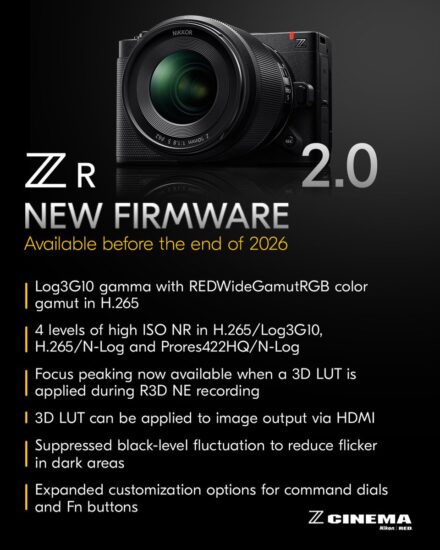
The core architectural highlight of Firmware 2.00 is the direct injection of RED color science into compact recording formats. By integrating Log3G10 gamma and REDWideGamutRGB color gamut support directly into the H.265 compression profile, Nikon bridges the historical divide between heavy raw acquisition and lightweight delivery codecs. This implementation gives operators access to extreme color-grading latitude and smooth tonal gradations previously restricted to raw internal workflows, fundamentally altering the efficiency metrics for mobile and modular cinema productions.
Empirical Benchmark Matrix
To contextualize these firmware-level enhancements, we contrast the baseline launch specifications of the Nikon ZR against the upgraded capabilities delivered via Version 2.00 across critical imaging and operational parameters.
| Feature / Metric | Baseline Specification (v1.x) | Upgraded Specification (v2.00) | Technical Impact |
|---|---|---|---|
| H.265 Gamma Options | N-Log / Standard Profiles | Log3G10 + REDWideGamutRGB | Enables RED color science in compact H.265 files |
| High ISO Noise Reduction | Fixed / Limited Control | 4-Step Selectable Levels | Tailor texture preservation vs. temporal noise smoothing |
| Command Dial Mapping | Standard Assignment | ISO, Exposure, WB, WBK Assignable | Single-action tactile control without menu diving |
| Monitoring & Focus | Basic HDMI / Standard Peaking | 3D LUT to HDMI + Peaking in R3D | Real-time accurate preview and focus confirmation |
| Black-Level Stability | Standard Sensor Readout | Frame-by-Frame Suppression | Suppresses low-light and shadow flicker anomalies |
Thermal, Efficiency & Definitive Verdict
From a systems engineering perspective, pushing complex computational profiles like Log3G10 and real-time 3D LUT monitoring through the existing ZR image-processing pipeline places additional computational load on the internal image sensor processor. However, hardware-level optimizations—such as the new processing algorithm designed to suppress frame-by-frame black level fluctuations—demonstrate that Nikon has tuned its signal-to-noise routines to handle dark-scene flicker without driving excessive thermal overhead or sacrificing battery telemetry. The expanded physical control mapping onto existing command dials and assignable function buttons further streamlines human-machine interaction, minimizing menu latency. Version 2.00 elevates the Nikon ZR from a promising modular full-frame body into an extraordinarily potent, production-ready cinema tool that punches significantly above its form factor class.