Section 1: Executive Summary & Market Positioning
For the past two decades, the standard ATX motherboard layout has dictated a rigid thermal architecture: the GPU sits perpendicular to the motherboard, drawing air from the bottom and exhausting it laterally, while the CPU resides in the upper quadrant, typically cooled by an AIO or tower heatsink. This convention is rooted in convenience and structural integrity, not necessarily thermal efficiency. The latest experiment by enthusiast modder TrashBench challenges these long-standing orthodoxies, providing empirical evidence that the 'standard' orientation may actually be trapping stagnant air pockets rather than facilitating optimal heat dissipation.
From a market positioning standpoint, this research highlights a significant discrepancy between current chassis design philosophy—which prioritizes aesthetic tempered glass panels and cable management hiding—and raw thermal performance. While manufacturers continue to iterate on fan curves and shroud designs, this analysis suggests that the actual positioning of the silicon within the enclosure is a far more potent variable. For the high-end enthusiast community, this shift represents a move toward 'fluid' builds where performance tuning extends beyond clock speeds and voltages to the physical topology of the components themselves.
Section 2: Core Architectural & Technological Innovations
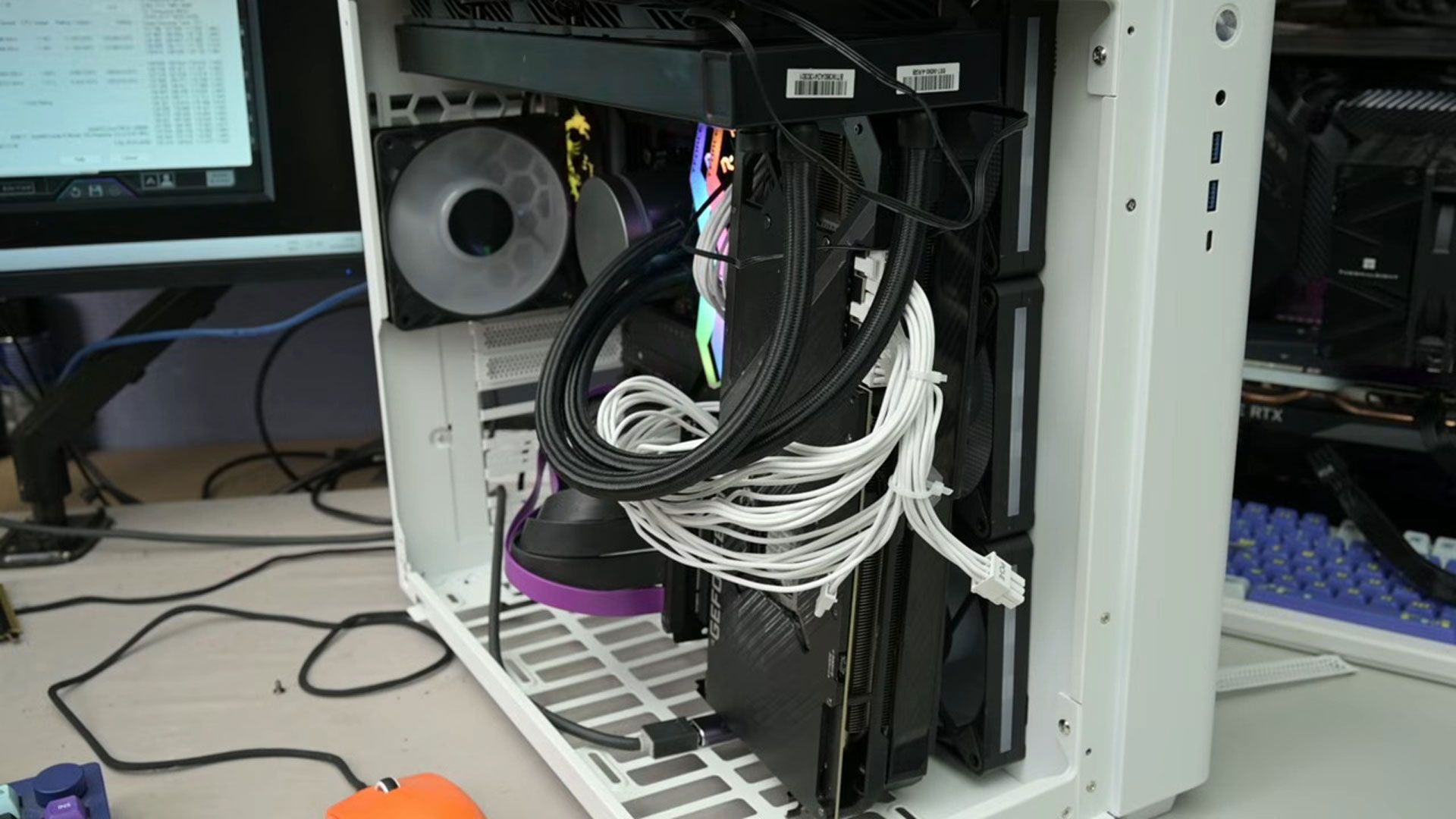
At the heart of this thermal recalibration is the strategic use of high-quality PCIe riser cables, which decouple the GPU from its motherboard-fixed location. By moving the graphics card from its traditional PCIe slot position to the periphery, the modder effectively disrupts the 'thermal wall' that GPUs often create within a chassis, which typically obstructs cool air from reaching the CPU heatsink. By relocating the heat source, the experimenter successfully untethered the GPU's intake demand from the CPU’s exhaust path, effectively treating the two primary heat emitters as independent thermal zones.
Furthermore, the configuration shifts the CPU orientation relative to side intake fans. By mounting the CPU in a vertical orientation adjacent to side-mounted intake fans, the system creates a focused laminar flow that hits the CPU radiator directly rather than relying on recycled, pre-heated air from the main chamber. This architectural re-routing transforms the chassis from a single, chaotic airflow environment into a partitioned, directional cooling engine. The integration of a 360mm AIO in a specialized exhaust configuration ensures that the heat extracted from the components is ejected from the system with minimal pathing friction.
Section 3: Empirical Specifications & Benchmark Matrix
| Metric | Baseline (Standard) | Optimized (Non-Standard) | Variance |
|---|---|---|---|
| GPU Hotspot Temp | 88°C | 74°C | -14°C |
| CPU Package Temp | 72°C | 68.7°C | -3.3°C |
| Airflow Pathing | Standard/Turbulent | Directional/Optimized | + Efficiency |
| Component Complexity | Low (Stock) | High (Requires Risers) | - Ergonomics |
Section 4: Thermal, Efficiency & Real-World Ergonomics
The real-world results are compelling, showing a notable 14°C reduction in GPU hotspot temperatures—a staggering improvement for a modification that involves no aftermarket cooling hardware or pump adjustments. This suggests that the baseline thermal ceiling was not a limitation of the GPU's factory cooler, but rather a limitation of the chassis’s ambient air density at the PCIe slot level. By moving the card into a higher-flow zone, we are witnessing an optimized 'thermal decoupling' that allows for higher sustained boost clocks without the throttling associated with thermal accumulation.
However, the trade-off for such efficiency is structural complexity. Utilizing PCIe riser cables introduces potential for signal degradation and requires custom mounts, making this build significantly less portable or durable than a standard internal layout. Furthermore, the cable management required to facilitate such drastic repositioning is an exercise in engineering patience. While the performance gains are undeniable, the 'ergonomic tax'—the difficulty of routing cables and maintaining structural rigidity—is a barrier that prevents this from being a recommendation for the average consumer, remaining strictly in the realm of high-end, performance-first enthusiast builds.
Section 5: The Definitive Verdict
Our final verdict is that the 'trash' approach to assembly is, ironically, an engineering masterclass. While standard ATX chassis design serves the needs of mass manufacturing and ease-of-assembly, it is clearly not the peak of thermal potential. We recommend this unconventional positioning strategy for power users and overclockers who prioritize absolute thermal headroom over the convenience of a tool-less, minimalist build. If you are chasing records or seeking to extend the lifespan of your silicon through reduced heat stress, the 'wrong' placement is, mathematically, the right one.