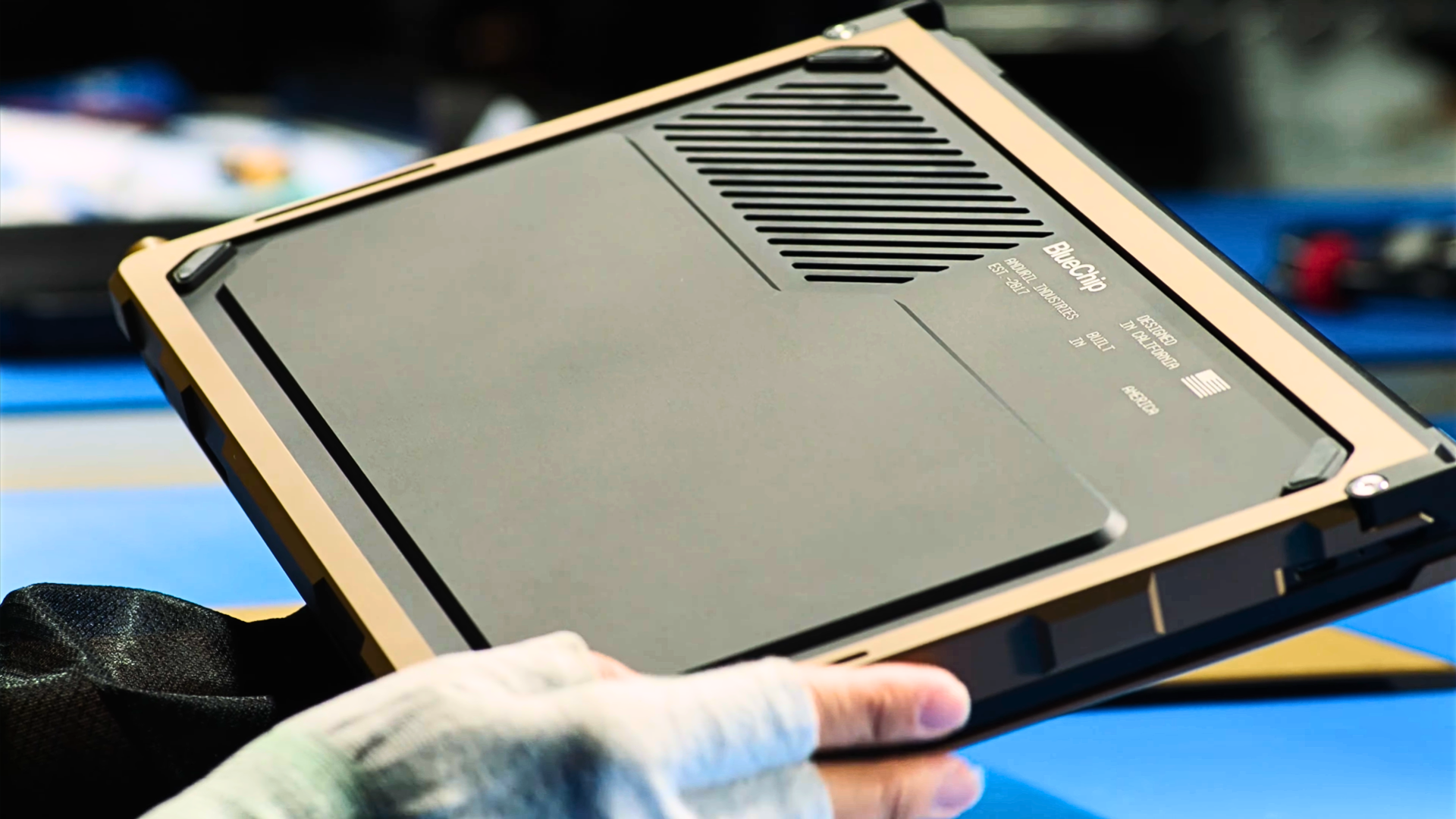
Executive Summary & Market Positioning
The landscape of mobile computing hardware has long been dictated by offshore manufacturing hubs, deeply reliant on complex, fragile trans-Pacific supply chains. Defense contractor Anduril, renowned for its autonomous military systems, is seeking to disrupt this paradigm through its newly announced BlueChip venture. Developed in partnership with Qualcomm, BlueChip aims to pioneer a lineage of high-performance laptops built entirely on United States soil. With functional prototypes already operational and order books slated to open in 2027, this initiative represents a calculated convergence of defense-grade security requirements and commercial silicon architecture.
Targeting mission-critical verticals—including government agencies, defense infrastructure, first responders, and high-security public safety sectors—BlueChip addresses a long-standing vulnerability in Western IT infrastructure: hardware supply chain compromise. While consumer markets prioritize marginal cost optimizations achieved through foreign fabrication, enterprise and defense sectors operate under a different calculus where provenance, supply chain transparency, and tamper-resistance are paramount. By leveraging Qualcomm’s advanced Snapdragon X Series processors and intentionally anchoring 90% of current component procurement costs within the U.S. and allied nations, Anduril is laying the foundational scaffolding for total domestic computer manufacturing independence.
Core Architectural & Technological Innovations
At the silicon heart of the BlueChip ecosystem lies Qualcomm’s Snapdragon X Series System-on-Chip (SoC), an architecture explicitly chosen for its high performance-per-watt profile and integrated neural processing units (NPUs). While traditional x86 architectures dominate legacy enterprise deployments, Qualcomm’s ARM-based Snapdragon X platform provides the requisite computational throughput for on-device artificial intelligence tasks—crucial for edge analytics in tactical environments—while maintaining thermal envelopes suitable for passive or low-noise active cooling configurations. This ensures that field operators benefit from instantaneous machine-learning inferencing without offloading sensitive telemetry to cloud infrastructure.
Beyond the silicon, the true engineering feat of the BlueChip initiative lies in its holistic approach to material science and mechanical assembly. Founder Palmer Luckey and his engineering teams have meticulously sourced domestic alternatives for historically outsourced hardware components. The laptop chassis relies on metals extracted, refined, processed, and milled domestically at scale. Furthermore, critical peripherals—ranging from proprietary battery chemistries to chemically strengthened display glass—are being integrated into an emerging, localized manufacturing pipeline. While complex multi-layer printed circuit boards (PCBs) and specialized display panels still necessitate foreign sourcing in this initial phase, the long-term roadmap targets an absolute end-to-end American supply chain.
Empirical Specifications & Benchmark Matrix
| Specification Parameter | BlueChip Enterprise Target (Projected) | Standard Commercial Enterprise Baseline | Industrial/Tactical Delta |
|---|---|---|---|
| Core Architecture | Qualcomm Snapdragon X Series (ARM) | Intel Core Ultra / AMD Ryzen (x86) | Optimized for high IPC efficiency & dedicated NPU |
| Supply Chain Origin | 90% Allied/U.S. (Targeting 100% domestic) | Primarily Asia-Pacific (Taiwan/China) | Sovereign provenance and tamper mitigation |
| Chassis & Metallurgy | Domestically Milled Aerospace-Grade Alloys | Cast or Extruded Foreign Aluminum | Superior structural rigidity and thermal dissipation |
| Battery Technology | Locally Formulated & Assembled Cells | Imported Lithium-Ion Packs | Enhanced supply-chain traceability |
| Estimated Price Delta | ~20% Premium over baseline | Baseline Commercial Pricing | Premium justified by security compliance |
Thermal, Efficiency & Real-World Ergonomics
Deploying high-performance computing assets in volatile field conditions demands rigorous thermal management and structural resilience. The integration of Qualcomm's Snapdragon X architecture inherently mitigates thermal throttling risks through its advanced power-scaling capabilities. Because the platform delivers competitive multi-core CPU and GPU performance at a fraction of the thermal design power (TDP) required by legacy x86 silicon, BlueChip laptops can maintain quieter acoustics and sustained peak performance under demanding workloads. This efficiency translates directly to extended field endurance, minimizing logistical burdens regarding battery replenishment in remote deployment zones.
Ergonomically, the mechanical engineering behind the BlueChip chassis reflects Anduril's defense heritage. The utilization of domestically milled metals provides exceptional torsional rigidity, protecting internal components against shock, vibration, and environmental ingress. While early adopters should anticipate a roughly 20% cost premium compared to commoditized consumer hardware—a byproduct of domestic labor rates and nascent localized component ecosystems—the mechanical integrity and lifecycle durability offset initial capital outlays. For high-stakes environments, the reliability of a structurally fortified chassis combined with long-duration battery chemistry creates a formidable mobile workstation.
The Definitive Verdict
Anduril’s BlueChip venture, bolstered by Qualcomm’s processing prowess and catalyzed by multi-billion-dollar domestic semiconductor investments (such as TSMC Arizona and Samsung Taylor), marks a watershed moment for American hardware engineering. It transitions the discourse surrounding supply-chain security from theoretical vulnerability assessments to actionable, localized manufacturing. While the phased roadmap acknowledges the sobering reality of rebuilding a dormant industrial base for displays and advanced PCBs, the foundational execution is undeniably robust. For government, defense, and enterprise entities where data integrity and hardware sovereignty supersede raw economic optimization, BlueChip stands as the definitive, forward-looking benchmark for secure mobile computing.