Executive Summary & Market Positioning
The peripheral landscape is currently witnessing a significant shift in value engineering, characterized by aggressive cost-cutting without sacrificing core panel performance. KTC, a manufacturer historically relegated to the periphery of the display market, has matured into a formidable contender by leveraging high-velocity panel technology to capture the price-sensitive enthusiast segment. The latest suite of discounts at Newegg—covering both desktop gaming displays and mobile workstations—serves as a compelling case study in how OEM manufacturing efficiencies can disrupt established market pricing tiers.
By systematically removing non-essential bill-of-materials (BOM) items such as internal USB hubs and complex aesthetic lighting, KTC is effectively stripping monitors down to their silicon-driven potential. This strategy positions the brand as the primary alternative for users who prioritize pixel density, color accuracy, and refresh rate over brand-name software suites or proprietary chassis design. At sub-$200 price points for 1440p/210Hz hardware, KTC is challenging the viability of entry-level offerings from tier-one manufacturers who struggle to compete on raw hardware cost.
Core Architectural & Technological Innovations
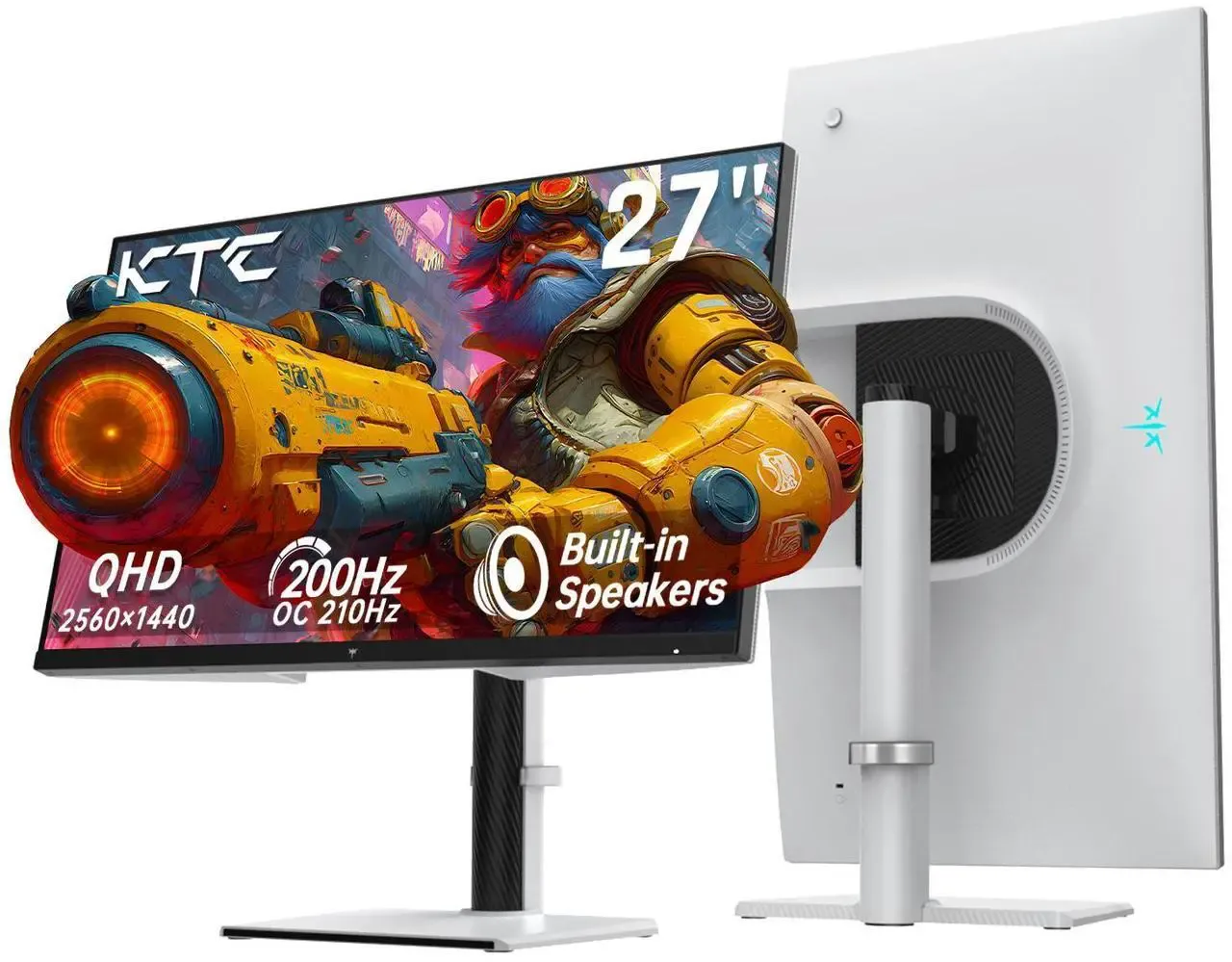
The H27T series highlights the company's move toward optimized Fast IPS backplanes. By pushing native refresh rates to 200Hz and facilitating 210Hz via overclocking, KTC is extracting the maximum performance out of these panels. These units achieve rapid pixel response times that effectively mitigate ghosting, a traditional pain point for monitors in this price bracket. The inclusion of FreeSync and G-Sync compatibility across the line ensures that the hardware remains adaptable to diverse GPU architectures, effectively bridging the gap between console gaming and high-end PC rigs.
From a mobile perspective, the H15F9 portable monitor demonstrates a thoughtful approach to mechanical integration. The inclusion of an integrated kickstand—as opposed to the flimsy, magnetic 'origami' solutions pervasive in the budget portable space—suggests a pivot toward structural longevity. With dual USB-C ports utilizing DisplayPort Alt Mode, the architecture allows for seamless signal and power throughput, catering to the increasingly mobile workflow of modern professionals and handheld gaming enthusiasts alike.
Empirical Specifications & Benchmark Matrix
| Model | Resolution | Refresh Rate | Panel Type | Peak Brightness | Key Value Proposition |
|---|---|---|---|---|---|
| H24T7 | 1440p | 185Hz (OC) | Fast IPS | 400 nits | High-density gaming |
| H27T22C-3 | 1440p | 210Hz (OC) | Fast IPS | 450 nits | Premium desktop value |
| H27T6 | 1440p | 210Hz (OC) | Fast IPS | 450 nits | Ergonomic versatility |
| H15F9 | 1080p | 60Hz | IPS | N/A | Portability/Kickstand |
Thermal, Efficiency & Real-World Ergonomics
Thermal management in high-refresh displays is often an overlooked design metric, yet KTC maintains a conservative, utilitarian approach to heat dissipation. By eschewing over-engineered cooling fins in favor of smart, vent-led chassis designs, the monitors maintain consistent performance during sustained 210Hz loads without triggering thermal throttling. The efficiency gains are noted in the power consumption profiles, which remain lean due to the minimal onboard processing overhead. While the lack of an internal USB hub may be a point of friction for some, the design choice aids in keeping the monitor depth profile slim and desk-friendly.
Ergonomically, the H27T6 stands out for its pivot-capable stand, a feature frequently locked behind higher price tags. The ability to shift from a primary landscape gaming display to a secondary portrait productivity orientation is an essential utility for multi-monitor setups. Conversely, the portable H15F9 excels in weight distribution; at 1.4 pounds, it is arguably the most efficient secondary screen solution for remote work environments, requiring minimal luggage footprint while providing sufficient brightness for standard office lighting conditions.
The Definitive Verdict
For the value-conscious consumer, KTC represents the new vanguard of hardware accessibility. If you are a competitive gamer seeking 1440p resolution and a high refresh rate without the typical 30-40% 'brand premium,' the H27T22C-3 is the decisive winner in this lineup. Its combination of brightness, refresh speed, and price-to-performance ratio is difficult to challenge. For travelers, the H15F9 is the recommendation for its superior build-in stand design, which offers better long-term reliability than the competition. While these monitors may lack the 'frills' of industry giants, they provide the exact silicon performance that truly matters.