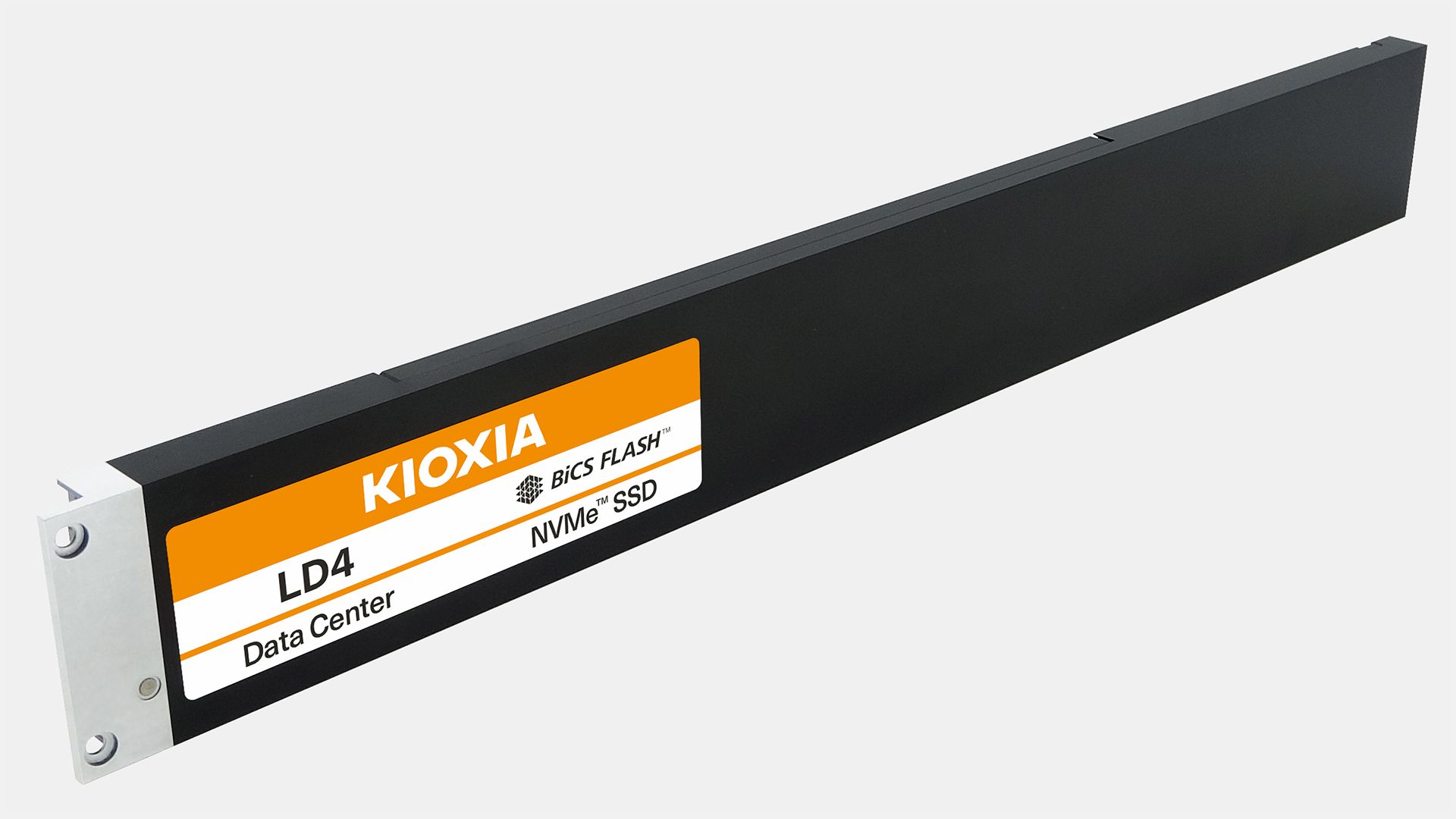
Executive Summary & Market Positioning
Modern hyperscale data centers face an unprecedented architectural bottleneck: explosive AI model training data, multi-petabyte object storage repositories, and deep-learning data lakes require extreme storage density without inflating rack footprints or power budgets. Addressing this systemic challenge, Kioxia has introduced its LD4-series solid-state drives. Built around the elongated E1.L form factor, the LD4 family is engineered specifically for ultra-dense hyperscale infrastructure, scaling up to an astonishing 122.88TB per single drive slot. By leveraging proven BiCS8 3D QLC (Quad-Level Cell) NAND flash, Kioxia aims to capture read-intensive enterprise workflows where cost-per-gigabyte economics and spatial efficiency supersede write endurance.
Positioned squarely at the intersection of high-density flash deployments and Open Compute Project (OCP) server designs, the LD4-series targets cloud service providers (CSPs) and AI infrastructure architects who must pack maximum petabytes into standard 1U server chassis. While initial sampling focuses on more conservative 15.36TB and 30.72TB configurations, the validated architecture for 122.88TB units demonstrates Kioxia’s long-term roadmap commitments. However, competing directly against high-capacity enterprise drives from Samsung and Solidigm, Kioxia enters a fiercely contested market where raw capacity must be backed by transparent endurance metrics and predictable thermal performance.
Core Architectural & Technological Innovations
At the foundational level, the LD4-series exploits the physical geometry of the E1.L (Enterprise and Datacenter Standard Ruler, Long) form factor, measuring 318.75mm in length, 38.4mm in height, and 9.5mm in thickness. This elongated printed circuit board layout allows Kioxia to populate a massive array of BiCS8 3D QLC flash packages onto a single PCB, bypassing the spatial limitations of traditional 2.5-inch U.2 or U.3 drives. This geometric advantage is what ultimately enables multiple high-capacity drives to coexist in thin, OCP-compliant 1U server sleds, vastly improving rack-level storage density.
From a protocol and interface perspective, Kioxia’s proprietary platform complies with the NVMe 2.0e specification and incorporates key requirements from the Open Compute Project Datacenter NVMe SSD Specification 2.6. Interestingly, while the drives feature PCIe 5.0 hardware compliance, Kioxia has chosen to operate them at PCIe 4.0 x4 speeds (up to 16 GT/s per lane). This design choice caps the theoretical maximum bidirectional bandwidth at approximately 7.88 GB/s—a deliberate trade-off. For read-intensive AI repositories and object stores, maximizing raw multi-terabyte density and lowering thermal output via PCIe 4.0 speeds often outweighs the marginal utility of pushing full PCIe 5.0 line rates in high-density, thermally constrained environments.
Empirical Specifications & Benchmark Matrix
| Feature / Metric | Kioxia LD4-Series (Target/Validated) | Baseline Enterprise QLC Standard | Analysis & Implications |
|---|---|---|---|
| Form Factor | E1.L (318.75mm × 38.4mm × 9.5mm) | E1.S / U.3 / 2.5-inch | Optimized for 1U dense OCP server sleds |
| Max Capacity | Up to 122.88TB (Roadmap validated) | 30.72TB – 61.44TB | Quadruples density baseline for hyper-scale storage |
| NAND Technology | BiCS8 3D QLC Flash | BiCS5/6 or 192+ layer QLC | Advanced vertical scaling for cost-effective petabytes |
| Interface & Protocol | PCIe 4.0 x4, NVMe 2.0e, OCP 2.6 | PCIe 4.0 / PCIe 5.0 NVMe | Balanced for power efficiency over raw speed |
| Max Bandwidth | ~7.88 GB/s (Theoretical) | ~7.00 GB/s – 14.00 GB/s | Sufficient for read-heavy object stores & AI data lakes |
| Endurance (DWPD) | Undisclosed by Vendor | 0.5 – 1.0 DWPD (Typical QLC) | Critical metric pending full hardware release |
Thermal, Efficiency & Real-World Ergonomics
Deploying a 122.88TB flash drive inside a dense 1U server chassis presents formidable thermodynamic hurdles. While Kioxia has not yet published explicit power consumption metrics, idle and active thermal dissipation will dictate the success of the LD4-series in production environments. The E1.L form factor inherently accommodates robust thermal solutions, often utilizing built-in heatsinks or efficient chassis airflow channels designed specifically for ruler-type form factors in OCP hardware. Because QLC NAND is sensitive to sustained thermal loads during heavy read operations, the thermal design of the server backplane must efficiently wick heat away from the extended PCB.
Equally vital to real-world deployment economics is the drive's endurance profile and power efficiency ratio (IOPS-per-watt). Because Kioxia has withheld detailed figures regarding Drive Writes Per Day (DWPD), Total Bytes Written (TBW), and active power draw, enterprise architects must approach initial sampling with cautious optimism. In read-intensive AI data ingestion and cold-storage repositories, low idle power and predictable latency distributions are paramount. Without concrete endurance guarantees, hyperscalers will likely run extensive internal qualification cycles on the 15.36TB and 30.72TB sample units before approving the architecture for the ultimate 122.88TB tier.
The Definitive Verdict
Kioxia’s LD4-series E1.L SSD architecture represents a major step forward in enterprise storage density, directly tackling the physical scaling limits of modern data centers. By harnessing BiCS8 QLC NAND and an OCP-compliant E1.L footprint, Kioxia has engineered a viable path toward 122.88TB per drive slot—a game-changer for hyperscale AI repositories and object storage farms.
However, the lack of published performance figures, IOPS ratings, and endurance metrics leaves critical engineering questions unanswered for now. While the hardware roadmap is undeniably impressive, widespread enterprise adoption will hinge on the empirical validation of thermal stability and write endurance during live production sampling. For forward-thinking cloud architects, the LD4-series warrants immediate inclusion in evaluation pipelines, provided internal testing aligns with Kioxia's high-density promises.