Executive Summary & Market Positioning
The debut of Apple’s long-anticipated foldable entry, the iPhone Duo, has decisively altered the competitive landscape of book-style foldable smartphones. For years, Samsung’s Galaxy Z series has anchored the foldable market largely uncontested, iterating on hinges, thinness, and software optimization. However, fresh regulatory filings from the European Product Registry for Energy Labelling (EPREL) have laid bare the exact power and durability metrics of Apple's first foldable entrant, challenging the status quo. The iPhone Duo enters the market not just as a proof of concept, but as a heavily funded engineering statement designed to capture high-end enterprise and consumer segments.
While marketing narratives often lean heavily on raw device thickness and marketing-speak typical capacities, empirical data tells a more granular story. Apple has managed to pack a larger aggregate energy reserve into its chassis than Samsung’s baseline Galaxy Z Fold 8, yet hardware trade-offs remain stark. The battle lines are no longer drawn simply around who can make a thinner folding chassis, but rather how tightly coupled power density, chemical longevity, and structural robustness truly are under stress testing.
Core Architectural & Technological Innovations
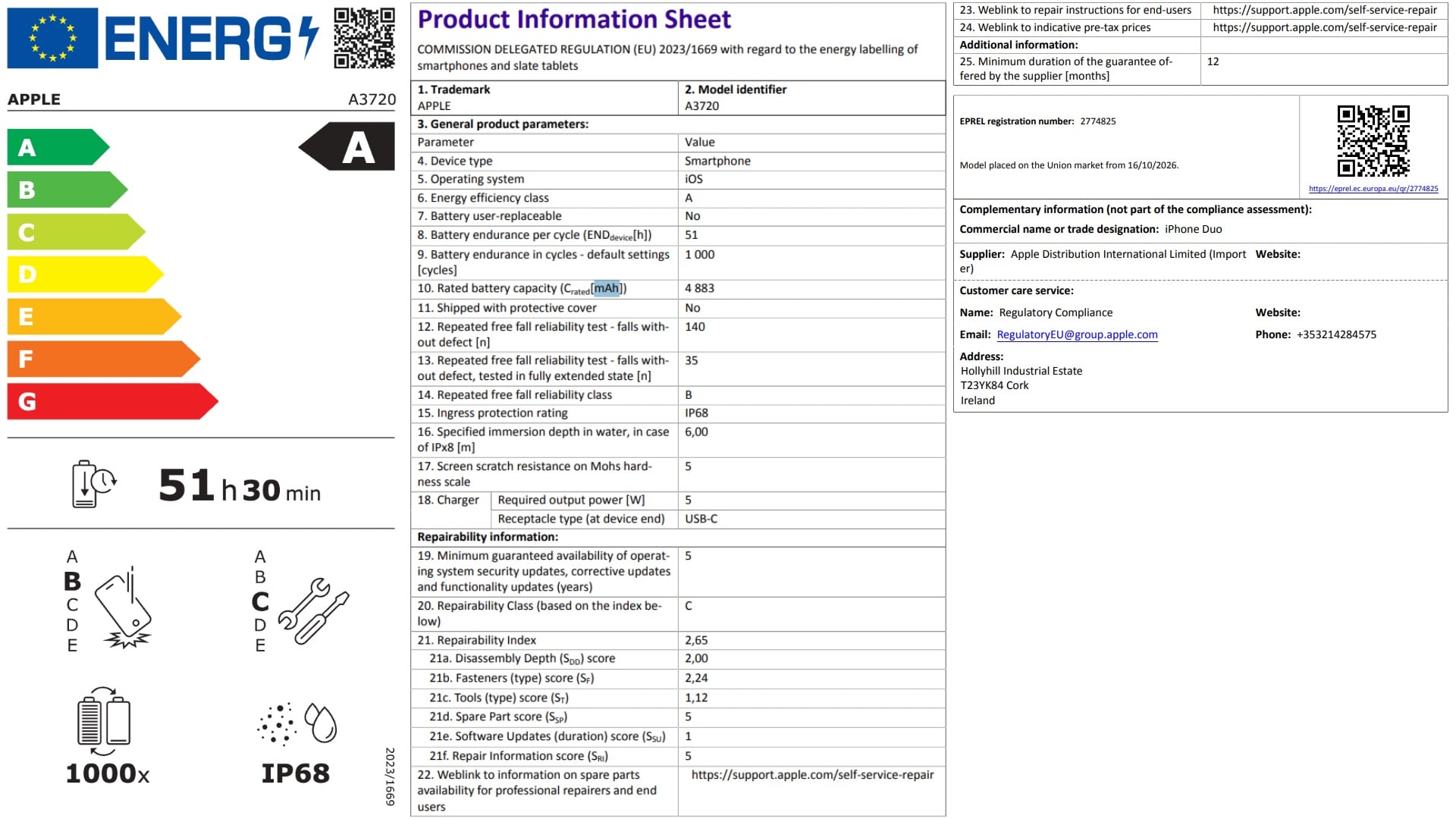
At the silicon and chassis level, engineering a book-style foldable demands immense compromises. Apple's EPREL disclosures verify that the iPhone Duo operates on a combined rated battery capacity of 4,883mAh. This edges out the standard Galaxy Z Fold 8, which relies on a rated capacity of 4,660mAh (marketed typically at 4,800mAh), and even surpasses the nominal rated 4,854mAh of the heavy-duty Galaxy Z Fold 8 Ultra. Achieving this chemical storage within a folding architecture required aggressive internal space management, likely relying on multi-cell pouch configurations contoured to the dual-housing layout.
Yet, raw capacity does not tell the whole story of thermodynamic and chemical health. Samsung counters Apple’s volumetric advantage with superior materials science in its cell chemistry and structural integrity. The Galaxy Z Fold 8 series is rated for 1,200 full charge cycles before dropping below standard degradation thresholds, whereas the iPhone Duo maxes out at 1,000 cycles. Furthermore, Samsung's foldables secure a Class B free-fall reliability rating, outperforming the iPhone Duo’s Class C score, even though Apple managed a class-leading IP68 dust and water ingress rating compared to Samsung's IP48 framework.
Empirical Specifications & Benchmark Matrix
| Specification Metric | Apple iPhone Duo | Samsung Galaxy Z Fold 8 | Samsung Galaxy Z Fold 8 Ultra |
|---|---|---|---|
| Rated Battery Capacity | 4,883 mAh | 4,660 mAh | 4,854 mAh |
| Marketed Typical Capacity | 4,900 mAh (Estimated) | 4,800 mAh | 5,000 mAh |
| Standard Battery Endurance | 51h 30m | 44h 10m | 51h 10m |
| Long-Term Cycle Longevity | 1,000 Cycles | 1,200 Cycles | 1,200 Cycles |
| Ingress Protection (IP) Rating | IP68 | IP48 | IP48 |
| Free-Fall Structural Rating | Class C | Class B | Class B |
Thermal, Efficiency & Real-World Ergonomics
Power efficiency in a dual-screen foldable hinges heavily on display panel power consumption and mobile processor thermal throttling profiles. EPREL’s standardized testing protocol clocks the iPhone Duo’s battery endurance at 51 hours and 30 minutes per charge cycle. While robust, this sits slightly behind the monolithic slate iPhone 18 Pro (52 hours) and significantly trailing the iPhone 18 Pro Max (62 hours), illustrating the inherent energetic toll of driving a large folding internal display panel. By comparison, the baseline Galaxy Z Fold 8 lags behind at 44 hours and 10 minutes, though the larger Z Fold 8 Ultra matches parity with Apple at roughly 51 hours and 10 minutes.
Ergonomically, Samsung still retains an edge in physical dimensions, engineering a noticeably thinner and lighter chassis profile than Apple's debut iteration. The iPhone Duo compensates for this slight volumetric penalty with its IP68 dust resistance—a historical engineering hurdle for folding displays that Apple cleared on its very first attempt. Nonetheless, real-world users must weigh whether Apple's marginal gains in daily endurance and dust ingress resistance outweigh Samsung's proven advantages in structural drop survival and long-term chemical battery lifespan.
The Definitive Verdict
From an analytical standpoint, the iPhone Duo is an extraordinary engineering debut that successfully matches or beats Samsung on raw daily endurance (51h 30m vs. 44h 10m) and achieves a milestone IP68 rating. However, Samsung's Galaxy Z Fold 8 retains a decisive edge in long-term hardware sustainability—offering 200 more charge cycles and a superior Class B drop rating—while maintaining a more refined, thinner physical footprint. For short-term endurance and maximum ingress protection, the iPhone Duo wins; for multi-year structural longevity and ergonomics, Samsung holds the crown.