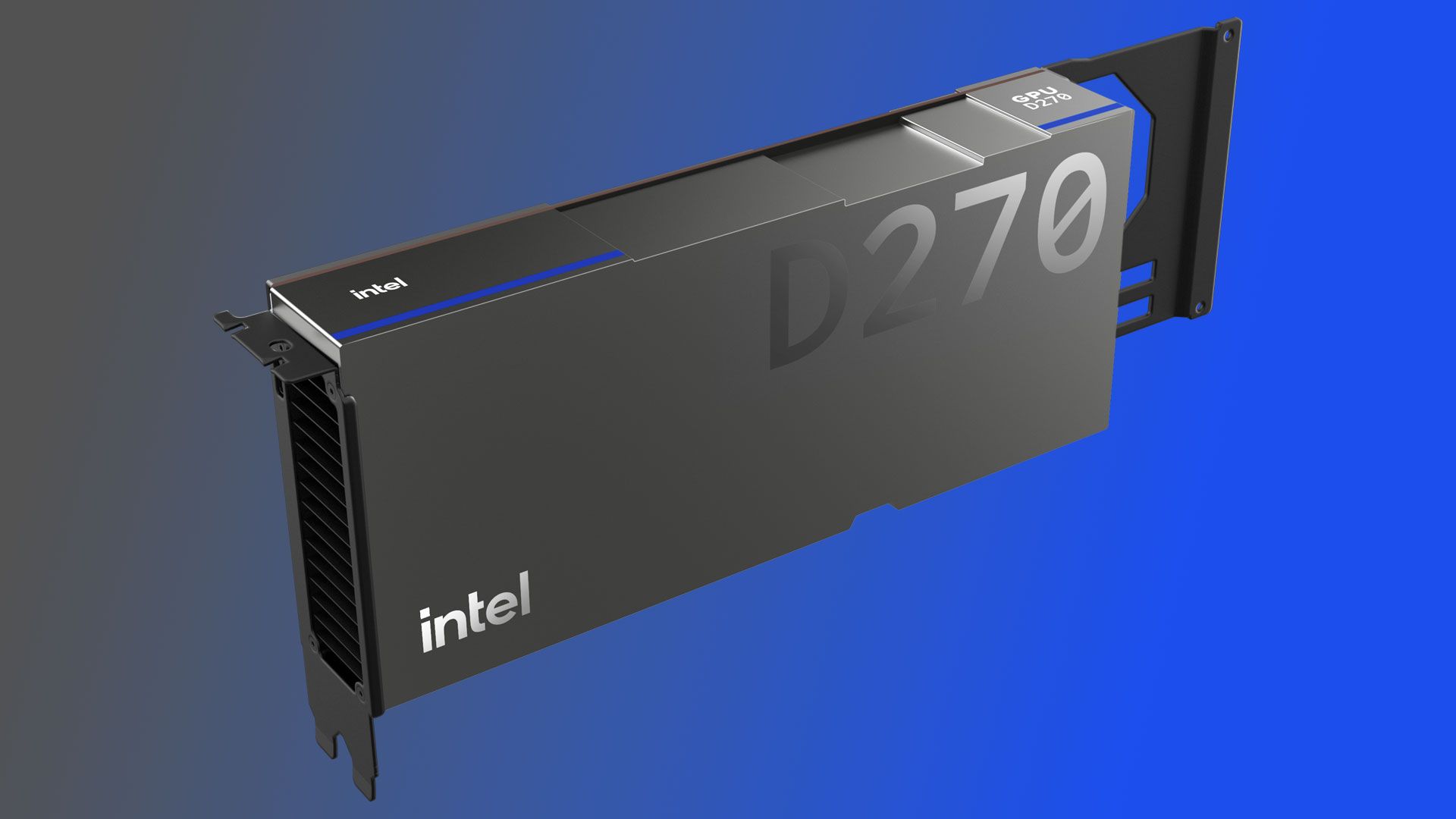
Executive Summary & Market Positioning
Intel’s formal unveiling of the GPU D-Series—formerly known by the codename "Crescent Island"—represents a pivotal strategic pivot for the company’s data center aspirations. Following the turbulent performance of the Data Center GPU Max (Ponte Vecchio) and the subsequent dissolution of its broader high-end accelerator roadmaps, the GPU D-Series signals a departure from competing directly with Nvidia’s ultra-high-end H100/Rubin flagships. Instead, Intel is positioning this silicon as an air-cooled, inference-optimized powerhouse, targeting the massive, underserved market of enterprise rack-scale servers that lack the infrastructure for liquid-cooled, multi-kilowatt per-GPU thermal densities.
The D-Series is effectively an admission that the path to market relevance lies in accessibility and thermal pragmatism rather than absolute, singular-die performance. By prioritizing a 350W TDP and traditional PCIe form factors, Intel is courting the vast population of legacy and current-gen AI infrastructure environments. This is a "bread and butter" strategy, aiming to provide a coherent, scalable solution for multi-tenant inference, robotics, and edge-heavy AI tasks where power-per-watt and operational simplicity take precedence over peak training throughput.
Core Architectural & Technological Innovations
At the heart of the D-Series lies the Xe3P architecture, a specialized derivation of Intel’s graphics foundation that has been stripped of traditional rasterization and geometry pipelines. This is not a GPU in the conventional sense, but rather a massively parallel computing engine designed specifically for the data-intensive nature of inference. The focus here is on high-bandwidth throughput, evidenced by the 1.5 TB/s memory bandwidth, which is critical for preventing the bottlenecks inherent in loading large-parameter models into local buffers during concurrent inferencing sessions.
Intel’s commitment to the "common Xe software foundation" is the linchpin for this hardware's success. Historically, the Achilles' heel of Intel’s discrete accelerator efforts has been the disconnect between silicon capability and software maturity. By anchoring the D-Series to an established software ecosystem that permeates their integrated and discrete mobile/desktop offerings, Intel is attempting to lower the barrier to entry for developers. The goal is to provide a seamless transition for models optimized for Xe-based mobile platforms to be deployed at scale on D-Series racks, effectively creating a unified AI deployment path from edge to data center.
Empirical Specifications & Benchmark Matrix
| Specification | Intel GPU D-Series | Nvidia Rubin (Est. Per GPU) | Market Segment |
|---|---|---|---|
| Architecture | Xe3P | Vera Rubin | Inference/Training |
| FP8 Peak Perf | 1.3 PFLOPS | 17.5 PFLOPS | Scaling |
| Memory BW | 1.5 TB/s | N/A (HBM4) | Throughput |
| TDP | 350W | 1000W+ | Thermal Envelope |
| Cooling | Air | Liquid | Infrastructure |
Thermal, Efficiency & Real-World Ergonomics
By capping the GPU D-Series at 350W, Intel has effectively bypassed the most significant hurdle for many enterprise clients: liquid cooling retrofits. In the modern data center, the overhead of installing advanced cooling infrastructure for a small cluster of AI servers is often cost-prohibitive. The D-Series provides a "drop-in" capability for existing air-cooled rack environments, allowing businesses to scale their inference capacity up to eight GPUs per node without triggering a massive overhaul of their power delivery or cooling systems.
Furthermore, the integration of up to 480GB of LPDDR5X memory addresses the demand for large-parameter model support in a compact footprint. While LPDDR5X trades off some absolute speed compared to HBM3/4, its efficiency and cost profile are ideal for long-context inference and multi-tenant services. This ensures that the D-Series remains viable for long-tail, latency-sensitive applications where the goal is maximizing the number of simultaneous user requests rather than pushing a massive model to finish a training epoch in record time.
The Definitive Verdict
Intel’s GPU D-Series is a calculated, realistic product that aligns with the current state of the industry: a desperate need for efficient, accessible inference hardware. It is not an "Nvidia killer" in the sense of pure performance, nor does it aim to be. Instead, it is an essential piece of the puzzle for enterprises that cannot, or will not, embrace the extreme liquid-cooled requirements of the current flagship AI chips. Provided that Intel’s driver stack and software ecosystem hold up under real-world deployment, the D-Series could be the most pragmatic accelerator in the company's recent history. For organizations prioritizing inference scale and operational cost, the D-Series is highly recommended as a primary deployment candidate.