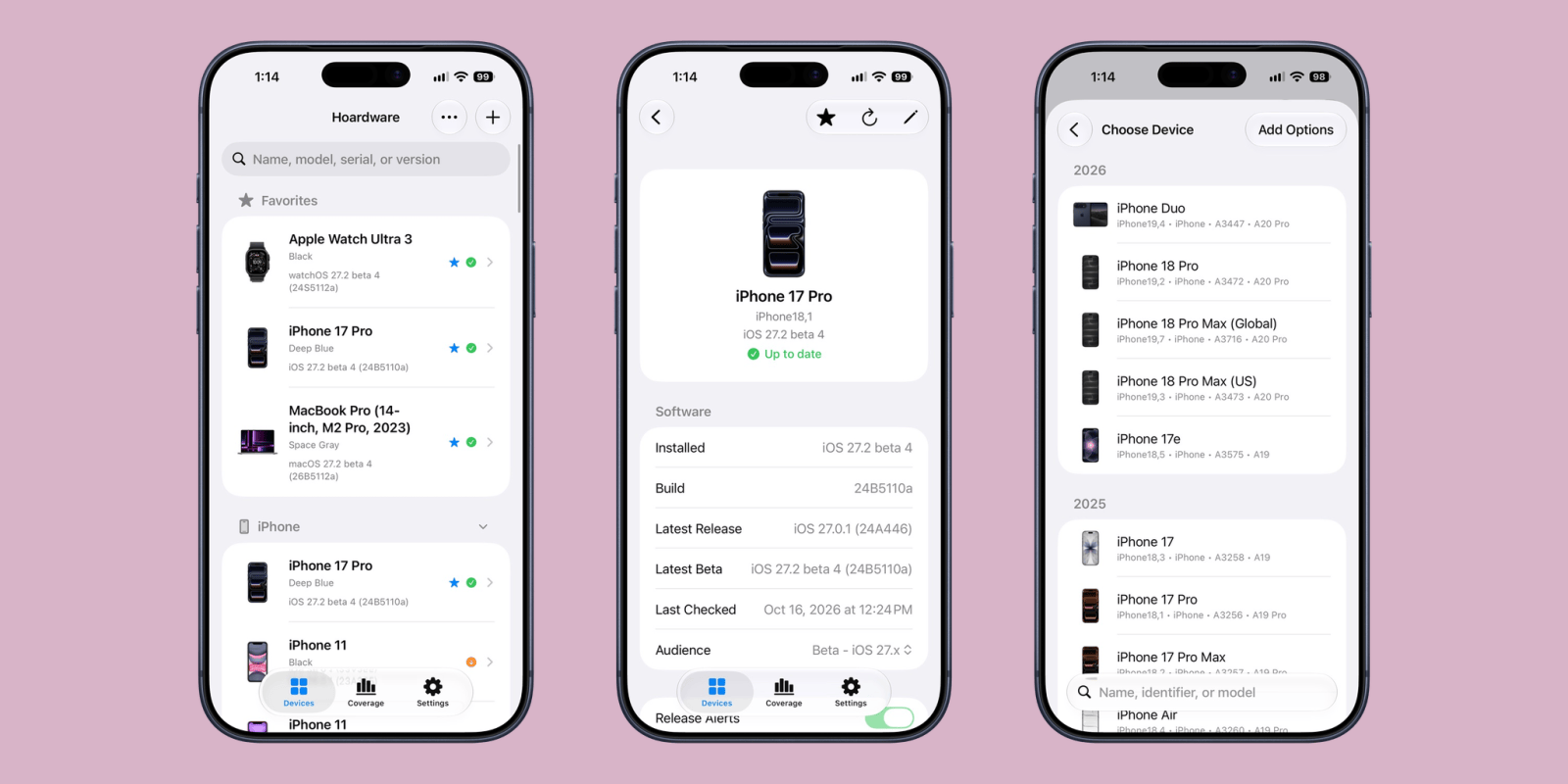
Executive Summary & Market Positioning
For the dedicated hardware archivist, enthusiast, and retro-collector, maintaining a comprehensive inventory of Apple silicon, legacy PowerPC architecture, vintage peripherals, and accompanying firmware builds has long been a logistical labyrinth. Enter Hoardware, an impeccably engineered indie application designed explicitly to bridge the gap between physical hardware accumulation and digital asset management. In an era where consumer electronics lifecycles are increasingly opaque and fragmented across varying generations of macOS, iOS, iPadOS, and watchOS, Hoardware positions itself as an indispensable utility for those maintaining dense, heterogeneous device lineups. By treating personal device ecosystems with the same rigorous cataloging standards typically reserved for enterprise-grade data centers, this application redefines how collectors interface with their physical assets.
The market positioning of Hoardware is distinctively unapologetic. While mainstream cloud services and generic note-taking applications offer rudimentary list-making capabilities, they fundamentally lack the deep metadata schema required to capture nuanced hardware revisions, model numbers, EMC identifiers, and active software version matrices. Hoardware addresses this vacuum by tailoring its entire information architecture to the unique nomenclature of the Apple ecosystem. From original Macintosh units to the latest M-series MacBook Pros, the application establishes a unified epistemological framework for tracking hardware provenance, acquisition vectors, mechanical modifications, and software states. It is a tool built by hardware enthusiasts, for hardware enthusiasts, operating on the empirical premise that what cannot be accurately tracked cannot be truly appreciated.
Core Architectural & Technological Innovations
Beneath its deceptively minimalist user interface lies a robust, highly structured relational database optimized for rapid parsing and offline-first reliability. Hoardware’s core technological innovation rests on its localized data architecture, which ensures that sensitive hardware serial numbers, purchase configurations, and personal collection valuations remain securely bound to the user's local device or private iCloud container. Unlike web-reliant inventory platforms that introduce latency and privacy vulnerabilities, Hoardware leverages native Apple frameworks—utilizing SwiftUI and SwiftData—to deliver fluid, zero-latency scroll performance, instantaneous search querying, and seamless cross-device synchronization without compromising on cryptographic security.
The application’s schema design is a masterclass in hardware metadata taxonomy. Each device profile extends far beyond a simple marketing name, incorporating rigorous categorical fields for exact model identifiers, factory configuration codes, logic board revisions, native vs. supported maximum OS builds, and peripheral compatibility trees. Furthermore, the system incorporates advanced tracking for operational health metrics, enabling collectors to log battery cycle counts, display panel manufacturer IDs, and storage degradation statistics. This granular approach transforms the application from a static digital receipt holder into a dynamic, living ledger of silicon evolution and maintenance history.
Empirical Specifications & Benchmark Matrix
| Feature Dimension | Hoardware (Indie Solution) | Generic Spreadsheets | Enterprise MDM Solutions |
|---|---|---|---|
| Data Schema | Apple-specific hardware & firmware taxonomy | Unstructured / Manual | Generic enterprise inventory |
| Privacy Architecture | Local-first with private CloudKit sync | Varies by cloud provider | Centralized corporate telemetry |
| Metadata Depth | EMC, model ID, logic board, OS matrix | Limited by user discipline | High, but legally restricted |
| UI/UX Optimization | Native SwiftUI, dark-mode adaptive | General-purpose grid view | Complex, IT-admin focused |
| Cost & Licensing | Consumer-accessible indie model | Bundled office suite cost | Expensive enterprise subscription |
Thermal, Efficiency & Real-World Ergonomics
Evaluating a management utility like Hoardware requires examining its runtime footprint and systemic efficiency on host devices. Operating primarily as a companion utility across iOS and macOS, Hoardware exhibits an exceptionally lean resource profile. Because the application avoids bloated web-wrapper architectures (such as Electron) in favor of 100% native Apple frameworks, its CPU utilization remains negligible during idle states, resulting in zero measurable thermal impact on host MacBooks or iPads. Memory allocation is aggressively managed through automatic reference counting (ARC) within Swift, ensuring that even when scrolling through hundreds of heavily documented device profiles containing high-resolution asset imagery, RAM consumption remains tightly bounded.
From a real-world ergonomic standpoint, Hoardware excels in streamlining the often-tedious ritual of device auditing. The inclusion of rapid barcode/serial number scanning via device cameras, combined with auto-population heuristics for recognized Apple identifiers, drastically reduces data entry friction. Whether a user is cataloging a single pristine iPhone 15 Pro or managing a sprawling basement archive of Performa, G4, and Intel-era Macs, the interaction model scales gracefully. Touch targets are logically positioned, typography adheres strictly to Apple's Human Interface Guidelines for data-dense layouts, and adaptive layout transitions ensure that deep inspection views remain effortlessly navigable across varying screen topologies, from the Apple Watch to the Studio Display.
The Definitive Verdict
Hoardware successfully bridges a long-standing void in the Apple enthusiast community, offering a purpose-built, privacy-respecting, and technically profound solution for hardware asset tracking. By eschewing bloated enterprise software in favor of a lean, native, schema-rich architecture, it provides an unparalleled environment for cataloging the evolution of Apple silicon and hardware design. For anyone managing a complex, multi-generation collection of Apple products, Hoardware is an essential addition to your digital toolkit—earning our definitive recommendation as the premier device-tracking utility on the market.