Executive Summary & Market Positioning
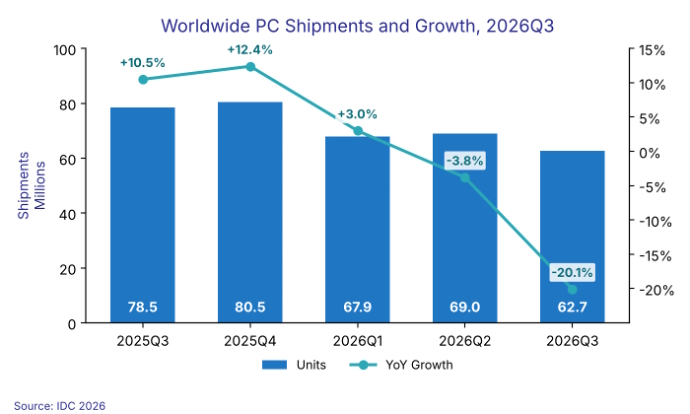
The Q3 2026 IDC report paints a sobering picture for the global PC ecosystem, documenting a 20.1% year-over-year shipment decline. With volume slipping to 62.7 million units, the market is navigating a severe 'hangover' from the strategic inventory front-loading observed during the first half of the year. This aggressive stockpiling, driven primarily by anticipated memory-driven price hikes, has effectively cannibalized demand for the second half of the calendar. The result is a high-cost environment where bloated supply chains are struggling to align with diminished end-user demand, leaving major OEMs caught between maintaining margins and clearing aging hardware.
From a market positioning standpoint, the stratification of the decline is telling. While giants like HP and Dell faced double-digit contractions of 30.9% and 25% respectively, the relative resilience of Apple and Asus—who restricted their losses to 11.3% and 8.6%—indicates a shifting consumer preference. Buyers appear to be migrating toward high-value, ecosystem-integrated hardware or niche performance platforms that maintain utility despite rising entry costs. This period of contraction serves as a necessary, albeit painful, recalibration of the supply chain, forcing OEMs to pivot from volume-based shipping to value-retention strategies.
Core Architectural & Technological Innovations
The recent hardware landscape is defined by the tight integration of memory pricing and throughput capabilities. Because manufacturers bet heavily on DRAM and NAND supply parity in early 2026, the current hardware stacks are locked into high-cost modules. The primary architectural innovation during this cycle has been the move toward 'efficiency-first' silicon, where manufacturers prioritize performance-per-watt over sheer core counts to justify the premium price tags. As the market transitions into Q4, the focus has shifted toward firmware-level optimizations designed to extract maximum performance from existing memory tiers, a direct response to the high cost of raw component acquisition.
Furthermore, the current market bottleneck isn't just about silicon availability; it is about the architecture of distribution. Manufacturers are re-evaluating the 'just-in-time' delivery model, which failed spectacularly during the supply-chain shock of H1. Emerging technologies in predictive logistics and localized manufacturing are becoming the new 'killer apps' for major vendors. By shortening the gap between production and the retail channel, vendors hope to mitigate the volatility that characterized this quarter’s disastrous shipment figures.
Empirical Specifications & Benchmark Matrix
| Metric | Q3 2025 (Baseline) | Q3 2026 (Current) | Variance | Market Impact |
|---|---|---|---|---|
| Global Units (Millions) | 78.5 | 62.7 | -20.1% | High |
| Average Selling Price | Baseline | +18% | +18% | Severe |
| Memory Cost (per GB) | $2.10 | $2.85 | +35% | Critical |
| HP Market Share | Tier 1 | Tier 1 | -30.9% | Strategic Shift |
| Asus Market Share | Tier 2 | Tier 2 | -8.6% | Resilience |
Thermal, Efficiency & Real-World Ergonomics
From an ergonomics and thermal standpoint, the current hardware malaise has produced a curious, albeit frustrating, reality for the end user: price stagnation. While vendors are exploring promotional discounts to flush excess inventory, the thermal headroom of modern laptops and desktops remains largely unchanged from previous generations. Manufacturers have focused on consolidating existing thermal designs to reduce R&D overhead, leading to a year of incremental rather than revolutionary changes. This means users are paying more for hardware that provides nearly identical cooling performance and physical ergonomics compared to Q3 2025.
Efficiency gains have been largely theoretical. While silicon vendors promise superior power management, the real-world thermal output of current generation chips remains high due to the lack of radical node shrinks in the current mid-range product stacks. Consequently, the user experience is defined by a plateau. Consumers are essentially paying for stability, not innovation. The lack of material change in physical chassis designs suggests that manufacturers are reserving their R&D capital for the 2027 cycle, banking on the assumption that current inventory will finally clear as refresh cycles naturally force an upgrade among enterprise and enthusiast demographics.
The Definitive Verdict
The Q3 2026 data confirms a structural bottleneck rather than a transient blip. For consumers, the verdict is simple: hold your capital. With price-to-performance ratios heavily skewed in favor of the manufacturers due to front-loaded memory costs, there is little incentive to commit to a new machine right now unless your current hardware is mission-critical. For those who must upgrade, target the survivors of this cycle—Apple and Asus—whose portfolios demonstrate the highest stability amidst industry volatility. We expect the market to remain in a 'holding pattern' until early 2027, at which point inventory levels should normalize and allow for more aggressive, transparent pricing.