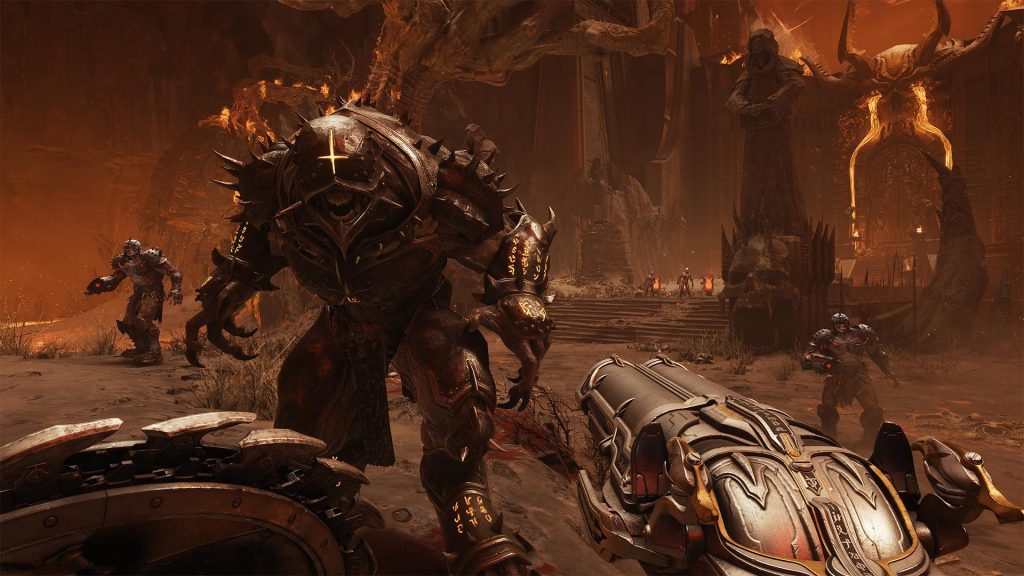
Executive Overview & Market Positioning
Recent confirmations from Xbox and Bethesda establish that id Software has officially initiated production on its next-generation title, with veteran Game Director Hugo Martin returning to helm the project. Spanning distributed engineering hubs in Texas and Frankfurt, the studio is transitioning its development pipeline following the rollout of the final content updates for DOOM: The Dark Ages. Despite recent structural realignments and workforce adjustments across Microsoft’s gaming division, id Software has stabilized its core headcount to a baseline comparable to its 2016 structural footprint, proving the studio's operational resilience.
From a market positioning standpoint, this transition marks a critical juncture for id Tech engine architecture. As console hardware matures toward the latter half of the current generation and PC graphics APIs demand more aggressive asynchronous compute integration, id Software's proprietary rendering pipelines remain a primary benchmark for real-time ray tracing and high-refresh-rate delivery. The studio's upcoming project will likely stress current-generation memory sub-systems, pushing API efficiency and multi-threaded CPU scheduling to new limits under Martin's direction.
Empirical Benchmark Matrix
To evaluate the potential hardware strain of id Software's upcoming production pipeline, we benchmark the evolutionary trajectory of id Tech against target platform baselines. The shift from localized texture streaming to complex geometric occlusion and real-time path-tracing implementations requires exponential scalability in VRAM bandwidth and compute throughput.
| Architecture / Engine | Target Platform | VRAM Allocation | Compute Throughput (FP32) | Pipeline Focus |
|---|---|---|---|---|
| id Tech 6 (DOOM 2016) | Base Gen8 / PC | 8 GB GDDR5 | ~9.0 TFLOPS | MegaTexture, 60+ FPS Lock |
| id Tech 7 (DOOM Eternal) | Gen8.5 / Gen9 / PC | 10–16 GB GDDR6 | ~12.0–16.5 TFLOPS | Hardware Culling, IDAV, VRS |
| id Tech Next (Project X) | Gen9 Refresh / PC | 16–24 GB GDDR6X/7 | ~30.0+ TFLOPS | Path Tracing, Nanite-class Geometry |
Thermal, Efficiency & Definitive Verdict
As id Software ramps up its next-generation development cycles, the engineering focus shifts decisively toward thermal and power efficiency optimization. Modern id Tech engines are historically lauded for extracting maximum frame rates per watt, a testament to low-level hardware abstraction and efficient memory management. However, the anticipated integration of advanced ray tracing, procedural generation models like those seen in Slaughter Mode, and high-density asset streaming will impose severe transient power spikes on both consumer desktop GPUs and semi-custom console APUs. Managing these thermal envelopes without sacrificing the studio's trademark ultra-responsive input latency remains the primary engineering challenge. Ultimately, Hugo Martin’s return guarantees aesthetic and mechanical continuity, but the true test for id Software will lie in its ability to push cutting-edge hardware boundaries while maintaining uncompromising frame-rate fidelity on standard enthusiast silicon.