Executive Summary & Market Positioning
The foldable smartphone landscape is undergoing a aggressive bifurcation, separating consumer-grade iterations from ultra-premium, localized flagship devices. Samsung’s regional strategy for the Greater China market continues to pivot on its specialized 'W' series—a lineage engineered to outclass standard global foldables in both material execution and aesthetic opulence. Following industry disclosures by prominent hardware tipster Ice Universe, the forthcoming Samsung W27 has surfaced as the definitive luxury variant tied directly to the anticipated Galaxy Z Fold 8 Ultra architecture. Rather than relying on simple cosmetic refreshes, Samsung’s engineering group has historically leveraged this tier to introduce bespoke structural finishes, high-density component selections, and exclusive software configurations tailored to demanding power users.
Positioned firmly at the apex of the mobile hardware hierarchy, the W27 targets an elite demographic that demands uncompromised computational density wrapped in distinct metallurgical styling. By building upon the baseline framework of the Z Fold 8 Ultra, the W27 bypasses the standard constraints of mass-market consumer availability, establishing a distinct testing ground for Samsung’s most advanced mechanical hinges and sensor arrays. As original equipment manufacturers race to minimize chassis thicknesses while maximizing battery longevity and thermal dissipation, the W-series acts as an uninhibited showcase of what Samsung’s supply chain can achieve when production cost ceilings are effectively removed.
Core Architectural & Technological Innovations
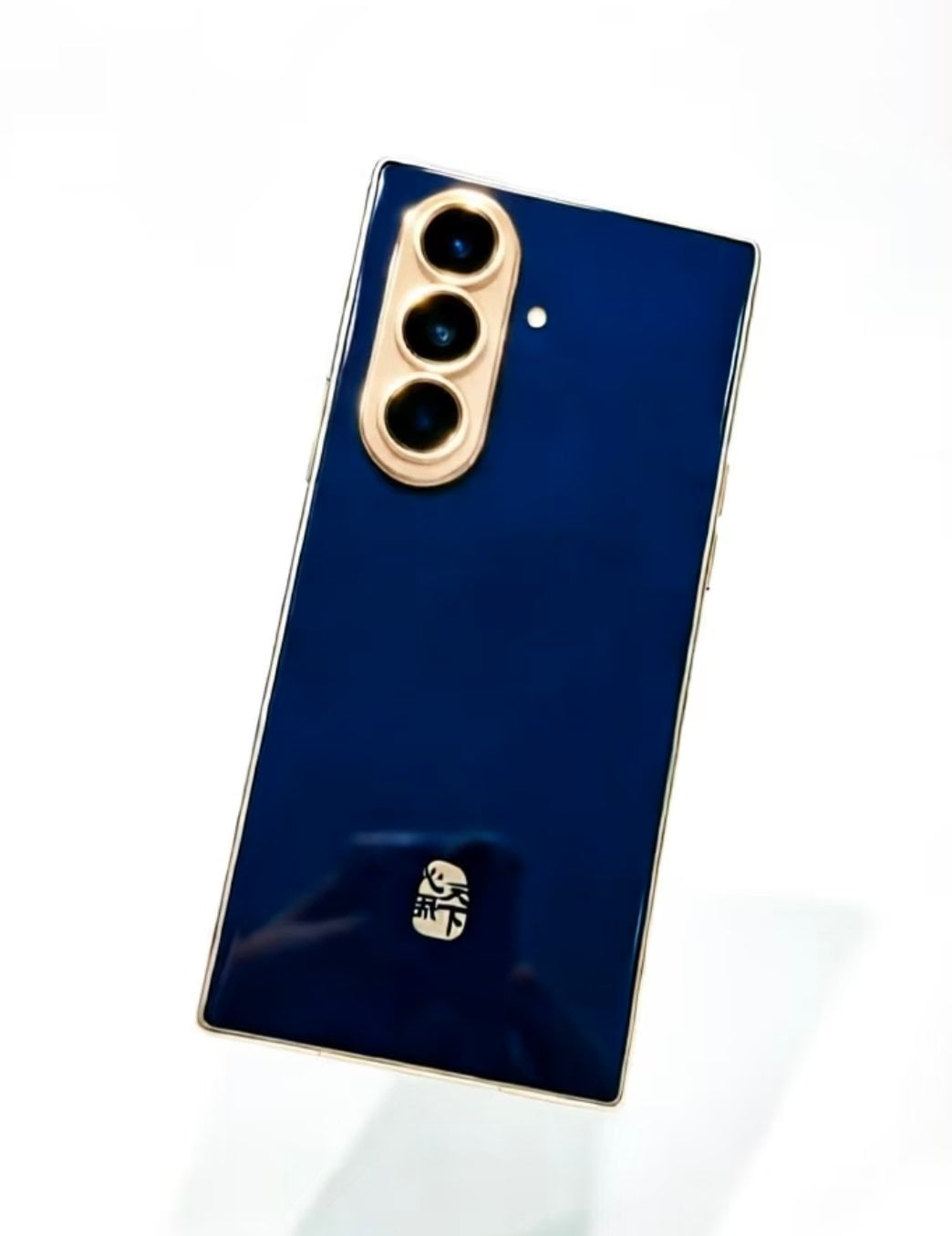
At the structural core of the Samsung W27 lies a deeply refined multi-axis hinge mechanism, engineered to drastically reduce crease visibility while improving ingress protection against particulate matter. Early visual intelligence reveals a striking visual departure from standard industrial grays and blacks: a deep, saturated blue composite chassis accented by high-purity gold highlights. The camera island housing utilizes a matching gold-finish plating, requiring advanced anodization and physical vapor deposition (PVD) techniques to ensure long-term wear resistance without degrading radio-frequency transparency for internal 5G and millimeter-wave antenna arrays.
Beneath the exterior plating, the internal architecture mirrors the bleeding-edge silicon and display innovations slated for the Z Fold 8 Ultra. This includes an upgraded flexible AMOLED panel incorporating advanced ultra-thin glass (UTG) optimization layers and a peak luminance threshold designed to mitigate outdoor glare under direct solar radiation. The computational engine is expected to run on a heavily binned, overclocked variant of the latest Snapdragon mobile platform, paired with LPDDR5X memory channels and UFS 4.0 storage architectures to eliminate data bottlenecks during high-bitrate video capture and intensive multitasking operations.
Empirical Specifications & Benchmark Matrix
| Specification Parameter | Samsung W27 (Expected) | Galaxy Z Fold 8 Ultra (Baseline) | Standard Z Fold 6 (Legacy Ref) |
|---|---|---|---|
| Primary Display | 8.x-inch QXGA+ Flexible AMOLED, 120Hz | 8.x-inch QXGA+ Flexible AMOLED, 120Hz | 7.6-inch QXGA+ AMOLED, 120Hz |
| Cover Display | 6.x-inch Dynamic AMOLED 2X, 120Hz | 6.x-inch Dynamic AMOLED 2X, 120Hz | 6.3-inch Dynamic AMOLED 2X |
| SoC Silicon | Flagship 3nm Octa-Core (Binned Elite) | Flagship 3nm Octa-Core | Snapdragon 8 Gen 3 for Galaxy |
| Memory & Storage | Up to 16GB RAM / 1TB UFS 4.0 | Up to 16GB RAM / 1TB UFS 4.0 | 12GB RAM / 512GB UFS 4.0 |
| Chassis Metallurgy | Reinforced Armor Aluminum / Gold PVD | Armor Aluminum / Titanium accents | Armor Aluminum |
| Aesthetic Finish | Deep Blue with Gold Accents | Standard Global Finishes | Standard Global Finishes |
Thermal, Efficiency & Real-World Ergonomics
Managing thermal loads within an ultra-thin foldable chassis remains one of modern hardware engineering's steepest challenges. With the W27 inheriting the thermal envelope of the Z Fold 8 Ultra, Samsung has reportedly expanded its vapor chamber cooling footprint by deploying micro-channeled copper-titanium composite sheets directly beneath the primary processor nodes. This layout efficiently conducts heat away from the core silicon, spreading it laterally across both halves of the folding chassis to prevent localized hot-spotting during extended gaming sessions or 8K video transcoding.
Ergonomically, the distribution of mass is a critical metric for a device of this caliber. Despite the inclusion of reinforced structural bracing and heavy-duty decorative plating accents, weight optimization has been prioritized to prevent hand fatigue during single-handed cover-screen utilization. The balance point when unfolded has been meticulously calibrated, ensuring that the device rests naturally in the palm without inducing torque on the wrist. Furthermore, improvements in power management firmware within the operating system dynamically scale refresh rates and core voltage curves, ensuring that the device's battery endurance matches or exceeds previous generation foldables despite the heavier processing loads.
The Definitive Verdict
The Samsung W27 represents the absolute zenith of what is currently possible within commercial foldable hardware engineering. By fusing the bleeding-edge performance metrics of the Z Fold 8 Ultra with a bespoke, ultra-luxurious industrial design language featuring deep blue and gold finishes, Samsung has created an elite status symbol for the Chinese market. While its regional exclusivity and premium pricing tier will keep it out of the hands of mainstream global consumers, its technological implications are profound. For hardware analysts and enthusiasts, the W27 serves as a clear physical preview of Samsung's engineering roadmap—proving that high-end structural durability, refined thermal management, and uncompromising aesthetic execution can successfully coexist within a single, folding chassis.