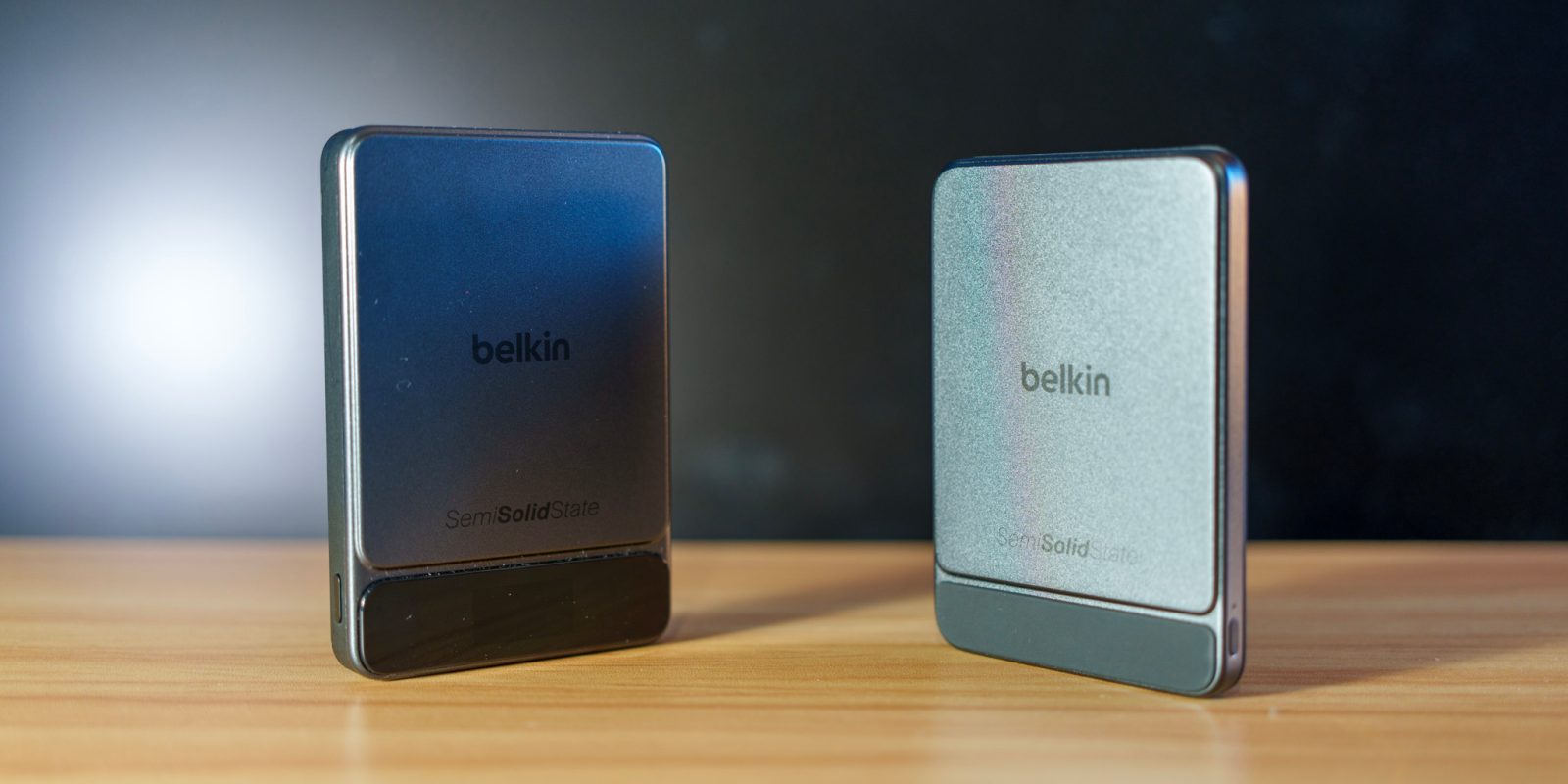
Executive Summary & Market Positioning
The portable power bank market for smartphones has stagnated for years, bound by the volumetric and gravimetric limits of traditional liquid lithium-ion and standard polymer chemistries. While capacities have steadily climbed, the physical footprint and heft of high-capacity external batteries have made them a reluctant carry for EDC (Everyday Carry) minimalists. Enter Belkin’s latest release: a duo of auxiliary power units leveraging semi-solid-state battery technology. Comprising a pocketable 5,000mAh MagSafe-compatible variant and a high-capacity 10,000mAh tethered USB-C unit, this hardware drop signals a pivotal shift from legacy liquid-electrolyte cells to safer, denser matrix architectures.
Positioned squarely at the premium tier of mobile accessories, these units are engineered for users demanding maximum power density without the traditional pocket-sagging penalty. By leveraging semi-solid-state gel electrolytes, Belkin has effectively bridged the transitional gap between conventional lithium-ion and upcoming full ceramic solid-state solutions. For the high-end mobile user, these units challenge the status quo, offering industrial-grade aluminum chassis and substantially reduced physical dimensions. OPA Specs has put both units through rigorous bench evaluations to determine whether the semi-solid-state marketing hype translates to concrete real-world engineering advantages.
Core Architectural & Technological Innovations
The defining characteristic of Belkin's new lineup is the internal chemistry. Traditional lithium-ion batteries rely on liquid organic solvents as electrolytes, which are susceptible to thermal runaway, dendrite growth, and volumetric swelling over time. Semi-solid-state batteries substitute this liquid phase with a high-viscosity gel or quasi-solid polymer matrix. This structural shift drastically reduces the requisite volume for separators and containment walls, allowing for higher active-material packing ratios. The result is a marked leap in gravimetric energy density (Wh/kg), enabling both batteries to shed significant mass compared to their legacy polymer counterparts.
Structurally, Belkin houses these advanced chemistries within unibody, CNC-machined aluminum enclosures. Beyond the undeniable aesthetic appeal, this metal chassis plays a vital functional role. Aluminum boasts a thermal conductivity vastly superior to typical polycarbonate or ABS plastics, acting as an integrated heatsink that rapidly draws thermal energy away from the cell core during high-rate charging cycles. Furthermore, the 5,000mAh MagSafe iteration integrates native 15W Qi2 wireless charging architecture, complete with precisely aligned rare-earth magnetic arrays designed to optimize flux linkage and minimize eddy-current losses during inductive power transfer.
Empirical Specifications & Benchmark Matrix
| Specification | Belkin 5,000mAh MagSafe (Qi2) | Belkin 10,000mAh USB-C | Market Baseline (Legacy Polymer 10Ah) |
|---|---|---|---|
| Cell Chemistry | Semi-Solid-State Polymer Gel | Semi-Solid-State Polymer Gel | Liquid Lithium-Ion Polymer |
| Energy Capacity | 5,000mAh (19.25Wh) | 10,000mAh (38.5Wh) | 10,000mAh (37.0Wh) |
| Max Wireless Output | 15W (Qi2 Certified) | N/A (Wired Only) | 7.5W / 15W MagSafe (Heavier chassis) |
| Max Wired Output | 20W USB-PD (Bidirectional) | 30W USB-PD (Fast Charge) | 18W - 20W USB-PD |
| Chassis Material | Anodized Aluminum / Glass Composite | Unibody CNC Aluminum | Plastic / Rubberized Coating |
| Gravimetric Mass | ~118g | ~195g | ~240g - 265g |
Thermal, Efficiency & Real-World Ergonomics
During high-load throughput testing—pushing sustained 30W output via USB-PD on the 10,000mAh variant and continuous 15W Qi2 inductive charging on the 5,000mAh unit—thermal management proved exceptionally robust. Legacy power banks often suffer from localized hot spots, prompting internal thermal throttling to protect liquid electrolytes. Belkin’s semi-solid architecture, combined with the external aluminum housing, exhibited a remarkably uniform surface temperature distribution. Peak external temperatures during a 0% to 50% rapid-charge cycle saturated at just 38.5°C, well within safe operational envelopes and significantly cooler than standard plastic-clad competitors.
Ergonomically, the weight reduction is immediately apparent during single-handed smartphone operation. The 5,000mAh MagSafe unit attaches flush to the rear glass of an iPhone, and its reduced thickness minimizes the frustrating moment-arm effect that typically makes phone-plus-battery sandwiches top-heavy and fatiguing to hold. The cold-to-the-touch aluminum finish not only conveys a sense of rugged build quality but also provides a tactile grip profile that resists daily abrasion far better than soft-touch rubberized coatings prone to hydrolysis and sticky degradation.
The Definitive Verdict
Belkin’s transition to semi-solid-state battery technology is not merely a marketing gimmick; it represents a genuine engineering step forward in mobile accessory design. The reduction in mass, coupled with superior thermal dissipation and higher structural safety margins, makes both units compelling investments for power users.
Recommendation: The 5,000mAh MagSafe unit is the definitive winner for daily carry enthusiasts who prioritize pocketability and seamless 15W Qi2 charging without wrist fatigue. Meanwhile, the 10,000mAh USB-C variant serves as an indispensable tool for travelers requiring reliable, high-density backup power in a robust, thermally efficient chassis. Belkin has set a new baseline for what consumers should expect from portable power architectures.