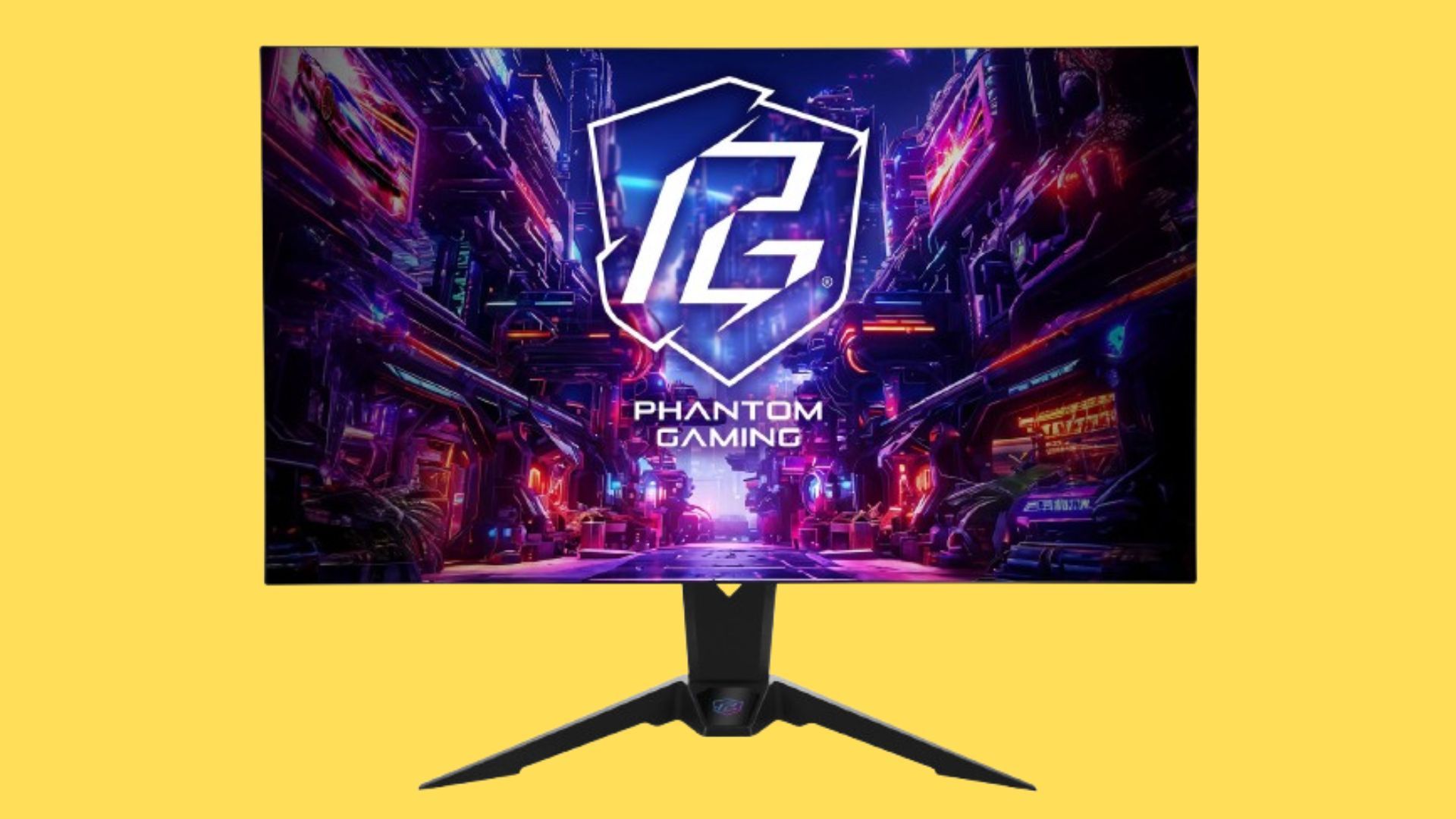
ASRock Phantom Gaming PGO32UFS Review: Dual-Mode 4K/480Hz OLED Redefines Value
Executive Summary & Market Positioning
The display component market has experienced volatile pricing trends over the past several hardware cycles, with core memory and NAND storage enduring persistent inflationary pressures. Countering this broad trend, the high-end gaming monitor sector has seen aggressive downward price corrections driven by panel production scaling and fierce competition. A prime manifestation of this market realignment is the ASRock Phantom Gaming PGO32UFS, a 32-inch 4K OLED desktop display that originally launched at a competitive $899 list price. Currently discounted to an unprecedented $596 at major retailers like Newegg, this hardware package undercuts virtually every direct competitor in its class.
From a market positioning standpoint, the PGO32UFS bridges the gap between ultra-high-resolution immersive gaming and elite esports performance. While traditional premium OLED panels force users to choose between high pixel density or high refresh rates, ASRock’s implementation addresses both requirements via a sophisticated hardware-level scaling architecture. By reducing the cost barrier to sub-$600 for a large-format 4K emissive panel, ASRock challenges legacy pricing models and positions the PGO32UFS as a high-value focal point for both enthusiasts and competitive esports athletes.
Core Architectural & Technological Innovations
The defining engineering achievement of the ASRock Phantom Gaming PGO32UFS is its native dual-mode display architecture. The underlying organic light-emitting diode panel is capable of operating under two distinct temporal and spatial resolutions: a pristine 3840 x 2160 (4K UHD) canvas clocked at a fluid 240Hz, or a lightning-fast 1920 x 1080 (Full HD) resolution capable of driving a staggering 480Hz refresh rate. This versatility allows users to leverage full pixel density for cinematic single-player titles while instantly shifting to high-framerate, low-latency rendering for competitive first-person shooters.
Complementing this dual-mode capability is the inherent pixel response time of the OLED substrate, rated at an instantaneous 0.03ms gray-to-gray (GtG). This effectively eliminates ghosting and motion blur, setting the gold standard for motion clarity. Furthermore, the panel boasts an extraordinary 1,500,000:1 native contrast ratio, achieving infinite black levels by completely powering off individual pixels. With DisplayHDR True Black 400 certification, the display delivers exceptional local peak luminance dynamics, accentuating high-dynamic-range content without the blooming artifacts typical of traditional local-dimming LCD matrices.
Empirical Specifications & Benchmark Matrix
| Specification Feature | ASRock Phantom Gaming PGO32UFS | Standard High-End OLED Baseline | Advantage / Note |
|---|---|---|---|
| Panel Size & Type | 32-inch Flat OLED | 32-inch Curved / Flat OLED | Parity in diagonal size; flat profile preferred by many CAD/sim users |
| Native Resolution | 3840 x 2160 (4K UHD) | 3840 x 2160 (4K UHD) | Identical high pixel density |
| Dual-Mode Refresh | 4K @ 240Hz / 1080p @ 480Hz | Typically single mode (4K @ 240Hz) | ASRock Win: Unprecedented esports flexibility |
| Response Time (GtG) | 0.03ms | 0.03ms | Industry-standard instant pixel transition |
| Contrast Ratio | 1,500,000:1 | 1,500,000:1 | True blacks, zero haloing/blooming |
| Adaptive Sync | AMD FreeSync Premium Pro | FreeSync / G-Sync Compatible | Comprehensive tearing prevention |
| Video Connectivity | 2x HDMI 2.1, 2x DP 1.4, USB-C (DP Alt) | Varies (often fewer ports) | ASRock Win: Excellent modern console and PC IO |
| Street Price | $596 (Discounted from $899) | $800 – $1,100 | ASRock Win: Exceptional value proposition |
Thermal, Efficiency & Real-World Ergonomics
Operating an emissive panel at high luminance levels introduces notable thermal management challenges, particularly in passive-cooling desktop monitors. ASRock has integrated a robust internal thermal dissipation architecture within the chassis of the PGO32UFS to mitigate potential panel degradation and mitigate the risk of burn-in. Effective heat spreading ensures that peak full-field brightness can be maintained over extended gaming sessions without triggering aggressive automatic brightness limiter (ABL) routines that plague lesser OLED implementations.
Ergonomically, the monitor provides extensive connectivity to accommodate a multi-device hardware ecosystem. The inclusion of dual HDMI 2.1 ports ensures full-bandwidth uncompressed signal transmission for modern consoles such as the PlayStation 5 and Xbox Series X, running native 4K signals at high refresh rates. Dual DisplayPort 1.4 inputs alongside a versatile USB-C port featuring DisplayPort Alternate Mode round out the IO array, allowing seamless integration with modern productivity laptops and docking stations. The flat panel layout further enhances utility for mixed productivity and media creation workflows where curved distortion is undesirable.
The Definitive Verdict
The ASRock Phantom Gaming PGO32UFS represents a monumental shift in the high-end display landscape. By packaging a dual-mode 4K/240Hz and 1080p/480Hz OLED panel into a 32-inch flat-panel form factor, ASRock has successfully neutralized the traditional compromise between visual fidelity and competitive motion clarity. When factoring in the exceptional contrast performance, instantaneous pixel response times, and a comprehensive suite of modern video inputs, the hardware package is already formidable at its standard $899 MSRP. At the newly slashed promotional price of $596, this monitor transitions from a recommended upgrade to an absolute mandatory consideration for any serious hardware enthusiast. The PGO32UFS delivers flagship-tier performance at a mid-range price point, earning our highest empirical recommendation.