Executive Overview & Market Positioning
Google is rapidly diversifying its eighth-generation TPU silicon architecture, moving beyond generalized training and inference models to deliver highly specialized systems tailored for agentic workloads and secure enterprise deployments. By building modular variants on top of its base TPU 8t and 8i silicon, Google aims to drastically compress hardware iteration cycles down to a matter of months rather than years. This architectural agility directly challenges Nvidia and AMD in the high-stakes data center accelerator market, where diverse workloads require extreme specialization.
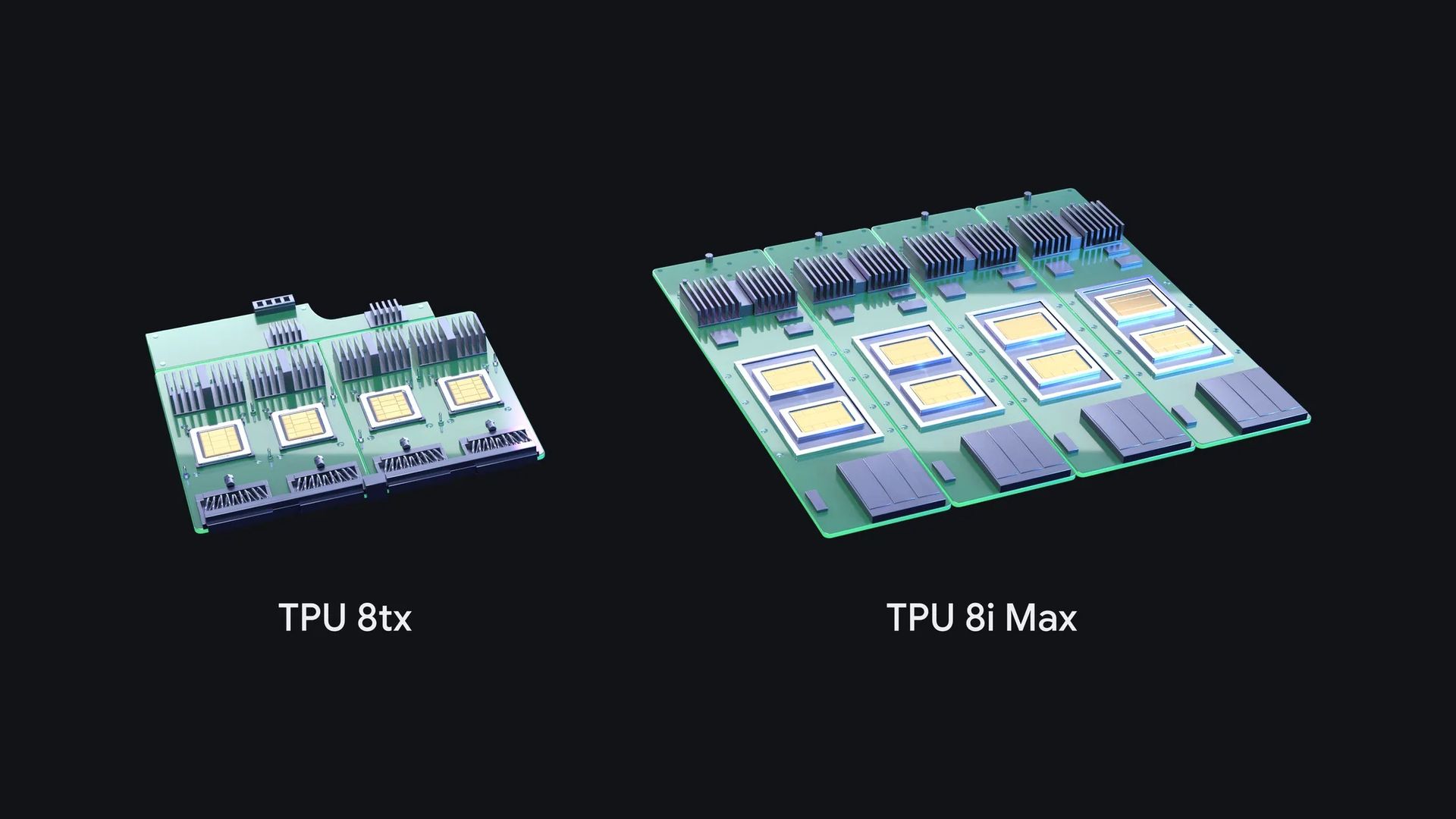
The newly introduced TPU 8tx and TPU 8i Max target distinct operational bottlenecks. The TPU 8i Max addresses the relentless memory demands of long-context agentic workflows by dual-packaging base 8i dies. Meanwhile, the TPU 8tx leverages the foundational TPU 8t silicon to establish a hardware-isolated, confidential computing environment tailored for regulated industries and government entities. Together, these systems illustrate Google’s shift toward workload-specific silicon packaging and host-platform optimization.
Empirical Benchmark Matrix
To evaluate these systems against existing baseline architecture, we examine the core hardware specifications, host configurations, and estimated performance scaling derived from Google’s eighth-generation product disclosures.
| Metric / Feature | TPU 8t (Baseline) | TPU 8i (Baseline) | TPU 8tx | TPU 8i Max | Verdict / Context |
|---|---|---|---|---|---|
| Primary Workload | Large-scale pre-training | Serving & reasoning | Secure confidential inference | Long-context agent work | Workload-specific specialization |
| Host CPU | Arm Axion | Arm Axion | 5th Gen AMD EPYC | Not stated | AMD EPYC selected for TEE integration |
| Network Topology | 3D Torus | Boardfly | Boardfly | Not stated | Boardfly optimized for low-latency inference |
| Peak FP4 PFLOPS | 12.6 | 10.1 | Not stated | ~20.2 (Derived) | Doubled compute density in rack footprint |
| HBM Bandwidth | 6,528 GB/s | 8,601 GB/s | Not stated | ~17,202 GB/s (Derived) | Mitigates the memory wall for KV caches |
| On-Chip SRAM | 128 MB | 384 MB | Not stated | 768 MB (Derived) | Expands local cache for massive context windows |
Thermal, Efficiency & Definitive Verdict
Google's architectural choices reflect a direct assault on the memory wall, particularly for long-context agentic applications running million-token windows. By doubling HBM bandwidth and on-chip SRAM via the dual-die TPU 8i Max, Google bypasses the need for complex multi-tier decoding storage while maintaining dense rack footprints. Furthermore, software integrations like TPU Sync offload massive KV caches to host DRAM in milliseconds, slashing transfer latencies by over 90 percent. For secure deployments, the TPU 8tx successfully integrates robust Trusted Execution Environment paradigms via AMD EPYC hosts and Boardfly networking, positioning Google as a formidable, vertically integrated alternative to Nvidia's monolithic GPU clusters.