Executive Summary & Market Positioning
The artificial intelligence accelerator landscape shifted dramatically following Nvidia’s structurally unique $20 billion transaction involving pioneering Language Processing Unit (LPU) architect Groq. Rather than executing a traditional, full-scale corporate buyout, Nvidia structured a hybrid agreement comprising a $17 billion licensing fee for Groq's core intellectual property alongside a dedicated $3 billion equity pool earmarked for the roughly 200 engineers who transitioned directly to Nvidia's hardware division. This unconventional maneuver—termed a "reverse acqui-hire" by regulatory watchdogs—has triggered intense scrutiny, culminating in a proposed class-action lawsuit filed in Delaware’s Court of Chancery by former Groq engineers Benjamin Serebrin and Joshua Rubin. The plaintiffs allege that the board favored specific venture capital backers while shortchanging general shareholders, a controversy further compounded by active inquiries from the Department of Justice and the Federal Trade Commission.
From a market positioning perspective, the arrangement allows Nvidia to integrate ultra-low-latency deterministic inference technology directly into its high-end data center deployment strategies. Nvidia’s SEC 10-K filings reveal that approximately $14.4 billion of the licensing capital was booked as goodwill, explicitly tied to the specialized workforce and forward-looking technological development, leaving only $2.5 billion assigned directly to the foundational hardware designs. Meanwhile, the residual entity of Groq has pivoted aggressively toward cloud-based AI services, operating data centers and deploying its own technologies under the newly badged Nvidia Groq 3 LPX framework. This high-stakes legal and commercial maneuver redefines how trillion-dollar enterprises acquire engineering talent and bypass traditional antitrust review channels while cementing silicon architectures built specifically for massive-scale large language model (LLM) decoding phases.
Core Architectural & Technological Innovations
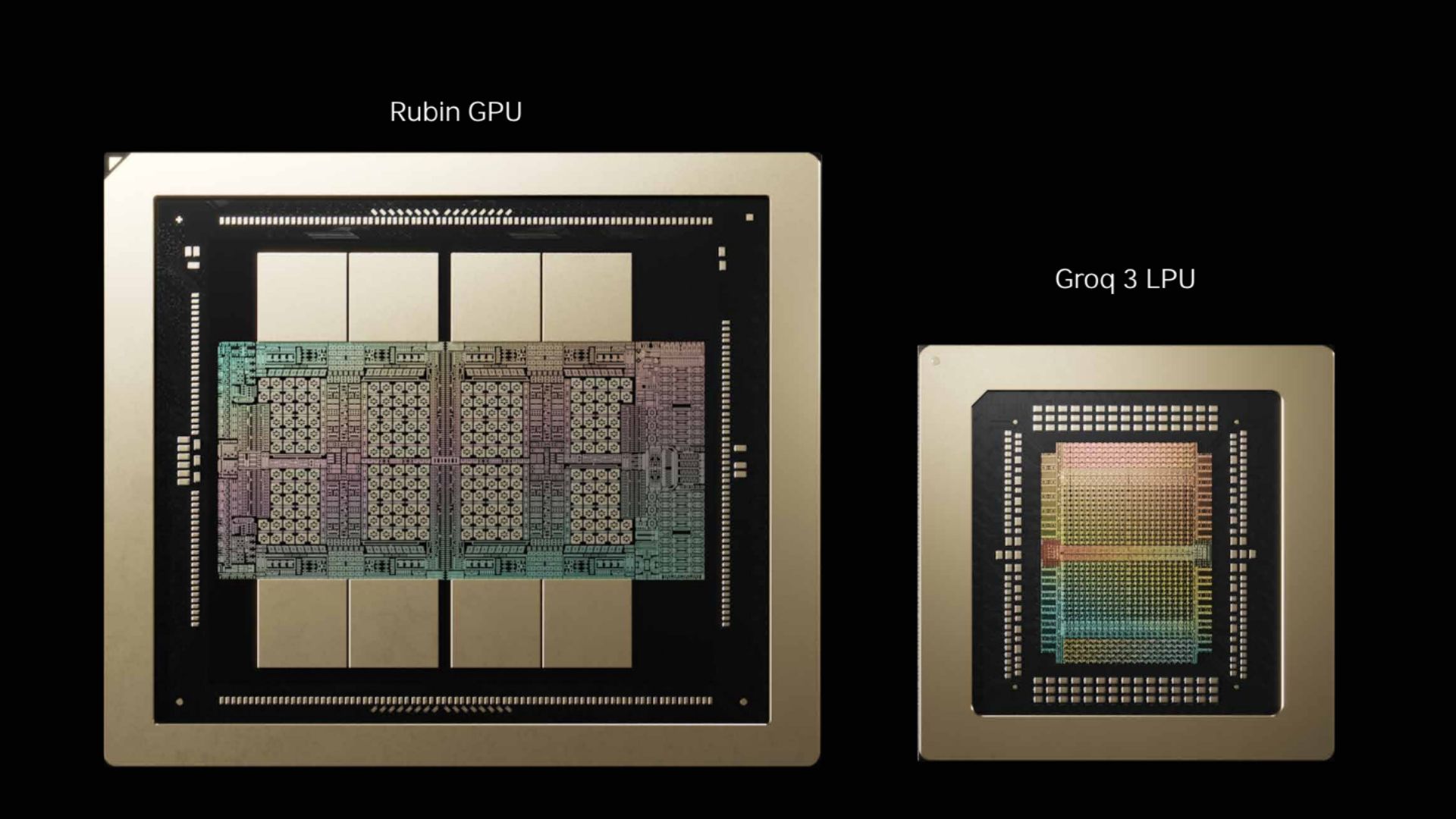
At the silicon level, the fruit of this transaction is manifested in the Groq LP30, a revolutionary inference engine built upon Samsung’s advanced 4nm (SF4X) process technology. Diverging fundamentally from traditional GPU architectures that rely heavily on complex caching hierarchies and dynamic scheduling, Groq’s Tensor Streaming architecture leverages a software-defined, deterministic execution model. Each LP30 die packs an astonishing 500MB of high-bandwidth SRAM directly on-chip, enabling a massive aggregate memory bandwidth of 150 TB/s per die. This design philosophy eliminates the von Neumann bottleneck inherent in off-chip HBM fetch cycles, making the LPU an exceptionally efficient decode co-processor when paired with Nvidia’s upcoming Vera Rubin NVL72 infrastructure.
Scaling this silicon to the system level, the Nvidia Groq 3 LPX rack consolidates 256 individual LPUs into a single dense compute node. This collective architecture yields 128GB of ultra-fast distributed on-chip SRAM, a staggering 40 PB/s of internal interconnect bandwidth, and an aggregate performance rating of 315 FP8 PFLOPS. By functioning as a specialized decode co-processor, the LPX architecture offloads memory-bound token generation phases from primary tensor cores, dramatically accelerating time-to-first-token and token generation throughput for massive generative AI workloads. Future roadmap iterations, such as the LP35 with native NVFP4 support and the subsequent LP40 designed for Feynman-generation systems, signal that Nvidia intends to deeply institutionalize this deterministic execution model across its multi-generational data center stack.
Empirical Specifications & Benchmark Matrix
| Architectural Parameter | Groq LP30 / LPX Rack | Baseline GPU Inference Node (H100/B200) | Advantage / Trade-off |
|---|---|---|---|
| Process Node | Samsung 4nm (SF4X) | TSMC 4N / 3nm class | Higher transistor density vs. mature foundry ecosystem |
| On-Chip Memory (SRAM) | 500MB per die / 128GB per rack | Limited L2 Cache (~50MB - 100MB) | Massive deterministic scratchpad capacity |
| Off-Chip Memory | SRAM-centric (No HBM dependence) | HBM3e / HBM4 (Up to 8TB/s per GPU) | Eliminates off-chip latency penalties for inference |
| Aggregate Bandwidth | 150 TB/s (Per Die) / 40 PB/s (Rack) | ~8 TB/s per accelerator node | Unprecedented token generation throughput |
| Compute Performance | 1.23 FP8 PFLOPS (Single LPU) | Variable FP8 Tensor Core throughput | Optimized explicitly for deterministic decode stages |
Thermal, Efficiency & Real-World Ergonomics
Integrating 256 LPUs alongside massive SRAM arrays within a standard server rack footprint introduces severe thermal density challenges. Unlike traditional GPU clusters where thermal dissipation is dominated by high-power HBM stacks and massive monolithic compute dies, the Groq LPX architecture distributes thermal loads across numerous smaller, high-frequency SRAM-heavy dies built on Samsung’s 4nm node. This distributed thermal profile requires bespoke liquid-cooling integration to maintain optimal junction temperatures, particularly when operating within dense 200+ MW data center footprints that Groq and its cloud partners are currently scaling toward.
From an efficiency standpoint, the omission of power-hungry off-chip memory interfaces (such as multi-stack HBM) yields substantial efficiency gains during the autoregressive token generation phase. By keeping active working sets entirely within the 128GB aggregate SRAM boundary of a 256-LPU rack, dynamic power consumption per generated token drops precipitously compared to traditional architectures that repeatedly fetch weights from external DRAM. Real-world deployment benchmarks underscore that this deterministic pipeline minimizes tail latencies, ensuring predictable operational SLAs for enterprise AI cloud providers like Nebius and Dell integration partners scaling out production inference clusters.
The Definitive Verdict
Nvidia’s $20 billion Groq transaction stands as a masterclass in modern corporate engineering acquisition, successfully circumventing standard merger blockades while capturing the industry’s premier deterministic LPU talent and intellectual property. Architecturally, the resulting Groq 3 LPX platform and its underlying LP30 silicon represent a monumental leap in autoregressive token generation efficiency, proving that SRAM-centric, software-defined execution models possess a permanent and critical role in next-generation hyperscale AI deployments. However, the shadow of active DOJ inquiries and unresolved shareholder litigation in Delaware injects persistent regulatory volatility into the hardware's long-term commercial horizon. For enterprise buyers and cloud architects, the hardware performance is undeniably elite; for the broader semiconductor market, this deal establishes a contentious precedent that will permanently reshape how intellectual property and elite engineering teams are acquired.