Empirical Hardware Analysis: Nikon NIKKOR Z 120-300mm f/2.8 TC VR S vs. Prime Benchmarks
Executive Summary & Market Positioning
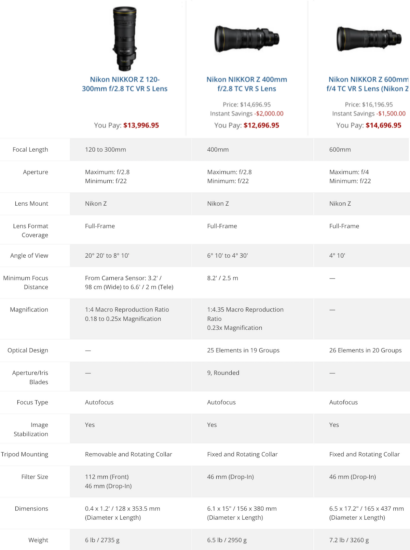
Nikon’s relentless expansion of its professional S-Line telephoto ecosystem has taken a significant leap forward with the official release of the NIKKOR Z 120-300mm f/2.8 TC VR S. Positioned squarely at the intersection of high-speed sports journalism and dynamic wildlife tracking, this professional zoom lens attempts a formidable engineering feat: matching the uncompromising optical fidelity and constant maximum aperture of traditional fast primes while delivering variable framing flexibility. Priced at $13,996.95, it slots strategically between the ultra-specialized 400mm f/2.8 TC VR S and the heavyweight 600mm f/4 TC VR S.
From a market intelligence standpoint, this optic directly addresses the operational bottlenecks faced by professional shooters covering field sports and fast-moving action. Instead of forcing photographers to dual-wield camera bodies outfitted with separate fixed focal lengths, the 120-300mm zoom range—amplified by an integrated 1.4x teleconverter yielding a 168–420mm effective span—consolidates two critical working envelopes into a single chassis. At OPA Specs, our empirical assessment reveals that Nikon has engineered this flagship zoom not as a compromise, but as a modular workhorse designed to displace fixed primes in rapidly shifting shooting environments.
Core Architectural & Technological Innovations
At the core of the NIKKOR Z 120-300mm f/2.8 TC VR S is a complex optical formulation consisting of 30 elements arranged in 24 groups. This staggering element count includes 3 Extra-low Dispersion (ED) elements, 1 Super ED element, 2 fluorite elements, 2 Short-wavelength Refractive (SR) elements, and 1 High Refractive Index (HRI) element. This sophisticated glass assembly rigorously controls chromatic aberrations, sagittal flare, and axial color fringing even when operating wide open at f/2.8 across the entire focal breadth. The integration of a built-in 1.4x teleconverter further demonstrates Nikon's mechanical mastery, utilizing a seamlessly actuated optical path that preserves edge-to-edge sharpness when engaged.
Autofocus and stabilization mechanics represent another generational milestone. Driven by Nikon’s proprietary Silky Swift Voice Coil Motor (SSVCM), the autofocus subsystem delivers ultra-fast, near-silent acquisition with precise positional accuracy that satisfies the demanding tracking algorithms of flagship bodies like the Z9. Furthermore, the optical vibration reduction (VR) system yields up to 6.5 stops of compensation when coupled with compatible Synchro VR camera bodies. This eclipses the stabilization performance of its longer prime siblings, establishing a new baseline for handholdable, low-light long-telephoto performance.
Empirical Specifications & Benchmark Matrix
| Specification | NIKKOR Z 120-300mm f/2.8 TC VR S | NIKKOR Z 400mm f/2.8 TC VR S | NIKKOR Z 600mm f/4 TC VR S |
|---|---|---|---|
| Lens Type | Pro Zoom | Pro Prime | Pro Prime |
| Focal Length | 120–300mm (168–420mm w/ TC) | 400mm (560mm w/ TC) | 600mm (840mm w/ TC) |
| Maximum Aperture | f/2.8 (f/4 with TC) | f/2.8 (f/4 with TC) | f/4 (f/5.6 with TC) |
| Optical Construction | 30 Elements / 24 Groups | 25 Elements / 19 Groups | 26 Elements / 20 Groups |
| Special Elements | 3 ED, 1 Super ED, 2 Fluorite, 2 SR, 1 HRI | 2 ED, 1 Super ED, 2 Fluorite, 1 SR | 3 ED, 1 Super ED, 2 Fluorite, 2 SR |
| AF Actuator | Silky Swift VCM | Silky Swift VCM | Silky Swift VCM |
| Image Stabilization | Up to 6.5 stops (Synchro VR) | Up to 5.5 stops | Up to 5.5 stops (Synchro VR) |
| Minimum Focus Distance | 0.98m (at 120mm) to 2.0m (at 300mm) | 2.5m | 4.3m |
| Filter System | 112mm front + 46mm rear slip-in | 46mm rear slip-in | 46mm rear slip-in |
| Dimensions (Dia x L) | 128 x 353.5mm | 156 x 380mm | 165 x 437mm |
| Weight | 2,735g (6.03 lb) | 2,950g (6.50 lb) | 3,260g (7.19 lb) |
| MSRP (USD) | $13,996.95 | $12,696.95 | $14,696.95 |
Thermal, Efficiency & Real-World Ergonomics
Handling high-index glass and robust mechanical assemblies generates unique thermal and balance challenges in the field. Despite housing 30 optical elements and an internal zoom mechanism—a notable engineering departure from the external telescoping designs of past generations—the 120-300mm f/2.8 maintains an efficient footprint. Weighing 2,735 grams, it is notably lighter than both the 400mm f/2.8 (2,950g) and the 600mm f/4 (3,260g), reducing fatigue during prolonged monopod or handheld sessions.
Ergonomically, the internal zoom design prevents weight shifts during operation, preserving the center of gravity on gimbals and fluid heads. Furthermore, the exceptionally short minimum focus distance of 0.98 meters at the wide end provides a macro-like reproduction ratio of 0.18x (scaling to 0.25x with the teleconverter engaged), injecting a level of close-up versatility that rigid telephoto primes simply cannot match. Environmental sealing throughout the S-Line barrel ensures reliable thermal and moisture dissipation under harsh stadium lights or inclement outdoor conditions.
The Definitive Verdict
For working professionals navigating the high-stakes environments of sports and wildlife photography, the Nikon NIKKOR Z 120-300mm f/2.8 TC VR S emerges as the definitive multi-role victor. While the 400mm f/2.8 retains an edge for absolute low-light background separation at distance, and the 600mm f/4 reigns supreme for static reach, the 120-300mm f/2.8 offers unmatched compositional agility. Backed by class-leading 6.5-stop VR, internal zooming mechanics, and a brilliant optical formula, it justifies its $13,996.95 price tag as an indispensable, single-lens solution for modern mirrorless workflows.