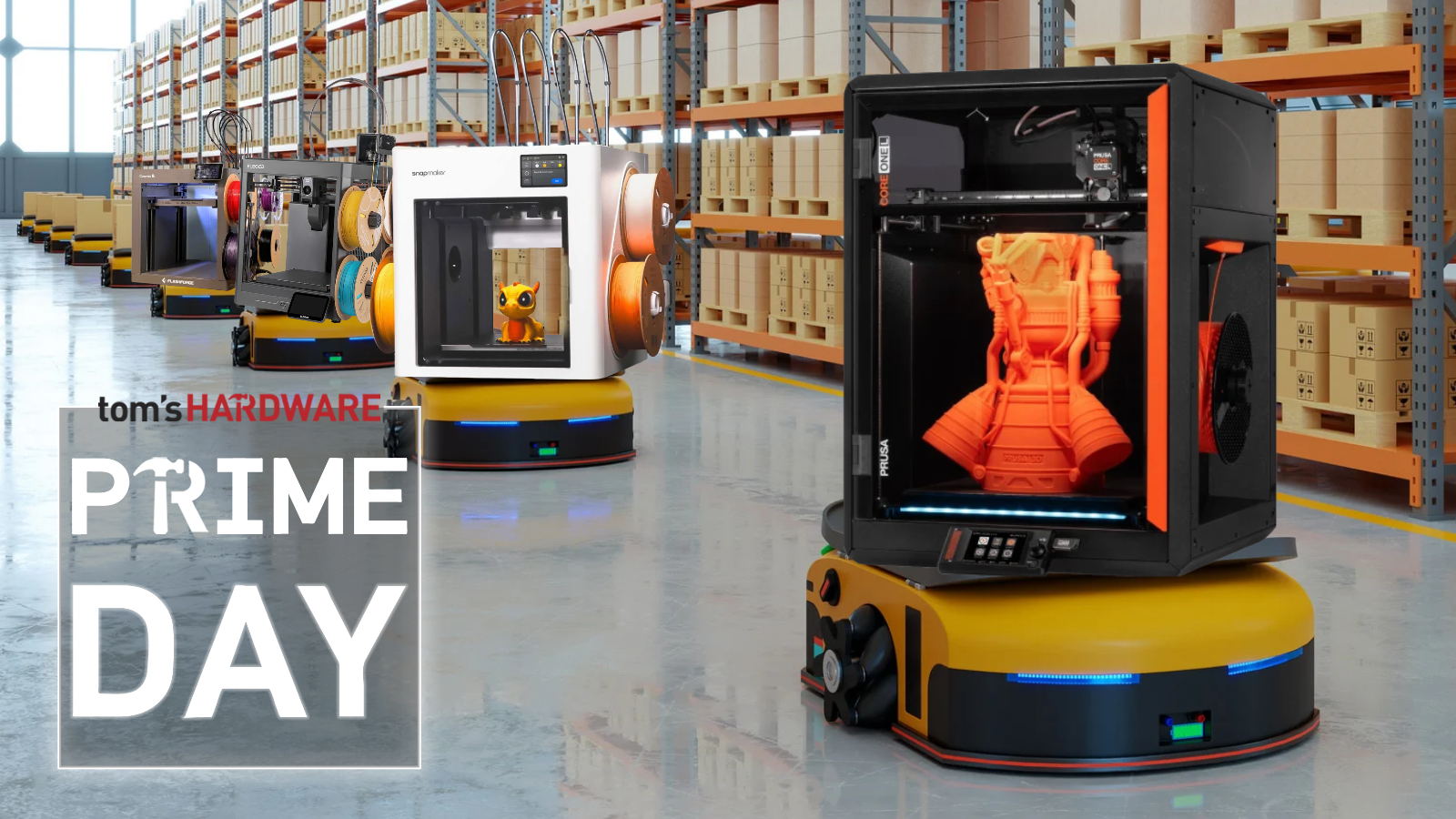
Executive Summary & Market Positioning
The 2026 hardware landscape for additive manufacturing has shifted decisively toward automated, multi-color workflows, effectively obsoleting the manual filament-swapping protocols of the previous decade. Amazon's Big Deal Days event this year underscores a clear democratization of previously enterprise-grade features, such as active vibration compensation, tool-changing kinematics, and high-flow extrusion systems. By bringing machines from innovators like Bambu Lab, Prusa Research, and Snapmaker to aggressive price points, the market is signaling that the 'tinkering' era of desktop FDM printing is yielding to a 'turnkey' era where throughput and material compatibility are the primary competitive vectors.
From a market positioning standpoint, we are observing a bifurcation between the hobbyist-grade 'bed-slingers' that now offer full-color automation, and premium, robust CoreXY architectures like the Prusa Core One series. The presence of specialized, four-color tool-changing machines at sub-$400 price points—such as the Creality SPARKX i7 and the Elegoo Centauri 2—indicates that silicon and mechanical motion control costs have reached a point of commoditization. For the hardware analyst, this represents a massive influx of accessibility, moving the ceiling for entry-level precision substantially higher while maintaining a lean cost-per-cubic-centimeter for the end user.
Core Architectural & Technological Innovations
The most significant architectural advancement in this cycle is the widespread adoption of multi-material handling units (MMHU) and specialized tool changers. Unlike early color-changing prototypes that suffered from excessive waste via 'poop' chutes, modern implementations like those found in the Snapmaker U1 utilize optimized tool-pathing algorithms that prioritize material conservation without sacrificing structural layer adhesion. These systems are now tightly integrated with firmware-level synchronization, allowing for reliable, high-speed multi-material deposition—a feat that previously required complex, often unreliable aftermarket hardware mods.
Beyond material handling, thermal management and kinematics have seen non-trivial iterative improvements. The move toward integrated, pre-tested, fully assembled chassis—specifically regarding the Prusa Core One and the refined Bambu Lab A1 Mini—represents a pivot toward reliable OOBE (Out-of-Box Experience). By standardizing the motion systems and using cloud-connected calibration, these manufacturers are effectively eliminating the 'calibration fatigue' that discouraged 70% of potential users in the pre-2024 market cycle. The utilization of high-precision sensors for Z-offset calibration and vibration resonance damping allows these machines to maintain sub-0.1mm tolerances at print speeds that were once considered dangerous or unsustainable for consumer-grade lead screws.
Empirical Specifications & Benchmark Matrix
| Model | Architecture | Build Vol (mm) | Multi-Color Tech | Market Segment |
|---|---|---|---|---|
| Bambu Lab A1 Mini | Bed Slinger | 180x180x180 | Single/Multi-Ext | Entry |
| Prusa Core One L | CoreXY | 300x300x300 | Single (High-Dur) | Professional |
| Snapmaker U1 | Tool Changer | 256x256x256 | 4-Color Logic | Mid-Range |
| Anycubic Kobra X | Bed Slinger | 220x220x250 | 4-Color Splice | Value |
| Creality SPARKX i7 | Bed Slinger | 250x250x250 | 4-Color Auto | Entry-Plus |
Thermal, Efficiency & Real-World Ergonomics
Thermal efficiency in the 2026 lineup is driven by closed-loop PID control and adaptive heating zones that prioritize energy recovery. For high-temperature materials like TPU or PETG, the current generation of printers demonstrates superior thermal stability through improved nozzle geometry and localized fan ducting. This enables consistent extrusion rates even at high volumetric flow, preventing the common 'clogging' artifacts seen in legacy hardware. The move toward modularity, particularly seen in the Snapmaker and Prusa ecosystems, suggests a commitment to long-term repairability, which is a vital metric for evaluating the true TCO (Total Cost of Ownership) of these devices.
Ergonomically, the shift toward US-warehouse fulfillment and 'pre-tested' status for machines like the Prusa Core One ensures that the barrier to entry is not merely financial, but operational. Modern UI/UX has finally caught up with mechanical capability; touchscreen interfaces now support granular control over material extrusion without requiring a PC tether. The integration of MakerWorld-style file-sharing platforms directly into the machine's cloud interface reduces the friction of the 'slicing' workflow, effectively making 3D printing an appliance-like experience rather than a technical endeavor.
The Definitive Verdict
For the discerning hardware enthusiast or professional, the Original Prusa Core One series remains the definitive benchmark for reliability, modularity, and long-term support, despite its higher entry cost. It is the logical choice for those who view 3D printing as a primary production tool. However, for the vast majority of the consumer market, the Bambu Lab A1 Mini represents the most balanced value-to-performance ratio currently available, especially with current pricing. It provides the best-in-class motion control and user interface, making it an unbeatable entry point for those looking to transition from 2D logic to 3D implementation. Act now, as the current price suppression is transient.