Executive Summary & Market Positioning
Bambu Lab has spent the last several years effectively commoditizing high-speed, reliable fused deposition modeling (FDM). With the teasing of the S1 3D scanner, the company is signaling its intent to capture the remaining "missing link" in the desktop manufacturing workflow: high-fidelity digitization. By moving upstream from print execution to object acquisition, Bambu is positioning itself not merely as a printer manufacturer, but as an end-to-end digital fabrication provider. This is a strategic expansion that targets the reverse engineering, archival, and rapid prototyping segments, where current prosumer solutions—while functional—are often hampered by fragmented ecosystems.
Historically, the 3D scanning market has remained a bifurcation of prohibitively expensive industrial solutions and inconsistent, high-effort entry-level optics. Competitors such as Revopoint and Creality have made strides in accessibility, yet the "messy middle" of the market—where ease of use intersects with actionable mesh data—remains under-served. By bringing their signature aggressive software integration and user-centric hardware philosophy to the S1, Bambu Lab has the potential to force a paradigm shift in how individual creators and small studios approach real-world digital asset capture.
Core Architectural & Technological Innovations
Technical analysis of recent FCC filings provides the first concrete evidence of the S1’s architecture. The device bears a 60W power rating, a figure that demands scrutiny. While enthusiast-grade scanners typically operate on standard USB-C bus power, a 60W envelope suggests either an array of high-intensity structured light projectors or a complex onboard compute module—or perhaps both. If the S1 follows the architectural footprint of the SCANOLOGY 3DeVOK MT Gen2, we are likely looking at a multi-modal capture system utilizing both infrared (IR) and high-density blue light lasers, providing the precision required for scanning both featureless industrial parts and complex, reflective organic geometry.
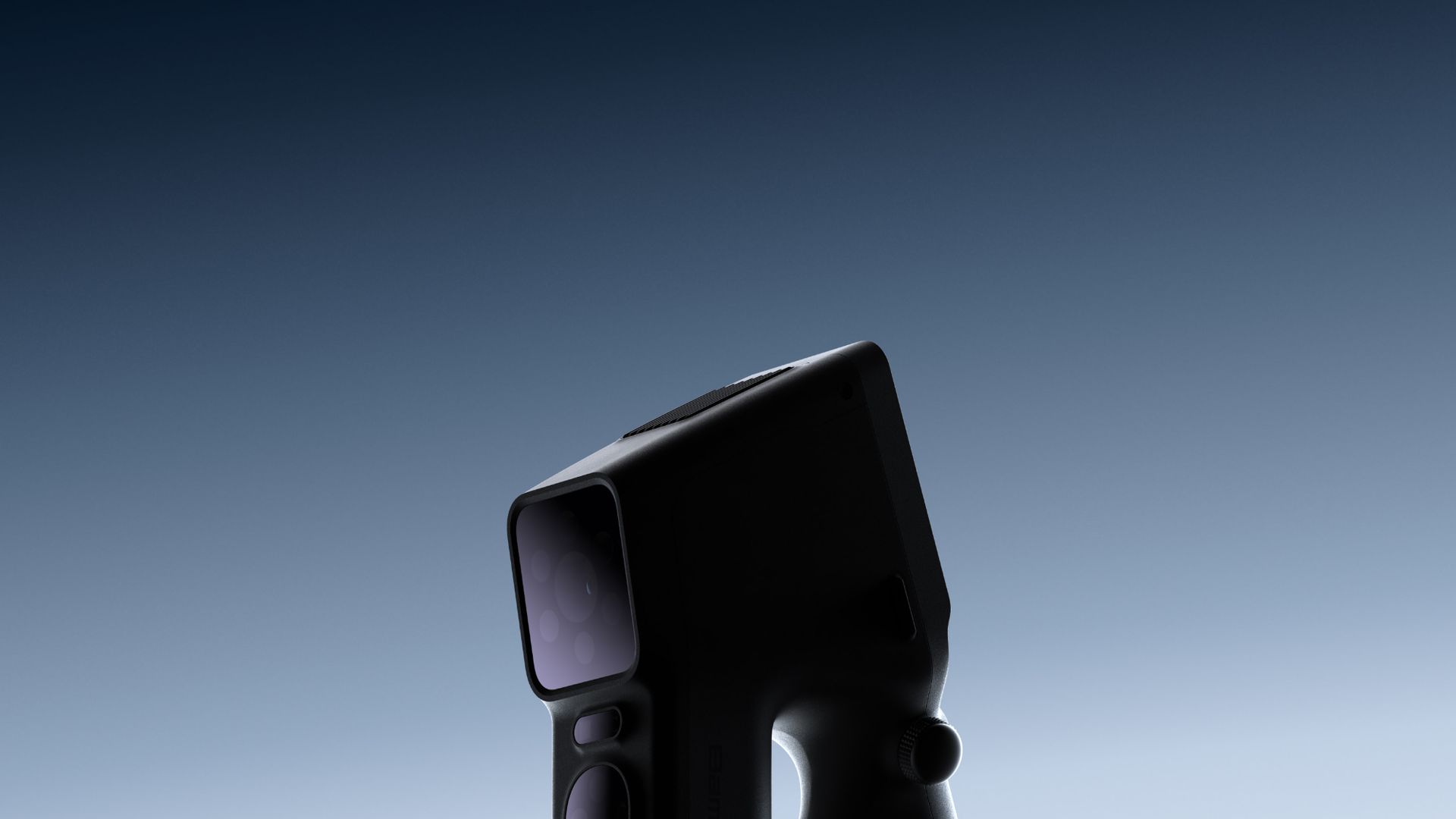
Furthermore, the industrial design evidenced in the filings highlights a clear focus on ergonomics. The flat-top handle design points toward the inclusion of a high-resolution viewfinder or an onboard status-monitoring screen, a necessity for tetherless operation or real-time point-cloud feedback. If Bambu integrates their proprietary motion-compensation algorithms—a hallmark of their current X-series firmware—into the S1’s scanning pipeline, it could solve the most significant barrier to entry: the jitter and data noise that currently plagues hand-held scanning workflows.
Empirical Specifications & Benchmark Matrix
| Specification | Bambu Lab S1 (Projected) | Revopoint MIRACO (Baseline) | Industrial Tier (Reference) |
|---|---|---|---|
| Power Consumption | ~60W | ~15W (Battery) | 80W+ |
| Light Source | Blue + IR Lasers | Structured IR Light | Multi-Laser/Photogrammetry |
| Compute | Tethered (Assumed) | Standalone (Onboard) | External Workstation |
| Target Market | Prosumer/Small Studio | Hobbyist | Enterprise |
| UI Interface | Integrated HMI | 6" Touchscreen | Specialized Software |
Thermal, Efficiency & Real-World Ergonomics
The 60W power requirement is the primary indicator of the S1’s operational constraints. Unlike the battery-operated, mobile-first approach of the MIRACO, the S1 appears to prioritize raw data acquisition speed and accuracy over raw portability. This suggests that the scanner will likely necessitate a tethered connection to a PC, which is a double-edged sword. While it forces a tethered workflow, it also allows for real-time processing of high-density point clouds on a GPU, bypassing the hardware limitations of onboard mobile processors. For users prioritizing sub-millimeter accuracy, this sacrifice in ergonomics is a standard, often preferred, trade-off.
Thermal management within this enclosure will be the definitive engineering challenge. Achieving 60W of power within a handheld, likely passive-cooled form factor requires exceptional thermal ducting to prevent sensor drift. If the S1 utilizes internal active cooling—such as a silent blower fan—the internal heat dissipation must be carefully isolated from the sensitive IR and laser emitters to maintain calibration over extended scan sessions. We expect the S1 to feature a heavy-duty alloy chassis, likely acting as a structural heat sink, a design choice consistent with Bambu’s focus on long-term hardware durability.
The Definitive Verdict
Bambu Lab’s entry into the 3D scanning space is not a signal that they intend to enter the industrial scanner market, but rather that they intend to dominate the integrated digital-to-physical pipeline. The S1 is positioned to be a "workflow glue" device. While the high power draw hints at a tethered, power-intensive operation, the potential for seamless integration with Bambu Studio software—allowing users to scan, process, and send to print in a unified environment—will likely make this the premier choice for the desktop manufacturing enthusiast. If they maintain their characteristic price-to-performance ratio, the S1 is poised to render current prosumer alternatives obsolete by making the scanning process as iterative as the printing process itself.