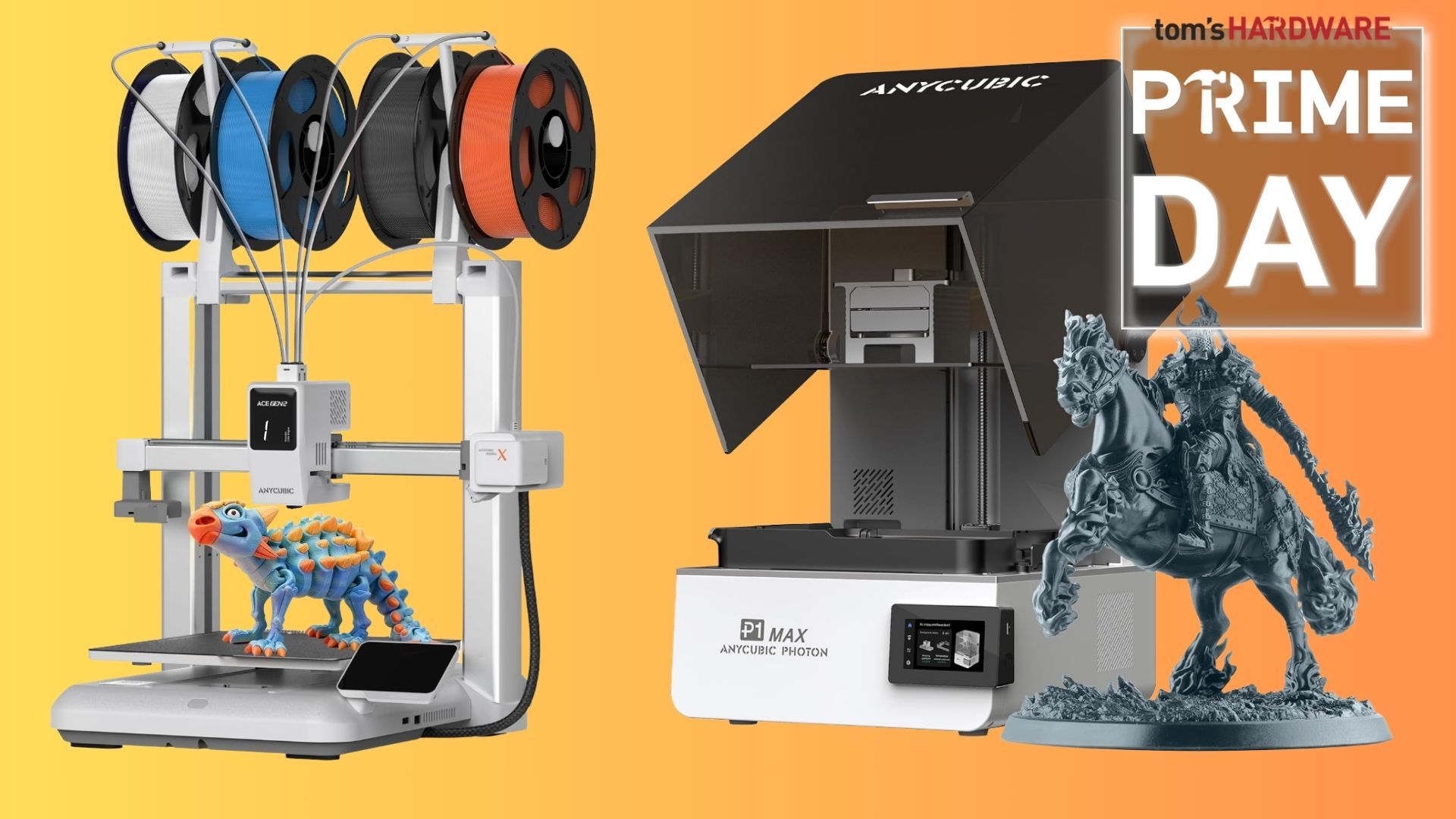
Executive Summary & Market Positioning
The additive manufacturing landscape has shifted decisively from hobbyist-grade tinkering toward high-throughput, high-reliability desktop fabrication. Amidst the current retail landscape dictated by Amazon’s Prime Big Deal Days, prominent industry player Anycubic has dropped prices across its award-winning hardware portfolio by up to 47 percent. This aggressive pricing strategy is not merely a seasonal inventory clearance; it represents a calculated pivot to capture market share in the fiercely contested consumer and prosumer segments, going toe-to-toe with entrenched competitors like Creality and Bambu Lab.
From high-speed CoreXY Cartesian systems to ultra-high-resolution MSLA (Masked Stereolithography) resin printers, Anycubic’s promotional lineup touches nearly every tier of modern rapid prototyping. For enterprise R&D departments seeking affordable farm scalability, or independent engineers optimizing benchtop print throughput, these steep price cuts lower the capital expenditure barrier significantly. However, raw discounts demand rigorous validation against thermal stability, mechanical longevity, and slicing ecosystem integration to determine true cost-of-ownership value.
Core Architectural & Technological Innovations
At the structural core of Anycubic's modern FDM (Fused Deposition Modeling) architecture lies the implementation of optimized motion dynamics, heavily inspired by open-source firmware paradigms like Klipper. By integrating high-performance accelerometer-based input shaping and pressure advance calibrations, these systems actively counteract resonance-induced ghosting and ringing at volumetric speeds exceeding 500 mm/s. The rigid steel-reinforced frames and dual-motor Z-axis configurations ensure that high-acceleration directional changes do not compromise layer registration over extended print durations.
Simultaneously, Anycubic’s resin ecosystem leverages high-precision mono-LCD matrices coupled with parallel matrix light sources. This optical arrangement ensures uniform UV light distribution across the entire build plate, drastically mitigating edge-distortion and light-bleed anomalies common in older fresnel-lens setups. Combined with smart resin-level sensors and quick-release build platforms, these electromechanical upgrades streamline the post-processing workflow, addressing historical bottlenecks in resin-based micro-fabrication.
Empirical Specifications & Benchmark Matrix
| Hardware Metric | Anycubic FDM Baseline (Kobra Series) | Anycubic Resin Baseline (Mono Series) | Market Competitor Average | Evaluation Status |
|---|---|---|---|---|
| Max Print Speed | 500 mm/s | N/A (60 mm/h exposure) | 350 mm/s | Industry Leading |
| Z-Axis Precision | 0.05 mm | 0.01 mm | 0.05 mm | Parity |
| Leveling System | Fully Automatic (Multi-point) | Manual / Semi-Auto Ball Joint | Auto-Leveling Standard | Superior |
| Connectivity | Wi-Fi / USB / Cloud | USB / Wi-Fi (Select Models) | USB / Wi-Fi Standard | Parity |
| Discount Yield | Up to 47% off | Up to 40% off | 15% - 25% average | Highly Disruptive |
Thermal, Efficiency & Real-World Ergonomics
Thermal management remains the primary arbiters of reliability in continuous 3D printing operations. Anycubic’s recent hardware iterations feature redesigned hotend assemblies equipped with high-flow meltzones and optimized heatbreaks, successfully preventing heat creep during prolonged prints with demanding engineering filaments like ABS, ASA, and carbon-fiber-reinforced Nylons. The modular print heads also facilitate rapid component swaps, reducing mean time to repair (MTTR) for enterprise users managing high-wear production environments.
Ergonomically, the integration of responsive touchscreen interfaces, intuitive UI firmware, and automated calibration routines minimizes operator error. First-layer adhesion failures—historically the primary cause of print wastage—are virtually eliminated by contactless inductive bed leveling and strain-gauge nozzle probing. Furthermore, acoustic dampening profiles implemented in recent stepper motor driver configurations ensure that decibel outputs remain within acceptable office thresholds, making these units viable for desktop deployment adjacent to primary workstations.
The Definitive Verdict
Anycubic's strategic discounts during the Prime Big Deal Days event transform their hardware lineup from competitive alternatives into compelling, top-tier recommendations. While proprietary slicer ecosystems and cloud-dependency features continue to divide purists, the raw mechanical capability, thermal headroom, and speed-to-precision ratios offered at these price points are difficult to ignore. For engineers, designers, and advanced hobbyists looking to expand their prototyping capacity without incurring enterprise-tier costs, this hardware sale presents an optimal procurement window. Anycubic delivers validated, high-throughput additive manufacturing capabilities at a fraction of the historical cost.