Decoding the August 2026 CIPA Metrics: A Quantitative Shift in Imaging Hardware
Executive Summary & Market Positioning
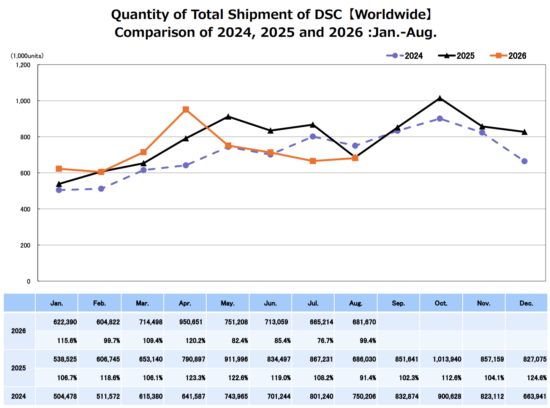
The latest empirical production and shipment data published by the Camera & Imaging Products Association (CIPA) for August 2026 reveals a fascinating inflection point in the global digital imaging hardware sector. As the industry moves further away from legacy systems, the macro data highlights a deepening bifurcation between rapidly diminishing legacy DSLR lines and resilient, value-appreciating mirrorless architectures. While raw unit shipments for mirrorless interchangeable-lens cameras (ILCs) experienced a modest contraction—down 6% year-to-date compared to 2025—their overall shipped value actually climbed by 3%. This divergence is a clear indicator of a maturing market where manufacturers are successfully pivoting toward high-margin, professional-grade bodies that command higher Average Selling Prices (ASPs).
Concurrently, the broader hardware ecosystem is absorbing notable shifts in consumer demand, particularly with the continued, unexpected resurgence of fixed-lens compact cameras. Up 15% in unit volume and 14% in shipped value year-to-date, compacts are carving out a defensive yet lucrative niche against ubiquitous smartphone photography. Analysts tracking these metrics now project total annual ILC body sales to land between 6.0 and 6.35 million units, sliding back toward 2023 baseline levels. This recalibration forces OEMs to rethink their supply chain volumes, prioritizing component durability, higher-tier stacked sensor allocations, and precision optical engineering over mass-market volume plays.
Core Architectural & Technological Innovations
Beneath the surface of these shipment numbers lies a profound architectural transition within the optical supply chain. The steep 35% collapse in DSLR unit volumes underscores the near-complete obsolescence of mirror-box assemblies in new product development roadmaps. R&D capital has fully migrated to electronic viewfinder (EVF) integration, deep-learning autofocus co-processors, and backside-illuminated (BSI) stacked CMOS sensors. This shift is mirrored in the lens ecosystem: although shipments for both sub-35mm and full-frame (35mm+) optical formulas experienced marginal unit contractions—down 3% and 7% respectively—their shipped values increased by 6% and 4%.
This valuation increase points directly to the proliferation of complex, high-resolution optical designs featuring advanced aspherical elements, specialized fluorite coatings, and high-torque linear focus motors necessary for modern high-fps bodies. Furthermore, the lens-to-body sales ratio has edged upward to 1.57, compared to 1.50 a year prior. This incremental metric proves that current hardware upgraders are not merely buying standalone camera bodies; they are heavily investing in proprietary mount ecosystems, securing a higher lifetime customer value for OEMs through dedicated glass acquisitions.
Empirical Specifications & Benchmark Matrix
| Hardware Segment | YTD Unit Growth (vs 2025) | Shipped Value Growth | ASP Trend & Market Implication |
|---|---|---|---|
| DSLR Bodies | -35% | -37% | Rapid phase-out; liquidation pricing dominating legacy inventory. |
| Mirrorless Bodies | -6% | +3% | Premium consolidation; higher ASPs offsetting minor unit drops. |
| Compact Cameras | +15% | +14% | Strong niche demand; premium pocketables driving revenue. |
| Sub-35mm Lenses | -3% | +6% | Margin expansion via specialized APS-C/MFT optical engineering. |
| 35mm+ Full-Frame Lenses | -7% | +4% | High-end glass adoption; heavy investment in native mount ecosystems. |
Thermal, Efficiency & Real-World Ergonomics
As manufacturers push mirrorless bodies to handle sustained 8K internal recording and high-bitrate RAW capture, the physical design constraints of these hardware platforms have intensified. The steady ASP growth observed in the CIPA metrics correlates directly with the integration of advanced passive thermal architectures—such as magnesium-alloy internal chassis acting as heat sinks, high-conductivity thermal pads, and in some flagships, active micro-cooling fans. Managing thermal loads without compromising weather-sealed magnesium body shells remains a paramount engineering challenge.
Ergonomically, the modern mirrorless footprint has stabilized. Consumers and professionals alike have signaled a clear preference for deep, contoured handgrips that can balance heavier, high-end optical glass, counteracting the theoretical weight savings of mirrorless mounts. The rise in the lens-to-body sales ratio to 1.57 reinforces this physical reality: users are regularly pairing their bodies with sophisticated, high-performance lenses that demand robust tactile control layouts, customizable multi-function dials, and exceptional battery efficiency to sustain prolonged field operations.
The Definitive Verdict
The August 2026 CIPA metrics validate a mature, value-optimized hardware landscape. While total unit volumes for ILC bodies are stabilizing downward toward 2023 levels, the industry's financial health remains remarkably robust, evidenced by a 4% overall increase in shipped value and expanding profit margins per device. For hardware consumers and industry stakeholders, the definitive takeaway is clear: the era of volume-driven commodity camera manufacturing is dead. In its place stands a resilient, high-performance ecosystem defined by premium mirrorless architectures, sophisticated optical engineering, and specialized compact systems that successfully command higher price points in an increasingly discerning market.